
 by
by 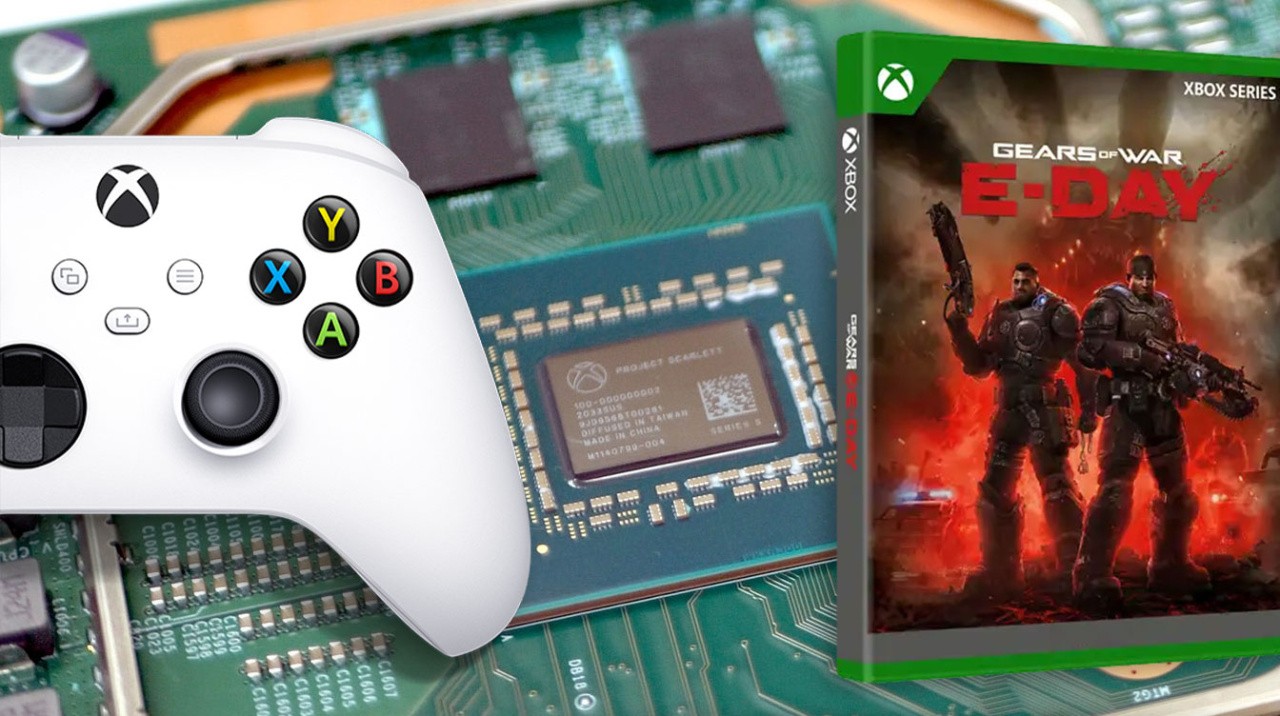
Gears of War: E-Day presents a huge, dense city, even on the memory-limited Xbox Series S. Achieving that was no easy feat, and what developers The Coalition settled on as a solution could be used as a blueprint for future games on Xbox Series S and other memory-constrained platforms. In short, the game uses the SSD as a new tier of memory to supplement the 10GB of GDDR6 on Series S, with a bespoke system developed in collaboration with Xbox's platform team and Advanced Technology Group.
The kernel of the idea here isn't new. Forgive the Computer Science lecture, but there's a hierarchy of data storage that successively trades off speed for capacity: caches on a CPU are super-fast but hold only a tiny amount of data, RAM serves a middle ground and SSDs have a huge amount of storage but access times many many times slower. If the data you're working on can't be kept in the CPU, it goes to the RAM; if it's expelled from RAM, you have to read it out of storage, taking a speed penalty at every stage.
The Coalition's system lets the game use the NVMe drive as random access memory, giving the streaming system enough to room to load and hold the complex city data. Memory that isn't being actively accessed is stored on disk, and what's needed at that moment is moved into system RAM. It's similar to paged virtual memory, with one important difference: it only covers specific subsets of memory that the team has decided won't slow the game down if they have to come back from the drive. The benefit is that, in exchange for a couple of gigabytes of storage on the SSD, you can gain about a gigabyte of usable system memory.
Deciding what gets paged out is where most of the special sauce lies. The Coalition use advanced heuristics to make that call, with the system tracking access patterns and seeing which data was used most recently. Memory that isn't used in a frame, or over a run of frames, becomes a candidate for paging. Frequently used data stays in RAM, and anything idle can move to the SSD. It only works because the NVMe drive is fast enough to bring paged data back without the player noticing - a nice workaround that ameliorates one of the biggest issues with the Series S.
The developers say that the game's density wouldn't have been possible with the use of the technique. The world contains around 1.6 million actors, so fitting everything into Series S memory became the baseline for all of the game's scaling work. The Series S is far from a slow platform - its CPU runs rings around last-gen machines like the Xbox One X and PS4 Pro - it's just about making the most of its 10GB of shared GDDR6 memory, versus the 16GB of the Xbox Series X. With this system in place, only one major feature had to be cut - Lumen reflections - in order to get a reasonable 60fps lock.
The approach does have its limits. Studio technical director Kate Rayner said overusing it eventually hurts performance, as swapping data has a cost and frames still need to be produced in-budget. The operating system also takes time to reclaim freed memory, so a game can be "technically out of memory" while it waits. The Coalition spent a lot of time tuning the system carefully so that it ought to come at no visible performance penalty - though we'll have to wait for our full review coverage to confirm this.
The result is that Series S doesn't get a stripped-back version of the world. According to Rayner, the technique let the team avoid "really lowering the quality of the game". The Coalition believes it's one of the first to use the idea. Rayner said other game teams are already interested, which could make the technique a fascinating blueprint for future game development on Series S.
The wider point is that the current consoles' fast storage can do more than stream assets quickly - it can take pressure off RAM itself. For a console that's often seen as holding back cross-generation games, that could matter a lot.