
 by
Modern Warfare 4 marks a significant milestone for the Call of Duty franchise, fully shedding last-generation console support to build its engine features around Switch 2 (for the first time!), PlayStation 5, Xbox Series X/S and PC - just like 2016's Infinite Warfare did following the PS3 and Xbox 360 generation. This technological leap has enabled enhanced ray-marched fog and smoke effects, improved weather systems and a thoroughly reworked material pipeline - which we've already covered in detail. But how do these technologies actually resolve in real gameplay across the campaign and multiplayer on each Xbox and PS5 console?
The goal for COD's developers is always to provide a level playing field for multiplayer, while stretching each platform a little further for the single-player campaign. However, image quality and performance can differ drastically across the PS5 and Xbox consoles, with the PS5 Pro offering some dedicated enhancements and the Xbox Series S facing tighter constraints in hitting the desired 60fps output.
Despite the generational step forward, certain visual quibbles persist across console releases too. Pre-rendered cutscenes suffer from noticeable hitching while mission data loads in the background, for example. Furthermore, the standard SMAA anti-aliasing solution employed on most platforms introduces image noise, flickering on fine geometry and even occasional ghosting trails.
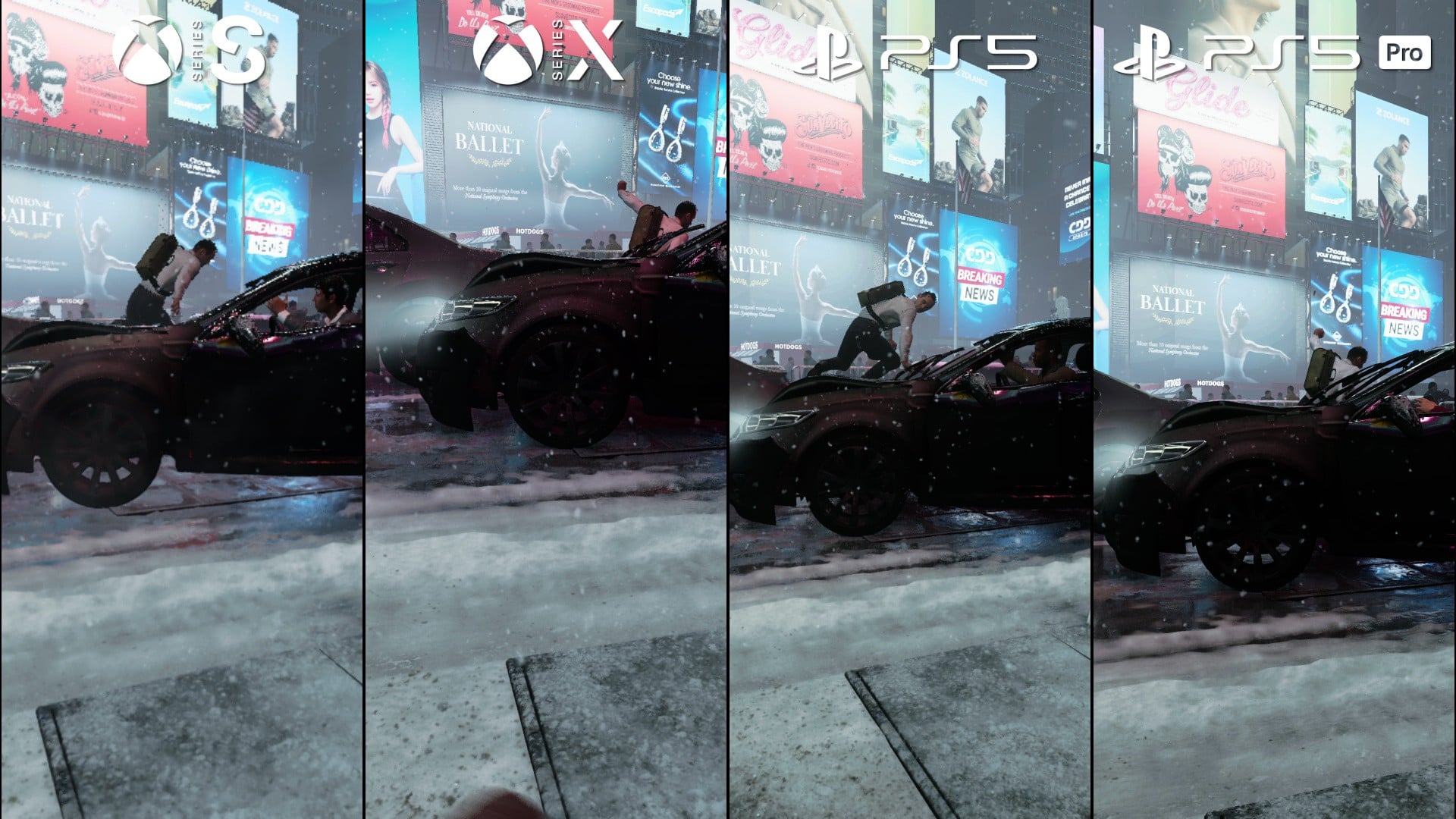
Dynamic resolution scaling is used across all systems except PS5 Pro to maintain a crisp frame-rate in the face of varying GPU load. Pixel counts visible in a camera cut in a New York city scene from the campaign shows Xbox Series X achieving a slightly higher internal resolution (1680p) than PS5 (1512p) or PS5 Pro (1440p), while Series S trails considerably (675p). You can see the full resolution ranges in the table below.
All consoles, save one, scale to a 4K output - and predictably it's Series S that is the exception, scaling to 1440p instead. SMAA is employed across the base PS5 and Xbox Series consoles, while PS5 Pro uses its exclusive PSSR tech instead.
Speaking of PS5 Pro, as well as boasting better image quality, temporal stability and transparency handling, thanks to AI-powered PSSR upscaling, this version also includes enhancements to some key visual settings. That includes increased particle volume, improved SSAO (screen-space ambient occlusion) and higher-res SSR (screen-space reflections). However, PSSR also introduces unique visual artefacts, most notably noise and instability across glossy or reflective surfaces. Additionally, selecting the 120Hz high frame-rate mode on Pro disables PSSR, reverting the console to standard SMAA to maximise performance headroom.
Platform |
Typical Internal Resolution |
Resolution Range |
Upscaler |
|---|---|---|---|
|
PlayStation 5 Pro |
2560x1440 |
2560x1440 (Fixed) |
PSSR, 4K Target |
|
PlayStation 5 |
2688x1512 |
1920x1080 - 3840x2160 |
SMAA, 4K Target |
|
Xbox Series X |
2986x1680 |
1920x1080 - 3840x2160 |
SMAA, 4K Target |
|
Xbox Series S |
1200x675 |
1200x675 - 2080x1170 |
SMAA, 1440p Target |
Performance at 120Hz varies across the main console line-up. During demanding campaign sequences, PlayStation 5 Pro delivers frame-rates ranging between 80fps and 120fps, whereas Xbox Series X and base PlayStation 5 average lower under heavy load. We measured an average of 82fps on Series X, 77fps on base PS5 and 104fps on PS5 Pro. In standard multiplayer modes, smaller map sizes allow all three premium console configurations to maintain a steady 120fps output for competitive play, save for small dips when graphically-demanding killstreaks are activated.
Standard 60Hz play remains exceptionally smooth on PS5 and PS5 Pro across campaign, multiplayer and DMZ, with just a handful of dropped frames across hours of play. Curiously, Xbox Series X is different, and exhibits minor frame-rate dips into the high 50s during intense firefights in the campaign and multiplayer, a minor instability that can be mitigated somewhat using displays with VRR (Variable Refresh Rate) or by using the 120Hz output mode. It's possible that the dynamic res algorithm here is a bit too aggressive in chasing higher resolutions, and might benefit from further tuning to achieve a better 60fps lock.
Xbox Series S makes several visual compromises to hit its 60fps performance target, completely removing screen-space reflections, lowering shadow resolutions, and reducing ambient occlusion complexity - though the shadow removals we saw in campaign mode on Switch 2 aren't replicated here. While Series S successfully holds a 60fps frame-rate in most standard scenarios, its 120Hz output mode struggles to maintain high frame-rates in campaign play. Still, there's not too much to complain about with a 70fps to 100fps range during online matches.
Overall, it's satisfying to see forward momentum with Call of Duty's rendering tech, and finally being freed from the shackles of last-gen consoles means that there are some meaningful steps forward here - while excellent performance is maintained.
There are still some long-standing issues, such as hitches during cutscenes, and some new ones in the form of noisy PSSR artefacts on PS5 Pro's 60Hz mode. The latter in particular should be addressed by Infinity Ward, as while PSSR does represent a step-up from SMAA used elsewhere, perhaps a toggle allowing users to make the choice between the two anti-aliasing methods would be the fairest choice.
Otherwise, MW4 is an exciting return to form for the series, with a well-considered campaign and some of the best multiplayer maps in years. Hopefully this is only the beginning of an initiative to target current-gen consoles with new bespoke features, and COD can keep up this momentum in the next regular instalment.