
 by
by Many times at Digital Foundry, a game we've spent years championing eventually gets the modern retail remaster treatment, which lets us refer back to copious past coverage in our eventual review of new PC and console ports. But sometimes, we need a tap on the nostalgic shoulder to remember an oldie-but-goodie.
That happens this week with Nightdive Studios' re-release and remaster of Outlaws, an imperfect but ambitious Lucasarts FPS that landed on Windows 95 in 1997. As far as PC-exclusive hits from Lucasarts go, this spaghetti Western and its star-studded voice-actor cast may have been lost between a flurry of Star Wars-branded PC shooters. But this week's remaster on modern PCs and consoles, with original expansion pack missions included and a "vault" of historical bonuses, does a great job of preserving an important Lucasarts historical footnote.
Like the recently re-released Star Wars: Dark Forces before it, Outlaws was built upon Lucasarts' Jedi Engine. Unsurprisingly, then, this follow-up translates well to modern systems via the same KEX Engine that powered the updated Dark Forces. (As of this review, we've only tested the new Outlaws version on PC, but the KEX Engine port of Dark Forces scaled well to consoles, so we're optimistic.)
The Jedi Engine resembled other pseudo-3D engines of the time, particularly 3D Realms' BUILD Engine, in adding vertical architectural options and 3D mouse-look support on top of the standard established by DOOM. Nightdive has additionally carried over Jedi Engine's Outlaws-specific tweaks, including slopes, stacked levels and custom per-stack colour maps.
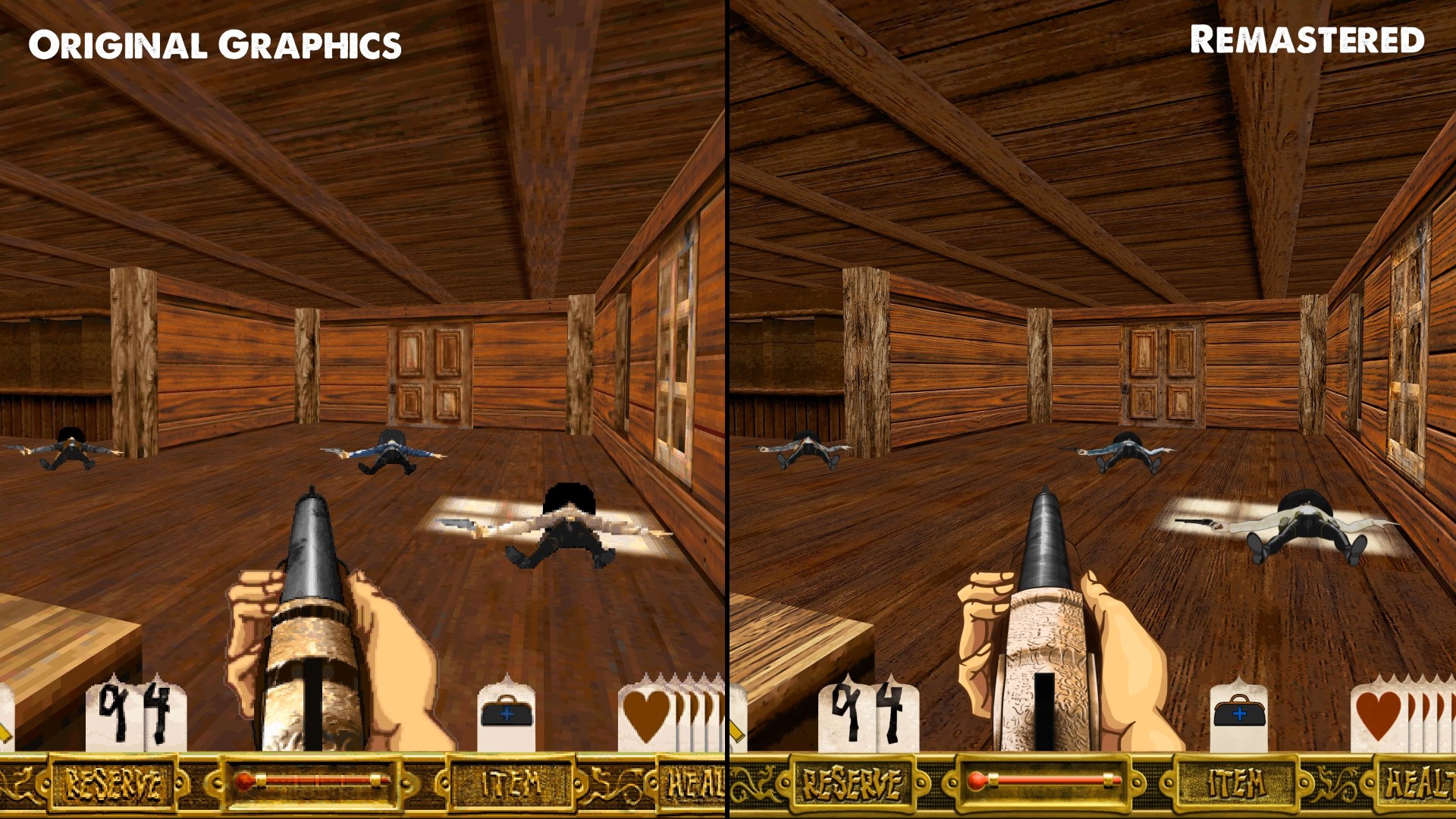
When tapping through the Outlaws remaster's menus, you'll find a standard and expected set of options, including native support for high frame-rates and options to enable or disable various effects and upgrades. One of these, a switch between original and updated textures and sprites, can be bound to a mid-game button-press, which is handy. Sadly, Nightdive elected not to add an optional visual filter to resemble older screens, and we would have loved something resembling the era's VGA monitors.
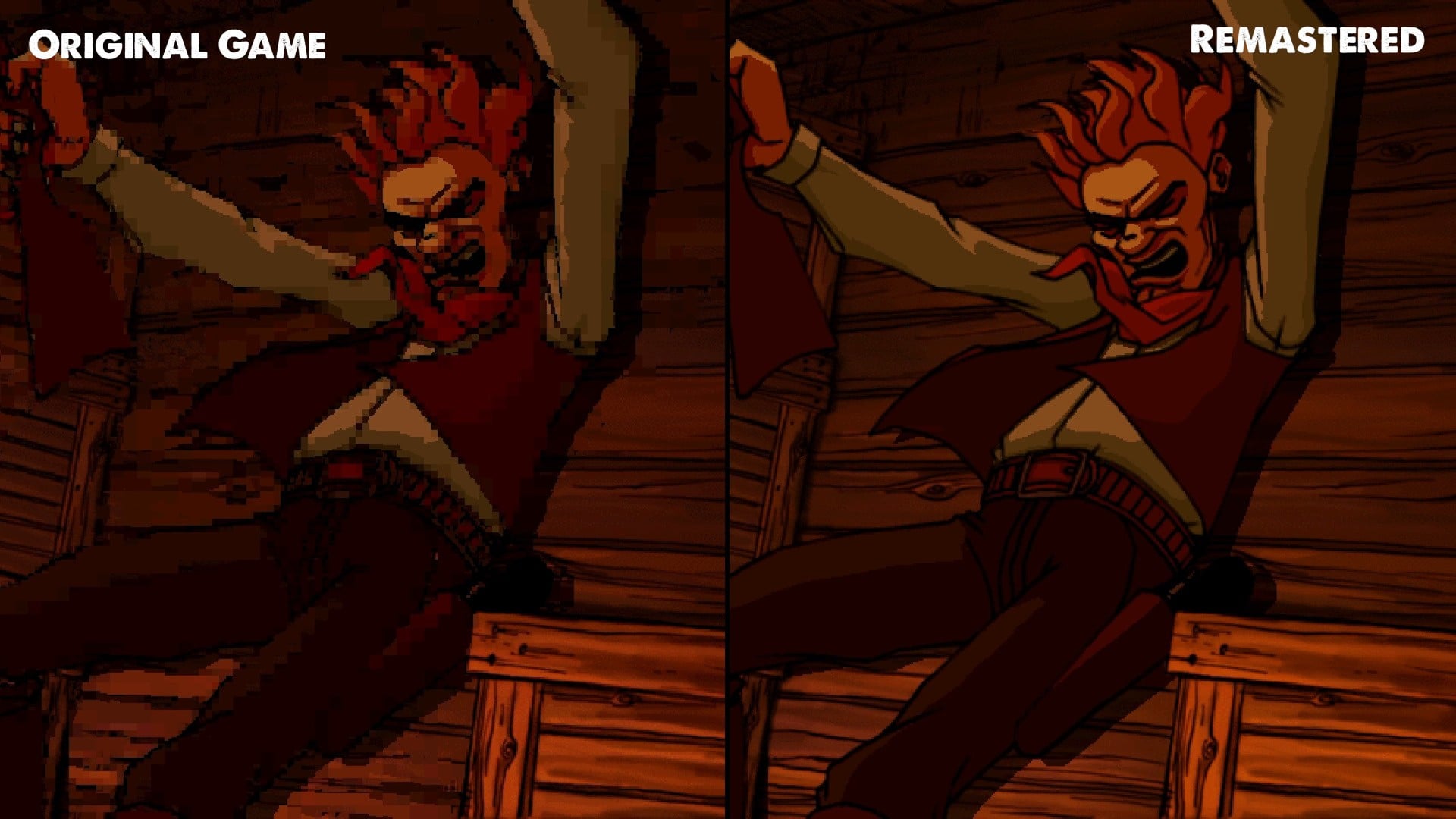
Outlaws was notable for its between-every-mission series of animated, fully voiced cutscenes, so we were delighted to see this remaster uses apparently uncompressed versions of the game's original video files. From what we can discern, these videos are presented at a sharp-yet-pixelated resolution, with few if any signs of AI-driven upsampling. It's great in today's re-release era to see raw mid-'90s assets scale up in a way that looks equal parts classic and updated.
Redrawn sprites and UI scale cleanly to 1080p-and-up screen resolutions, and they're tasteful, even if they might make the game's aesthetic look different than you remember. Your mileage will likely in terms of preferring either the older, more pixelated sprites or newer, redrawn ones. Original enemy sprites almost look like digitised stills, thanks to their heavy pixelisation, while their new versions are filled in with more hand-drawn touches and outlines.
For the most part, the game's variety of weapons, enemies, decals, textures and in-game objects have been touched up tastefully, though opinions may be more split on your trusty steed, who is often at your side at the start of missions. Outlaws' horse sprite is redrawn almost line-for-line compared to its original version, but its colourisation and outlines have a different impact on its art compared to other sprites. However you feel, rest easy knowing that art and UI reversion is a single button-tap away.
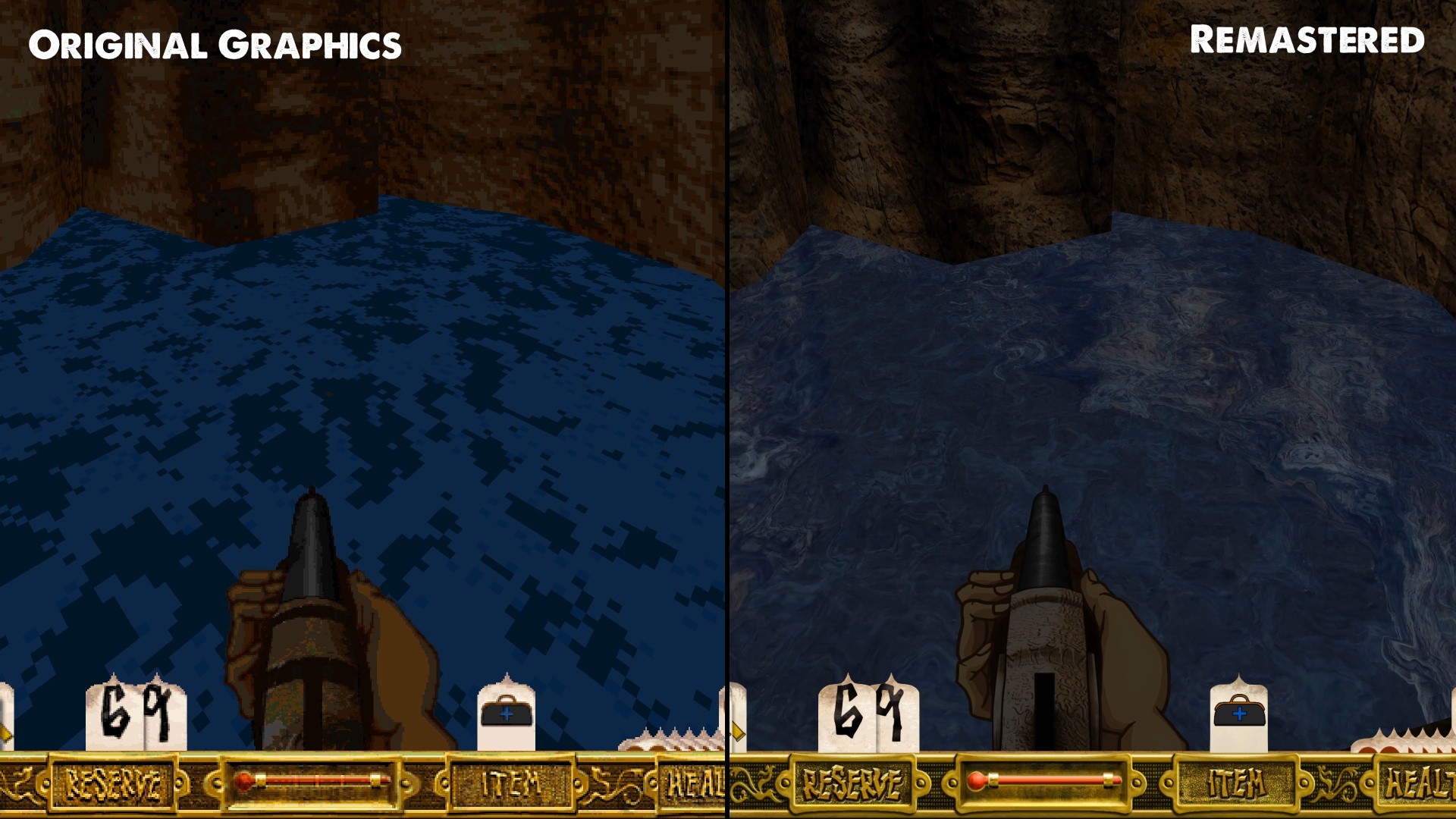
New visual effects are also added, the most noticeable of which is a semi-transparent pixel-shader effect on water surfaces. While we believe the updated water has a relatively dated look and thus fits with Outlaws' animated, almost cartoony presentation, an "enhanced visuals" mode can be toggled, removing these enhancements when playing with original art.
Thanks to these adjustments and options, Outlaws is one of the more impressive, top-to-bottom touch-ups in a Nightdive remaster yet - at least, on a technical level. Sadly, we're not sure the studio could have done as much to update and correct the game's admittedly dated gameplay without redesigning the entire game around fewer hunts for door-opening keys and tighter level layouts. In other words, it doesn't include the kinds of quality of life boosts, AI revisions, and other touch-ups seen in last year's remaster of The Thing.
Outlaws' philosophy of resembling real-world Wild West locations poorly padded its '90s-styled action gameplay instead of adding compelling realism. Sure, you could enter every in-game buildings - cool stuff for the time - but then you'd spend far too long trying to find hidden keys whose sprites blended too well with the desaturated look of building interiors. In exploring the game anew this week, the DF Retro duo of John Linneman and Audi Sorlie could get lost for 30 minutes at a time struggling to find hidden keys and gears.
Still, we remain charmed by Outlaws' clever ideas and era-specific ambition. Where many shooter series had gone fully polygonal by 1997 (including Lucasarts' own Jedi Knight: Dark Forces 2 later that year), Outlaws instead pushed the Jedi engine with impressive engine tricks, narrative emphasis and massive levels. And we have loved rediscovering the satisfying punch of its Western-styled weaponry and its memorable score from acclaimed video game music composer Clint Bajakian.
Thus, we strongly urge FPS diehards to look into and understand the quirks of this Lucasarts game so that they might get the most of out an unlikely Nightdive gem, as this is now easily the best way to enjoy Outlaws.


Comments 3
I might have missed the announcement but are these vids still being provided as downloads for patron members?
@Pitcher-T Somehow this was uploaded after the YouTube video went live. A day or so.
I remember well playing this game on multiplayer with a bunch of mates on a lan setup by Steve our cool IT guy back in the mid 90's. For a few months if we put in a hard days work a few hours of seamless outlaws afterwards was our reward. Good times for nerdlingers back then.
Show Comments
Leave A Comment
Hold on there, you need to login to post a comment...