
 by
by Sony's PS5 Pro launched with specific promises: a bigger, more potent GPU, enhanced ray tracing and state-of-the-art machine learning upscaling via PSSR. On paper, this is what we wanted but in practice, PSSR fell short at lower resolutions, even comparing unfavourably in some tests with FSR2. The narrative was reshaped by the upgraded PSSR (often dubbed PSSR2) in Resident Evil Requiem, but that was just one game. What about all the others?
We had the chance to check out five games at Sony's London HQ several weeks ago. Today, we're going to talk about Silent Hill f, Final Fantasy 7 Rebirth, Monster Hunter Wilds and Dragon Age: The Veilguard. However, Alan Wake 2 is a game we've tested most intensely in the past, and we'll report back on that one soon in a standalone piece.
To begin with though, a clarification. The upgraded PSSR is not just a port of AMD's FSR4 to PlayStation 5 Pro - something that can be seen from our original comparisons. It's more accurate to say that the new technology is a bringing together of know-how from Sony and AMD under the Project Amethyst umbrella. AMD brings the impressive FSR4 tech to the party, while Sony's PSSR improvements get fed back into the next FSR4, so both firms benefit.
Bottom line though: the upgraded PSSR on PS5 Pro delivers and if you want a proper showcase of the new upscaler against the old, Silent Hill f is the perfect example. The original PSSR implementation was one of the worst examples we'd seen. Ultra fine-detail foliage, heavy ray traced global illumination and Unreal Engine 5 issues created the worst possible scenario for the original PSSR, with shimmering vegetation, strobing GI, flickering sub-pixel detail and a generally unstable image. Compared to UE5's own TSR in the base PS5 version, it actually looked worse.
The new PSSR resolves all of our gripes. The pulsing RTGI is gone, vegetation and foliage rendering is crisp and consistent, while texture detail and characters and environments looks improved without sharpening artefacts. The noisy PSSR film grain-like artefacts are gone, with the kind of temporal consistency you get from the best upscalers. Meanwhile, sub-pixel flicker on fine geometry is substantially reduced or even eliminated.
In this and all the other games tested today, native resolutions remain as they were, but here, the final image is cleaner, more stable and more attractive on a 4K display. It transforms Silent Hill f from a demonstration of PSSR's failures into a showcase for what the upgraded version can do. It's the most transformed game of the quartet we're looking at today.
Meanwhile, Final Fantasy 7 Rebirth is intriguing. It was one of the finest examples of the original PSSR's implementations, aided by relatively high base resolutions and content choices. There was no RT noise because there was no RT, for example. However, other forms of noise were evident along with a fundamentally unstable temporal resolve.
The new PSSR sorts out the issues while aiding further benefits: crisper edges, reduced aliasing in motion and in rest, with improved foliage. Once again, the inherent noise pattern found in the old PSSR is gone. Texture detail also looks visibly improved, perhaps due to a more aggressive negative mipmap bias now that the algorithm can stably resolve higher detail material. PS5 Pro was supposed to deliver the base PS5's 30fps quality mode at 60fps on the Pro model. Finally, Final Fantasy 7 Rebirth delivers - but with even higher image quality.
Not every game is a night and day difference, however. Dragon Age: The Veilguard is still an improvement, mind you. Foliage quality is improved, noise reduced once again and reconstruction artefacts are reduced.
Meanwhile, Monster Hunter Wilds offers another angle. It's an open world game that isn't exactly Capcom at its best from a visual perspective, but the upgraded PSSR still delivers a solid improvement. Anti-aliasing qualities are significantly improved, sub-pixel detail is resolved more convincingly, while specular noise and screen-space reflections are noticeably more stable - especially in the lower resolution performance mode when targeting 60 frames per second.
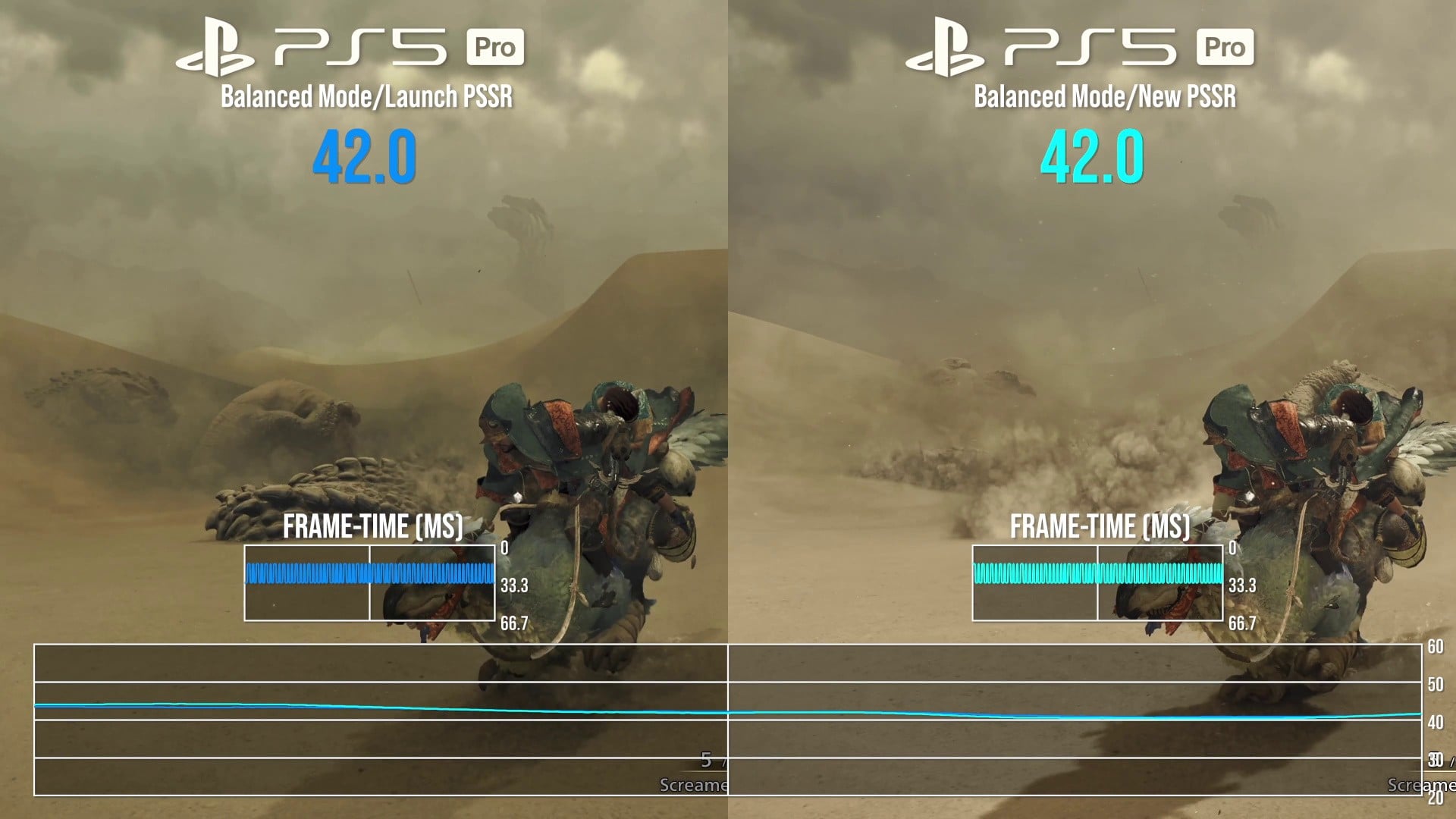
Monster Hunter Wilds also offers extended intro cutscenes rendered by the game engine that allow us to test the computational cost of the newly upgraded PSSR against the older, launch version. What's surprising here is that the game performs almost identically between the two builds, strongly suggesting that the frame-time cost of "PSSR2" is essentially like-for-like with the original.
So, the evidence is suggesting that when PS5 Pro receives its official upscaling upgrade, you're not paying for the improved image quality with decreased frame-rates. We'd venture to suggest that smarter training and better weighting can unlock image quality gains at the same compute cost. Even so, seeing the frame-rates so similar was a pleasant surprise.
According to Sony, all of the games we tested featured developer-upgraded versions of the new PSSR - apparently the results we're seeing here are not delivered by the system level toggle. We're still curious to see how the two iterations of the new PSSR will present, but that's a test for another time.
Right now, the feeling is that the new upscaler delivers the kind of upgrade we were looking for from PS5 Pro. The hardware was always fascinating - focusing more on improved RT and ML performance than a raw rasterisation boost. However, with the launch version of PSSR, the quality of the image quality upgrade varied on a per-title basis and could look worse than the original base PS5 game. That is no longer the case and that's simply great news.
From our perspective, the question is the extent to which the ML features of PS5 Pro will continue to grow. Will there be anything like FSR Redstone ML frame generation or ray reconstruction on Sony's enhanced console? Or will features like these end up gated off for PlayStation 6? That's a question for the future, but right now at least, PS5 Pro is a massive step closer to realising its initial promise.


Comments 13
It’s a shame that to get real results, developers need to implement it specifically, which means this feature will only be used by a handful of games. Don’t expect miracles from the automatic PSSR version, and in the end very few games will bother doing a proper upgrade — which makes sense given the small PS5 Pro install base.
It’s also unfortunate that we had to wait almost two years for a decent version of their AI upscaler. Since version 1 was often catastrophic or had no real effect, I remember that at launch I had to disable PSSR on some games because it caused so many bugs
In the end, I’m not convinced a proprietary AI upscaler is really worth it. It feels more like a marketing argument than a real benefit for players, considering how few games will truly take advantage of it
@fatpunkslim I'm pretty sure the PSSR toggle will work like DLLs on PC. This allows you get better image quality from new versions of the upscaler even without bespoke dev patches. Also PSSR will continue to be used on the PS6 so I don't see how it's not worth it.
Looking fantastic, PS5 Pro continues to look like a smart bet from Sony, not least they should be ahead of the game going into next gen, but in the meantime console enthusiasts have a meaningful upgrade. Barring a small handful of exceptions i've been very happy with mine.
Very interesting that, in your limited testing, it seems as performant or even slightly more performant than PSSR1 with a noticeable increase to quality. I look forward to seeing your more thorough testing on this when you have it in hand, especially with the console level toggle. It's looking fantastic so far.
UPDATE: also Cyberpunk 2077 PS5 Pro patch finally inbound!
@SonOfFaith I’m not as optimistic as you about the automatic version. And regarding its usefulness, I feel like it’s just another standard developers have to deal with, when what they actually need is more uniformity instead of spreading themselves across each company’s proprietary tech. We already have DLSS and FSR, so this just feels redundant to me. Especially since DLSS and FSR run on far more machines (PCs and consoles) than the ones compatible with PSSR. Honestly, it feels like Sony is wasting developers’ time just for marketing purposes — that’s just my opinion.
Besides, Sony directly assists developers to integrate this kind of tech, which shows it’s not really something that happens naturally. And I wouldn’t be surprised if Sony is outright paying some studios to implement it. That’s why I think this is basically part of their marketing budget, just to highlight a proprietary technology available only on their console, even though the actual benefits are only noticeable in a handful of optimized games.
@fatpunkslim Stop with the console war trolling! You don't even have a PS5 Pro. In fact you called it a "scam" on Pure Xbox, and said the Series X outperforms it. I don't want to have to keep calling you out, but this is just embarrassing.
@themightyant Actually, I had bought it and then sold it, and yeah, at the time I really thought it was a scam. I was very disappointed by the technical gap compared to the price. I’m mostly a PC and Xbox user, but since there’s no mid‑gen upgrade on Xbox, I still ended up buying the PS5 Pro out of frustration, but it didn’t meet my expectations
@fatpunkslim The fault lies with AMD for being slow with iterating their upscaler on consoles. So Sony came up with their own proprietary solution. They can do their own thing without being too reliant on AMD's cadence.
Based on the new video, you guys mentioned PSSR2 is not specifically FSR4, but it is Sony's own iteration. It's interesting how for Sony, the fruit of their collaboration with AMD are their own upscaler. With the new XBOX becoming fully focused on PC to make it easier to develop games, will the upcoming features of XBOX just be the next generation FSR features that will be readily available on PC platform as well?
Like for example, AMD mentioned FSR Diamond(branding) is just FSR 5.0. That and all its features are the ones that'll be used for Project Helix.
Loved the Pro from day one and am excited to try the new PSSR with the supported games.
Fun times.
@themightyant You gotta admire his dedication i suppose. To the point of lying about console ownership no less. Either way, im pretty sure most know of our friend and his traits. Dont push him though, he will chatGTP a spreadsheet of 'facts' from the internet.
I've gotten the console firmware update now, but I'm curious - for the titles that DF was able to see demonstrated, I'm assuming we're waiting for the developers of the various games to release game updates to take advantage of the new PSSR? Or were these titles enabled through the system level toggle?
Sambil maen mantap
@dlamb2471 they should be available via the system level toggle… but we haven’t seen how that matches up to an official patch, which perhaps might be able to do more (else why are devs doing it themselves)
Hopefully DF gets some footage in between i.e. it would good to compare how games run
This would give us the best idea of how each benefits and what we can expect from games where devs don’t update them manually.
Show Comments
Leave A Comment
Hold on there, you need to login to post a comment...