
 by
by This week, Final Fantasy 7 Remake Intergrade receives a surprise playable demo on Nintendo Switch 2 consoles - a holiday-timed gift for JRPG fans, with an equivalent demo debuting simultaneously on Xbox Series X/S systems.
The free, brief demo is limited to the game's opening, iconic Mako Reactor sequence, which is enough for us to discern some interesting details ahead of the three consoles' upcoming ports on January 22, 2026.
We start with a focus on the power-limited Switch 2 to answer a question: does this port's "Intergrade" label mean its visual characteristics better resemble the 2021 PS5 edition? Or did Square-Enix make sacrifices that hew closer to the 2020 PS4 original?
For the most part, the answer is decidedly in favor of a Switch 2 match with the PS5 version. On a lighting basis, volumetrics are nearly identical between Switch 2 and PS5, even in the scant moments where they're an apparent downgrade compared to the PS4 version. We also see more shadow-casting lights, more physically plausible volumetric effects and improved screen-space reflections (SSR).
The only basis where lighting more resembles the PS4 edition comes in the form of shadow resolution, thanks to softer and more dithered shadows on Switch 2. We also see texture art slightly differing - but not enough to make a firm determination in this limited demo sequence. If we look at Intergrade Switch 2 footage released by Nintendo in May 2025, we see texture upgrades over PS4.
Assuming that asset quality holds in the eventual retail version, we expect textures to receive improvements along the lines of PS5's Intergrade edition - though we've yet to see whether an entire town's worth of textures can fit at PS5-level quality on Switch 2's combination of memory capacity and bandwidth, or whether we can expect texture and art pop-in, such as the infamously blurry door in the early town zone.
The most substantial difference from any other FF7 Remake port is raw image quality, as this is the first version of the 2020 game to formally support machine learning-based image reconstruction. While other ports have relied exclusively on Unreal Engine 4's built-in temporal anti-aliasing (TAA), FF7 Remake Intergrade on Switch 2 appears to adopt the Switch 2-exclusive "tiny" DLSS model that we've seen in other Switch 2 ports.
This means still imagery looks surprisingly sharp and crisp, without any of the shimmering or break-up seen even in PS5's performance mode. Yet moving objects - like in Cloud Strife's gentle idle animation - expose raw, aliased edges on Switch 2, with dithered-looking regions left in the wake of swaying motion. Additionally, Cloud's hair rendering on other platforms is smoothed out thanks to a combination of dithering and UE4's TAA treatment, but the same hair on Switch 2 preserves the dithering effect instead of averaging its pixels.
Yet thanks to the higher base number of pixels being upscaled by this tiny DLSS variant, there is far less image breakup than the same DLSS model in Fast Fusion's more aggressive upscaling on Switch 2 - meaning, it's not nearly as distracting in action. Our pixel counting measures a base 1080p resolution on Switch 2 in docked mode, compared to 1080p on PS4 and 1512p on PS5's performance mode.
While we were concerned about preview footage that suggested frame-pacing issues with the Switch 2 port in docked mode, we're happy to report that we've only encountered a few errant dropped frames in an otherwise solid 30fps frame-rate.
New to this version is an occasional treatment of dithered or speckling marks on surfaces, and it's most obvious when surfaces are occluded and then reappear. This visual issue is admittedly less easier to notice in portable mode - which generally renders a base pixel resolution close to 720p and upscales it using the same tiny DLSS variant to 1080p. Though we notice occasional base pixel counts beneath 720p, we cannot yet determine if that's a matter of lower-resolution post-processing or a dynamic resolution scaler (DRS). Either way, those counts are an exception to a general 720p measurement.

Portable mode appears to target a 30fps frame-rate, but we perceive dips beneath that 30fps line almost immediately as the camera sweeps from the distance towards Cloud and his allies in the opening train sequence - and those dips are not present in docked mode. Without the ability to directly capture and measure frame-time cadence, we so far would say portable mode performance is thus far comparable far to a PS4. That's pretty solid for the visual makeup on display, even though we wonder how well the game can maintain that close-to-30fps level as the adventure moves into more demanding and open regions beyond this demo's scope.
On Switch 2, the opening FMV sequence unfortunately has lower fidelity than PS5, exhibiting macro-blocking and other compression-related artefacts. Thankfully, most FMV sequences throughout FF7 Remake Intergrade are rendered in real-time, so this issue shouldn't affect the final product too much, but it is an unfortunate sign of likely FMV compression to come.
HDR so far appears excellent on a proper OLED panel, which assuages the fears we've had with various Switch 2 ports missing the HDR memo. Sparks explode, spotlights project brightly and dark regions don't appear washed out.
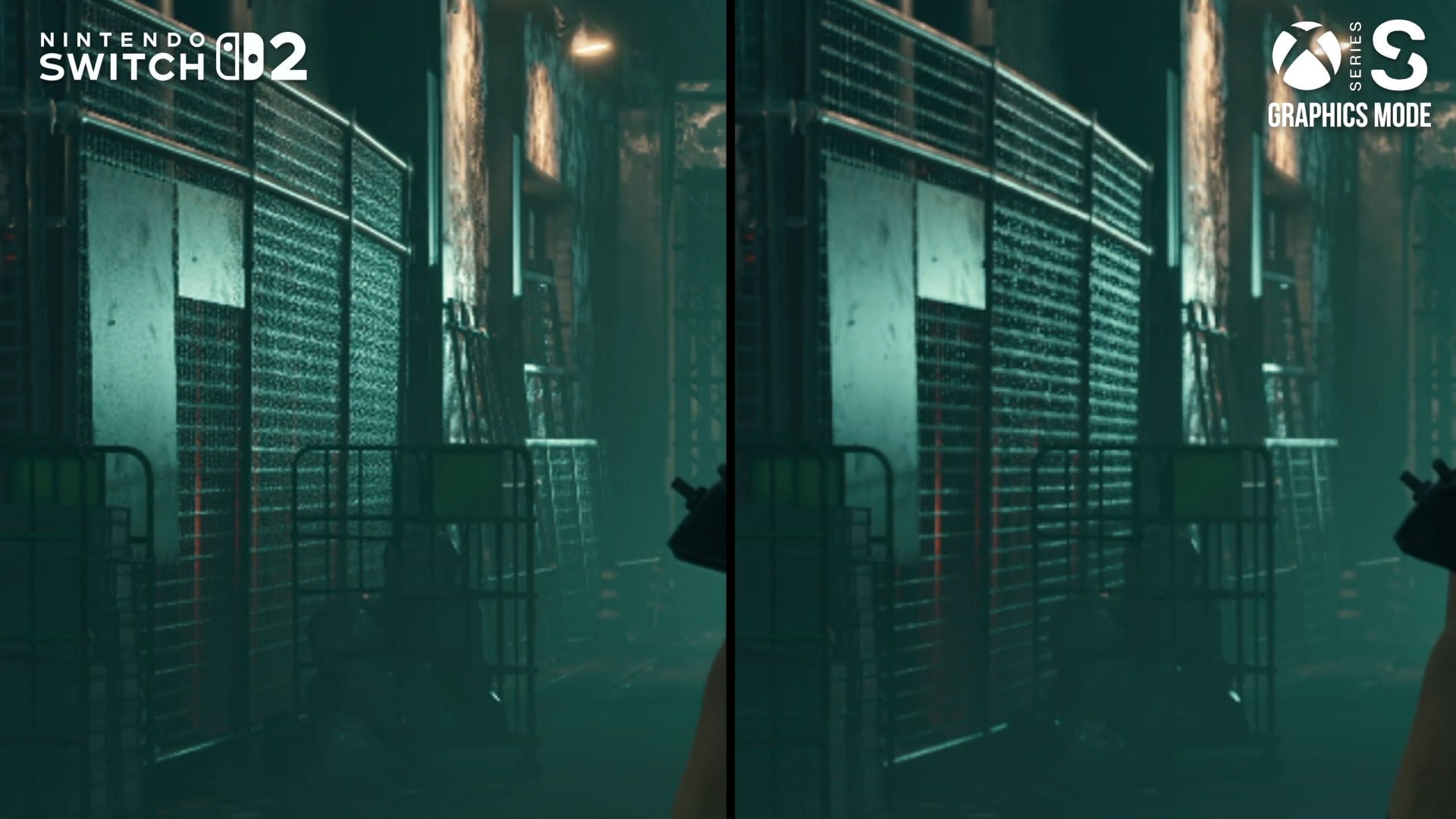
For good measure, we tested the Xbox Series X/S versions of the same demo, also new to those consoles this week. Both consoles offer two graphical modes: "graphics" and "performance," just like on PS5. These target 30fps at 2160p resolution and 60fps at 1512p resolution, respectively, and both lock to their frame-rate caps from what we've briefly tested. Series X has apparently identical visual makeup to PS5 in both of those modes - meaning, pixel counts, visual characteristics, and everything else appear identical in our brief testing.
Series S, meanwhile, turns in 1440p and 1080p resolutions in its graphics and performance modes, respectively, also with seemingly comparable graphics settings. In our initial testing, we are surprised to see that the 1440p output on Series S doesn't look as crisp as Switch 2 at 1080p. This possibly boils down to UE4 TAA and Switch 2 tiny DLSS ultimately adding up to different final image quality characteristics - at least in still shots. Rest assured, we'll have more to say about this trio of January ports once we play through the rest of the game's legendary JRPG campaign a few more times.

Comments 4
Sounds like they are doing a great job on these. Glad to see this.
This is very encouraging! I just want to know the final file size for the full game...
@JJtheTexan It is going to be approximately 87,9 GB, so like a third of the Switch 2‘s entire Storage. That’s also why it doesn’t fit on a cartridge!
Even in docked mode it looks terribly blurry. Based on these comparisons here I really don't think the "tiny" DLSS looks much if any better than the TAA in the other versions. Would it be technically viable to use MSAA or something like that? Would the Switch 2 handle that OK with this game without the devs needing to reduce, say, lighting or texture quality to compensate?
Show Comments
Leave A Comment
Hold on there, you need to login to post a comment...