
 by
by FSR 4.1 super resolution is now available on AMD's RDNA 3 graphics cards - which means we can test the utility of the machine learning-based technology across the RX 7000 stack, but equally as intriguing is the fact that Valve's recently released Steam Machine also uses the same GPU architecture. And pretty much as soon as AMD's official release arrived, native FSR 4 titles "just worked" on the Valve mini-PC/console. So, to what extent does the technology have utility on the new machine - and what of RDNA 3 more generally?
First of all, a word of reassurance. When we looked at the leaked FSR 4 DLL compatible with RDNA 2 and RDNA 3, the results were fine but the outputs were of a significantly lower quality in some scenarios up against FSR 4 running on RDNA 4 cards. We could barely tell any difference at all in our test cases with the official release - excellent news. Not only that, but the new version is indeed faster than the leaked DLL - not tremendously so, but welcome nonetheless. Not least because FSR 4 is no free lunch on any GPU - just like DLSS, it has a computational cost.
So, it stands to reason that the better your RDNA 3 GPU, the less impactful the hit to performance. On Steam Machine, effectively using a cut-back RX 7600, the cost of FSR 4.1 in its performance mode is generally slightly faster or slower than FSR 3 in quality mode. However, here's the thing: the quality of FSR 4.1 in performance mode can easily outstrip the efforts of FSR 3 even in quality mode. Ultimately, FSR 4.1 represents a net win for Steam Machine and by extension, it'll be exactly the same on the RX 7600, which is generally around 15 percent more performant than Steam Machine.
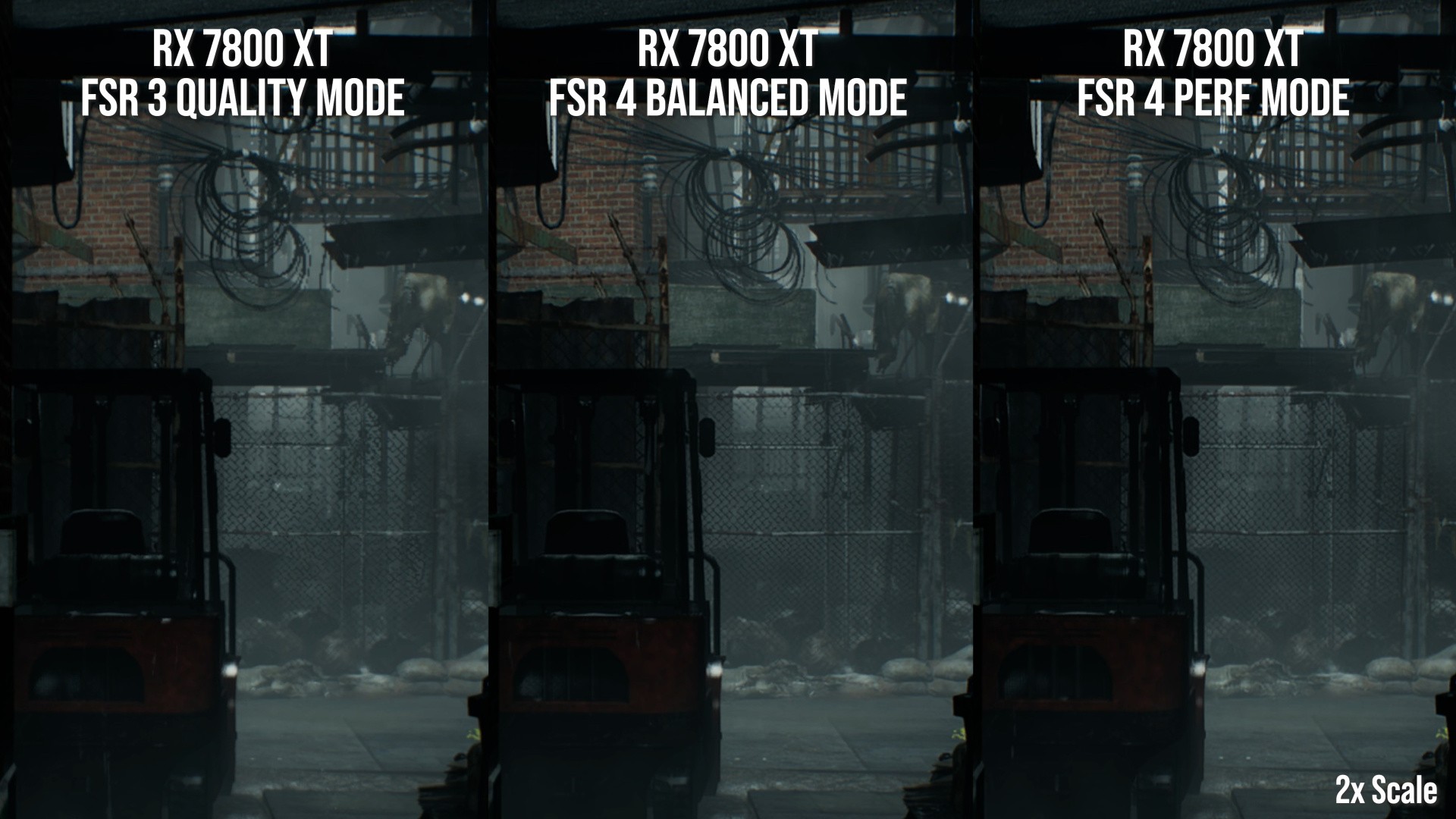
That's testing at 1440p output resolution, however. Now, there's an argument that says that Radeon cards like the RX 7700 XT, 7800 XT and 7900 GRE are also best suited for 1440p output. As the resolution hasn't changed vs Steam Machine, but the GPUs are more performant, the cost of FSR 4.1 goes down proportionately, making it even more compelling for Windows players on RDNA 3 cards. By the time you're at the top-end RX 7900 XTX, FSR 4.1 at 4K isn't just a big visual upgrade over FSR 3, the performance boost is such that ray tracing becomes much more viable without much in the way of visual impact. In short: the better your AMD GPU, the more utility FSR 4.1 brings, to the point where even demanding ray tracing becomes much more viable.
So, for Steam Machine and RX 7600, FSR 4.1 is a useful tool. However, for higher-end RDNA 3 cards, it's no exaggeration to call the new upgrade significant to the point of presenting like an actual refresh for those older cards. It's going to be fascinating to see how the RDNA 2-optimised version plays out early next year.
The video embedded at the top of the page delivers benchmarks and gameplay experiences on Steam Machine, RX 7800 XT and RX 7900 XTX - but allow me to summarise the content for those without half an hour of viewing time on their hands.
Different games running different workloads can provide wildly different results. In the standard Cyberpunk 2077 in-game benchmark, FSR 4.1 has limited results running on PS5 performance mode equivalent settings. FSR 4.1 performance mode may present better than FSR 3 quality mode, but the former only increases resolution over native by around 25 percent vs 33 percent on the latter. FSR 4.1 performance mode in Resident Evil Requiem delivers a handy 42.5 percent uplift over native resolution running at our optimised 8GB settings vs 44.7 percent from FSR 3 quality mode (which looks very poor, by the way). Finally, Crimson Desert at 1440p using the equivalent to PS5 balanced mode settings sees a 39 percent uplift from FSR 4.1 performance mode up against 34 percent from FSR 3 quality mode.
The numbers are the numbers, but what they enable is more interesting. I can play Cyberpunk 2077 on Steam Machine with dynamic resolution FSR 4.1 at 1620p output resolution, which looks impressive on a 4K display and runs very, very close to the 60fps threshold - better than the PS5 quality mode, even in Phantom Liberty content. I can run Stellar Blade on high settings with FSR 4.1 performance mode at 1800p resolution with a 50-60fps output - fine with VRR. In Alan Wake 2 at 2160p output targeting 30fps, I can use FSR 4.1 performance mode instead of PS5's FSR 2 balanced mode and the game looks much better. The "up to 60fps" performance mode drops frames vs PS5, but again, FSR 4.1 performance mode easily bests the standard FSR 2 balanced mode with a 1440p output.
There are limitations, however. Crimson Desert at 1440p in FSR 4.1 performance mode using PS5 balanced mode-equivalent settings runs in a 40-60fps window, which is OK for lower-end hardware but there's always the sense that you want it to run a little smoother. Lowering resolution to 1080p could be a thing except then you're at the mercy of the CPU-limited parts of the game. Meanwhile, games like Metal Gear Solid Delta and 007 First Light, using highly aggressive FSR 2 upscaling on PS5 give you no more runway on Steam Machine. Both can scale from a 720p minimum on the console and drop frames. Steam Machine will look a lot better, but you'll be dropping down into the low 40s and even lower in some scenarios.
There is a key difference between FSR 4.1 on Windows and on SteamOS. AMD's Adrenalin software has the ability to replace FSR 3.1 on a great many games with FSR 4.1, simply by using a toggle. During my period of testing, FSR 4.1 only worked on Steam Machine "out of the box" on titles with native support. Getting FSR 4.1 to work on games like Alan Wake 2, Stellar Blade and Metal Gear Solid Delta required installing Optiscaler - a cool utility that can reroute the inputs for any upscaler into FSR 4.1 instead. It's a pain, to be honest, but it does work - most of the time. In my experience, 007 First Light, Black Myth Wukong and A Plague Tale Requiem didn't produce wholly agreeable results.
And more generally, FSR 4.1 still has a support problem. Games are launching without FSR 4.1 integrated (007 First Light being the most recent example) and bearing in mind how transformative the technology is, it's frustrating that developers are not giving it equal amounts of care and attention. AMD users shouldn't need to be installing and tweaking Optiscaler in order to get access to a good super resolution solution. Indeed, Optiscaler proves that the same inputs DLSS uses generally tend to translate to very good FSR 4.1 outputs. Surely it can't be that hard to bring official FSR 4.1 support to more games?
Now more than ever, it makes sense. AMD takes centre stage with SteamOS and other Linux distros such as Bazzite and CachyOS - all of which tend to work best with Radeon cards, all of which should eventually receive robust FSR 4.1 support. Meanwhile, as the hardware crisis continues, RX 9070 and RX 9070 XT represent the best affordable 16GB higher-end GPU solutions. RX 9060 XT in its 16GB iteration also seems to stand alone as a reasonable, more budget-orientated solution that bypasses all the VRAM issues we're now having to produce optimised settings selections to accommodate.
There's a way to go before AMD catches up with Nvidia's full range of ML features, but super resolution remains the most important of all and the Radeon team has cracked it. Bearing in mind that the differentiation between price vs performance favours AMD so dramatically now, FSR 4.1 demands the same level of support as DLSS - and it's down to users and press alike to make the case as strongly as possible.