
 by
by How much is it? How powerful is it? Are you better off building your own PC? We've been hands-on with Steam Machine for just under a couple of weeks now and finally have some answers. However, while this is a PC built from existing AMD parts and fully comparable with existing PC technology, there is more to Steam Machine. Tiny, virtually silent, beautifully designed, it's a simply irresistible design. Imagine a taller Nintendo GameCube and you have some idea of how tiny it is, with performance falling into line with the kind of output you'll get from an Xbox Series X or PlayStation 5.
Delayed owing to the impact of the current component crisis, the Valve box comes at a cost that may dismay many. Steam Machine pricing starts at $1049 or £879 for the basic 512GB model, going all the way up to $1428/£1208 for 2TB of storage along with a bundled Steam Controller. The 2TB model also comes with a brace of faceplates - red fabric and solid walnut.
So, it's pricey. It definitely makes you think about considering a prebuilt PC or building your own and bearing in mind SteamOS works on a range of hardware, the user has options - and in fact, Valve itself points this out in its latest blog. Still, there's something about this pricing I think we should consider. There's the physical machine itself which has a premium feel, amazing form factor and virtually no noise in operation. The replaceable faceplate? I love it. Four magnets keep it in place, meaning it's simplicity to swap between them. Third parties will be able to make their own, making this a PC you can personalise.
Combine all of these things together and we have a lovely, bespoke mini-PC. I think we also shouldn't lose focus on SteamOS itself, which remains an absolutely brilliant front-end, packed with options - everything that worked on Deck works here, the difference being that the extra performance makes for a flowing, nigh-on flawless interface.
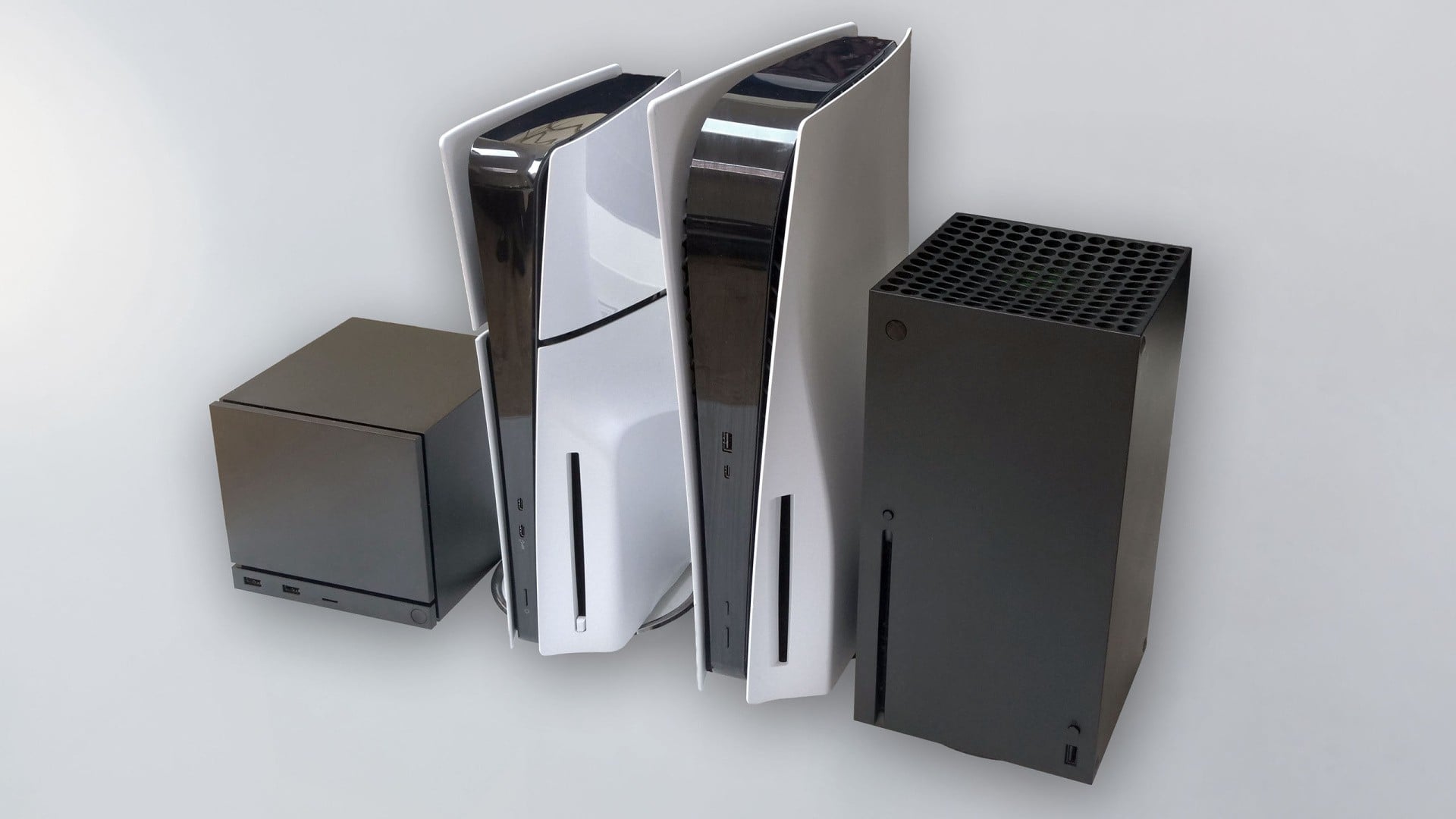
Steam Machine SpecsValve has not given specific model numbers for its choice of CPU and GPU, instead describing each as "semi-custom."
- CPU
- AMD Zen 4 CPU clocked at "up to" 4.8GHz, 6 cores, 12 threads - two Zen 4 cores, four Zen 4c
- Graphics Core
- AMD RDNA 3 Navi 33 processor with 28 compute units up to 2.45GHz, 8GB GDDR6 VRAM
- Power Draw
- 30W TDP (CPU), 110W TDP (GPU)
- Memory
- 16GB DDR5 RAM - 1x 16GB SODIMM, 5600 MT/s CL47
- Storage
- 512GB or 2TB M.2 2230 storage
- Output
- DisplayPort 1.4, up to 4K/240Hz or 8K/120Hz; HDMI "2.0," up to 4K/120Hz
- OS
- SteamOS
Steam Machine supports M.2 storage replacements in both 2230 and 2280 form factors along with hot-swapping microSD cards used in other SteamOS devices. HDMI 2.1 features like HDR and AMD FreeSync are active, despite the official spec listing HDMI 2.0.
So there's the experience of Steam Machine, which is pretty much flawless in my opinion but then there are the quantifiables - specs and performance - and if that's your focus, there are alternatives.
Uncharitably, but perhaps accurately, the Steam Machine "semi-custom" CPU is basically a Hawk Point 2 processor with six cores and 12 threads, running at up to 4.8GHz and capped to 30W TDP. Two cores are "full-fat" Zen 4, the remainder lower-clocked Zen 4c. Compared to the fully-enabled processor, two cores and four threads are missing and the unnecessary iGPU is removed. Meanwhile, the original 2x 8GB SODIMM DDR5 arrangement is swapped out for a single 16GB module running at 5600MT/s.
Less memory bandwidth does have implications for performance in CPU-limited scenarios. Using an architecturally-similar Ryzen 5 8500G with 5200MT/s DDR5, I noted around a 15 to 25 percent increase in CPU performance in Crimson Desert's notorious Bug Hill area when moving from single channel to dual channel memory. I would imagine that the Valve CPU would similarly benefit. At stock, the Steam Machine CPU with its single channel RAM is slower than both the Ryzen 5 8500G and the entry level "fan-favourite" AM4 offering, the Ryzen 5 5600X. However, the same Crimson Desert test run suggests it's handily faster than the PlayStation 5 CPU - around 20 percent to the better.
The Steam Machine's GPU is confirmed to be attached to the CPU via an eight lane PCIe 4.0 interface, and tools like CPU-X reveal that it is indeed a repurposed Navi 33 processor from AMD - the same used in the Radeon RX 7600. There are cutbacks. 32 compute units are reduced to 28, while TDP drops from 165W to 130W. According to our tests, this gives performance at a midway point between the RX 6600 and the RX 7600. The delta between Steam Machine and Radeon performance adjusts according to the game.
Tests at matched settings between Steam Machine and PS5 show that the Valve hardware can fall a little short - which is not surprising bearing in mind that the Radeon RX 7600 delivers quite similar performance to the PS5. The only big gap in performance I saw came from Forza Horizon 5 running at 4K 4x MSAA on the console console - you need to drop to 1620p on Steam Machine to get a similar 60fps experience across the board and even then, you can still drop frames. It's not an entirely fair fight - the console builds have dynamic resolution scaling and dynamic settings management - but the fact is that PS5 and Series X have much higher levels of memory bandwidth.
Still, VRR support, settings tweakery, varying output resolutions and the stronger CPU generally tend to see the Valve machine provide broadly equivalent experiences to the Sony console - plus there's FSR 4 support coming, which the base PlayStation 5 will not get.
So, the conclusion is pretty clear - Steam Machine delivers what we'd call ballpark entry level performance for a mainstream PC capable of running the latest titles at decent resolutions. This means that while 1440p is a viable output resolution (with upscaling depending on the title), settings management is key to getting a good experience.
On top of that, while Valve is working hard on VRAM optimisation, I'd still be recommending Digital Foundry optimised settings where we've done the heavy lifting in terms of ensuring everything fits into 8GB of framebuffer memory.
When Steam Machine was first revealed, the question was all about price and performance. Based on the specs, we've arrived with a piece of hardware that pretty much runs as expected - and it's fine. Technology-wise, it doesn't shift the needle, but I love the package. The form factor is beautiful, it's wonderfully put together and it's virtually silent in operation. To see it is to want it.
However, it's going to cost you. I guess pricing is relative in the current environment and ultimately, you'll have to make the call on whether the value proposition works for you. Assuming you can get a Steam Machine at all, of course.
That said, the good news is that not having a Steam Machine won't lock you out of PC gaming - the PC remains the ultimate open platform and even in these difficult times, there's a lot of choice out there in the hardware space, while SteamOS and other gaming-friendly Linux distros like Bazzite and CachyOS ensure that a range of kit is covered.