
 by
by 
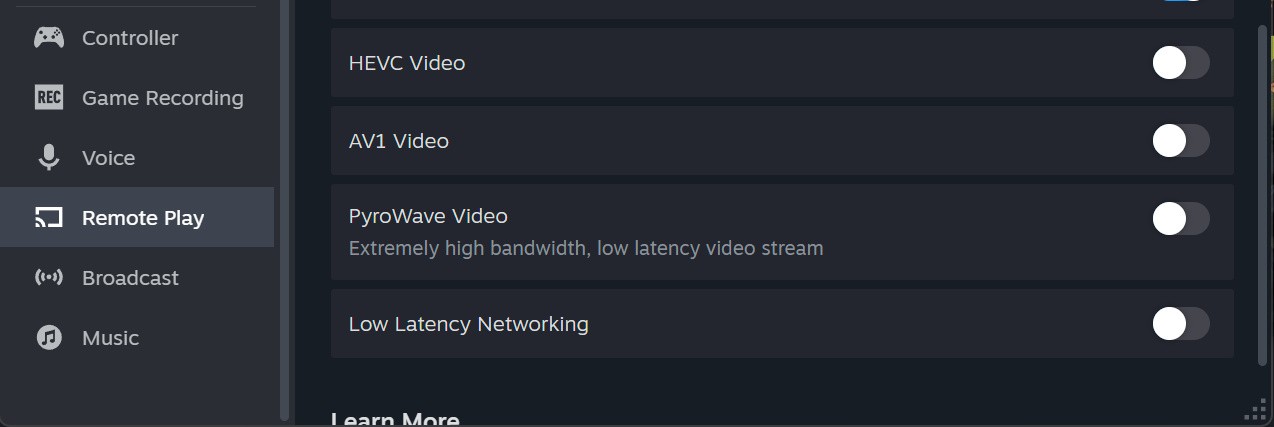
Steam's Remote Play feature works well for local game streaming, but it tends to be less aggressively developed than open source alternatives like Sunshine and Moonlight - the focus is simplicity rather than power. That dynamic has shifted with the latest Steam Client beta, which incorporates an experimental video codec called Pyrowave.
The idea is to make full use of available bandwidth to cut latency as much as possible, something Valve describe in their blog post as a "unique characteristic". In fact, the codec can use an order of magnitude (up to 10x) more bandwidth than other streaming codecs like H264, HEVC and AV1, so Valve suggests it's only useful on computers directly connected with at least gigabit ethernet on a local network.
In exchange, the codec uses GPU encoding/decoding for low latency; supports full colour (YUV 4:4:4) which is useful for 4K desktop streaming; and HDR is automatically enabled for streaming if it's used by both client and host systems.
The codec was created by Hans-Kristian Arntzen, a frequent Valve collaborator who is best known for their work on the VKD3D-Proton framework, which translates DX12 to Vulkan to allow Windows games to run on Linux.
Arntzen explained the idea behind Pyrowave more completely in a blog post last year, and it's fascinating stuff - in short, the codec essentially processes each frame independently, rather than relying on motion prediction to compress the video stream, while also eschewing other common tactics like entropy coding and discrete cosine transforms (DCTs). I won't pretend to understand video encoding this deeply, but it's interesting to see how Expedition 33's overworld is shown as an example of an extremely tough test (lots of fine foliage detail with TAA), while Stellar Blade's "blurred backgrounds" make it easier to stream. The full blog shows early results for Street Fighter 6 and Final Fantasy 7 Rebirth too. Clearly, the codec has developed substantially since last year to make it to the beta version of Steam.
Note that while Pyrowave is available for desktop Steam clients currently, it isn't yet available for the mobile app - though Valve employee Sam Lantinga says that it will be added to the mobile app "soon". Similarly, this is useful for streaming "flat" games, rather than being a Steam Frame or VR-related update.
In my testing between my desktop and an ethernet-connected Xbox Ally X at 1080p60, 007 First light streamed with 10ms of latency (<1ms input, 9ms display) at a bitrate of ~190MB/s. Doubling the frame-rate to 120fps worked out to 15ms of latency at a bitrate of 380MB/s.
Why not give the new codec a try yourself and let me know the results in the comments below?


Comments 3
Sounds great, but what would I stream this to? A Steam Machine? Anything running Bazzite? I can get a 10 Gbps NIC for my PC, but you clearly can't get a 10 Gbps NIC for a Steam Machine.
@Someguyperson Good question. Focusing only on hardware from Valve perhaps the steam frame can benefit with the dual wireless connectivity? That or a dongle to add 2.5g ethernet to the steam machine.
@Someguyperson 1Gbps is totally fine, so any wired connection from the past decade should work!
Show Comments
Leave A Comment
Hold on there, you need to login to post a comment...