
 review by
 Google "Valve's Gabe Newell and PS3" and you'll see why I approached this review with some trepidation.
Valve's Gabe Newell comes down hard on PS3
Valve: PS3 a "total disaster on so many levels"
PS3 is "a waste of everyone's time"
Valve's Gabe Newell trashes the PS3... again
You get the idea. Suffice to say that one of the world's foremost developers doesn't have much love for Sony's latest console offering, to the point where development work for the PlayStation 3 version of the excellent Orange Box was off-loaded to a UK-based internal EA studio, working closely with Valve's original code.
It's no exaggeration to say that Valve's work on PC and Xbox 360 is sensational, and a definite Game of the Year candidate. The Orange Box combines one of gaming's most celebrated first-person shooters with two excellent sequels, along with one of the finest slices of online gameplay we've seen all year and a 'bonus' puzzle game that by itself would score extremely highly were it released as a standalone PSN or XBLA download.
In short, there's no doubt that the raw DNA is all there for what could easily have been the best PlayStation 3 game of the year, and it's not as if Sony's hardware hasn't already proven its worth when it comes to first-person shooters and 3D action games: Resistance is a fine hors d'oeuvre, Uncharted: Drake's Fortune is a stunning technical showcase and Killzone 2 looks wonderful. But as regular readers of Eurogamer will know, the PS3 is often the victim of shoddy conversion work with cross-platform ports that rarely match the quality of the original Xbox 360 code, and the unfortunate reality is that the Orange Box is yet another squandered opportunity and a technical disappointment for owners of the Sony console.
Console Compromises
Contrary to popular opinion, I must admit that my initial impressions of the Xbox 360 conversion of The Orange Box were not that favourable. The Source Engine that powers Valve's games is simply untouchable on PC; its ability to scale the 3D to match the power of the graphics hardware running it is phenomenal, to the point where even a low-power computer runs Half-Life 2 extremely well. The Xbox 360, by contrast, is pegged at a maximum frame rate of 30 frames-per-second at 720p, without any form of anti-aliasing to smooth off the visuals. The notion that my three-year-old PC ran the game better than the 360 (at 1920x1200 to boot) just seems wrong - I expected more from an engine that performed so well on its original platform.
However, it seems that Valve's aim with their console version was to produce a consistent experience across all three Half-Life games in the pack. On 360 at least, the engine's performance doesn't radically alter from game to game, with The Orange Box acquitting itself well even with the intense detail inherent in Episode Two's outdoor environments. In short, while the PC version ekes out every last frame from your graphics card, Valve has opted to make the older Half-Life 2 'feel' the same as the more visually demanding later episodes.
It's this notion of consistency that ultimately sinks the PlayStation 3 rendition of The Orange Box, because frankly there isn't any. But first impressions of the conversion are actually rather favourable. Half-Life 2 kicks off and it's virtually identical performance-wise to the Xbox 360 game, to the point where I was ready to dismiss out of hand the early reports of the PS3 version's inadequacies. There's the odd dropped frame here and there, but then, the Xbox 360 version performed in a very similar manner - a touch of lag just before a whopper explosion kicked off, the occasional loss of smoothness as you pan around the scenery - all par for the course when playing Half-Life 2 on console. But the further you get into the game on PS3, the more scenarios crop up that hint that the Source Engine is struggling, even with a three-year-old game.
Cross-Platform Consequences
Dipping into the graphically more challenging Episode One, the game initially still manages to impress, matching the 720p/30 performance of Xbox 360 seemingly with few problems. However, the deeper you move into the game, the more the frame rate issues intrude on the experience. Catching falling debris with the gravity gun becomes an exercise in anticipating lag as the frame rate dives dramatically. Fierce firefights can become a slideshow. Death is your constant companion not necessarily because of your lack of gaming ability but because you literally can't see what's going on - the PlayStation 3 is simply not giving you enough visual information to work with.
But while Episode One is decent enough and just about bearable even when things go pear-shaped, its sequel is essentially a complete write-off. The Source Engine is pushed to its limits in Episode Two, rendering scenes far more complex than any seen in the previous Half-Life games. It looks absolutely gorgeous, but on PlayStation 3, the drop in frame rate is always with you, kicking in right from the beginning and rarely letting up.
Team Fortress 2 may well feature significantly less detailed graphics than the Half-Life 2 sequels, but it's still hit with frame rate issues compared to the 360 game, although thankfully they have far less of an impact on the gameplay than I feared, and crucially the online experience is still immense fun, despite the odd problem with lag - delayed responses on weapon fire and seemingly warping through doorways being the main gotchas, but nothing you don't automatically compensate for and nothing that fundamentally affects the superbly executed concept.
One slight irritation is that system link LAN games are not supported on PS3, whereas they are on both PC and Xbox 360. However, my main worry for PS3 owners is whether or not the patches for improved performance and the additional maps Valve are creating will make it to the Sony platform.
The experience of playing Portal is pretty much consistent cross-platform, but this is not necessarily such a good thing. You get the idea that the Xbox 360 version didn't get the same level of optimisation as the core Half-Life games and despite what must surely be a far lower level of detail compared to Episode Two, it doesn't seem to run as smoothly. Thankfully, Portal isn't the kind of game where its appeal is directly linked to a smooth update or ultra-precise response from the joypad, but it is interesting to see that both 360 and PlayStation 3 versions essentially perform as well as each other here.
Regardless, concept is king and Portal is quite unlike any other game released on console. What Valve saw as a bonus title to be bundled into the Orange Box has caught the imagination of gamers and hopefully the core idea will be spun out into an even better, more ambitious mainstream release.
Screenshot Face-Off
So, onto the face-off screenshots then - and this time we've really pushed out the boat with comparison screens encompassing all versions: PC, Xbox 360 and PlayStation 3. The PC version was running on a 2GB Quad Core system with a 512MB Radeon 1900XTX, resolution set to 1280x720 and all settings on maximum: in short, the yardstick the console conversions need to measure up to.
- Half-Life 2 Comparison Gallery
- Half-Life 2 Episode One Comparison Gallery
- Half Life-2 Episode Two Comparison Gallery
- Portal Comparison Gallery
- Team Fortress 2 Comparison Gallery
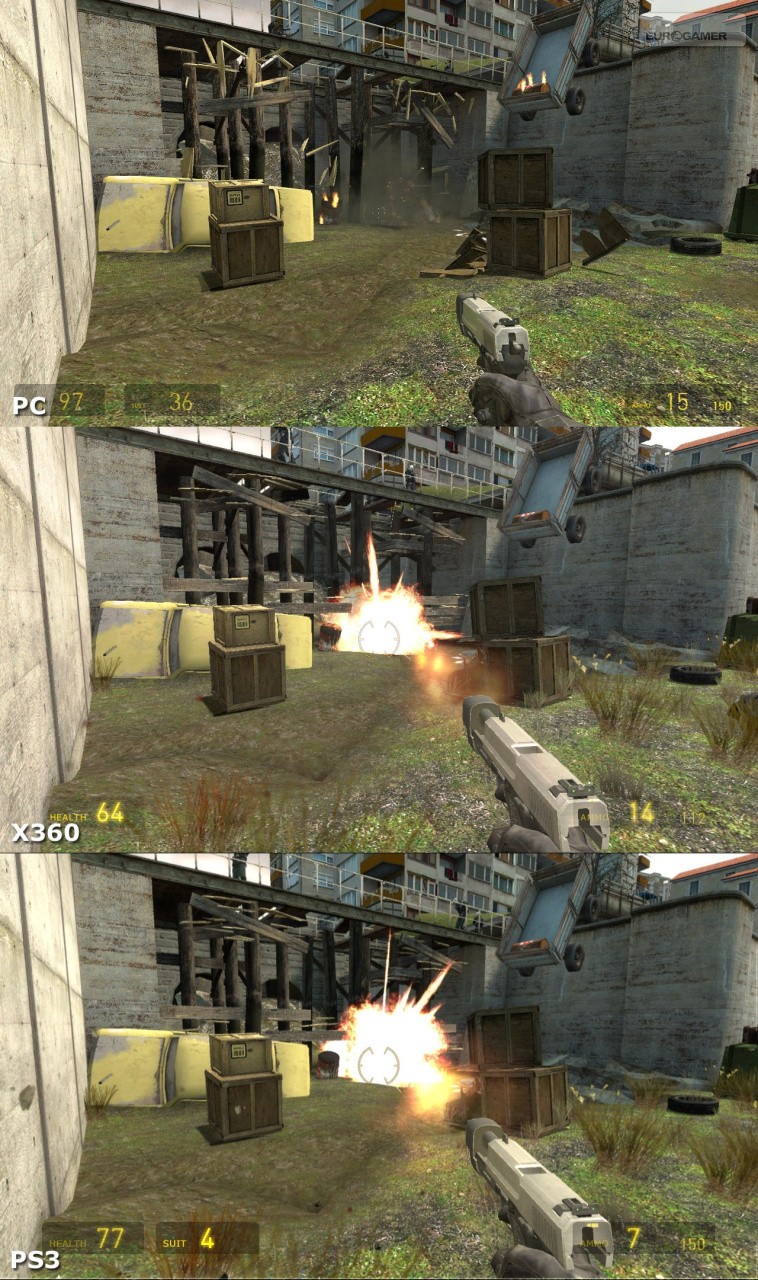
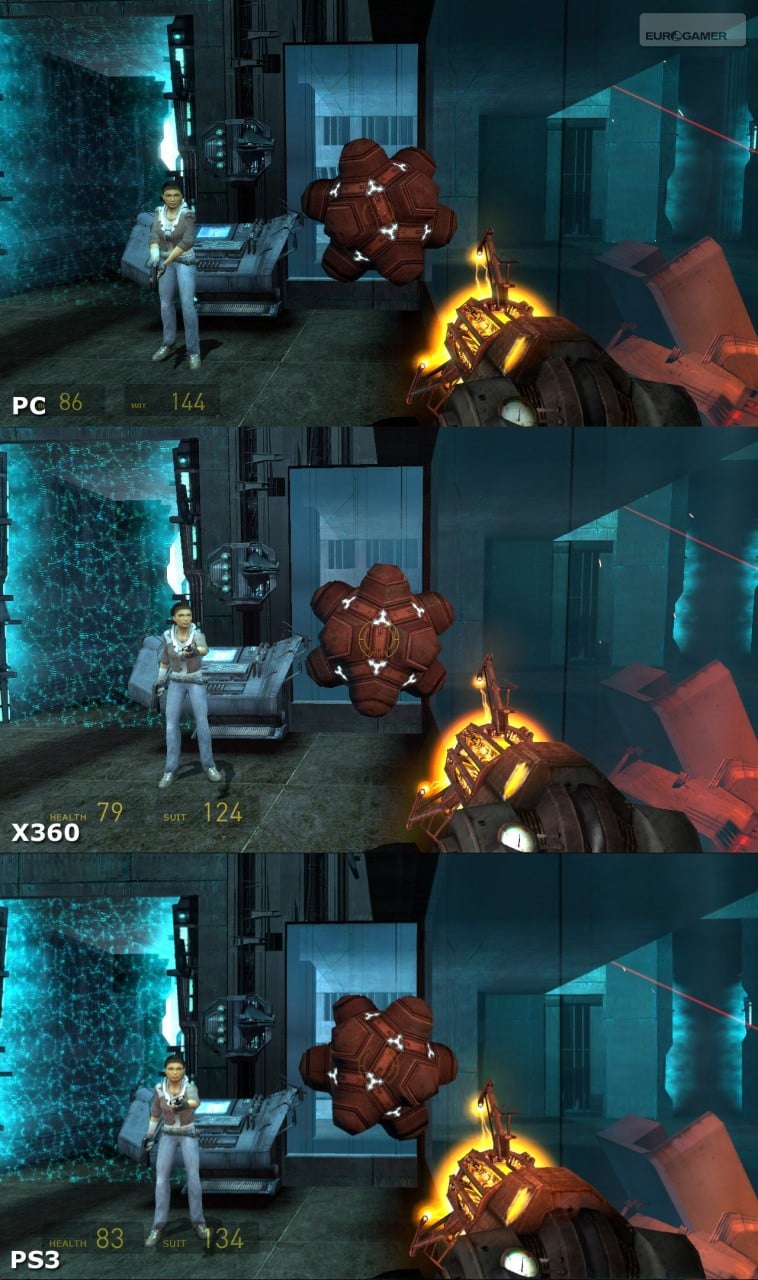
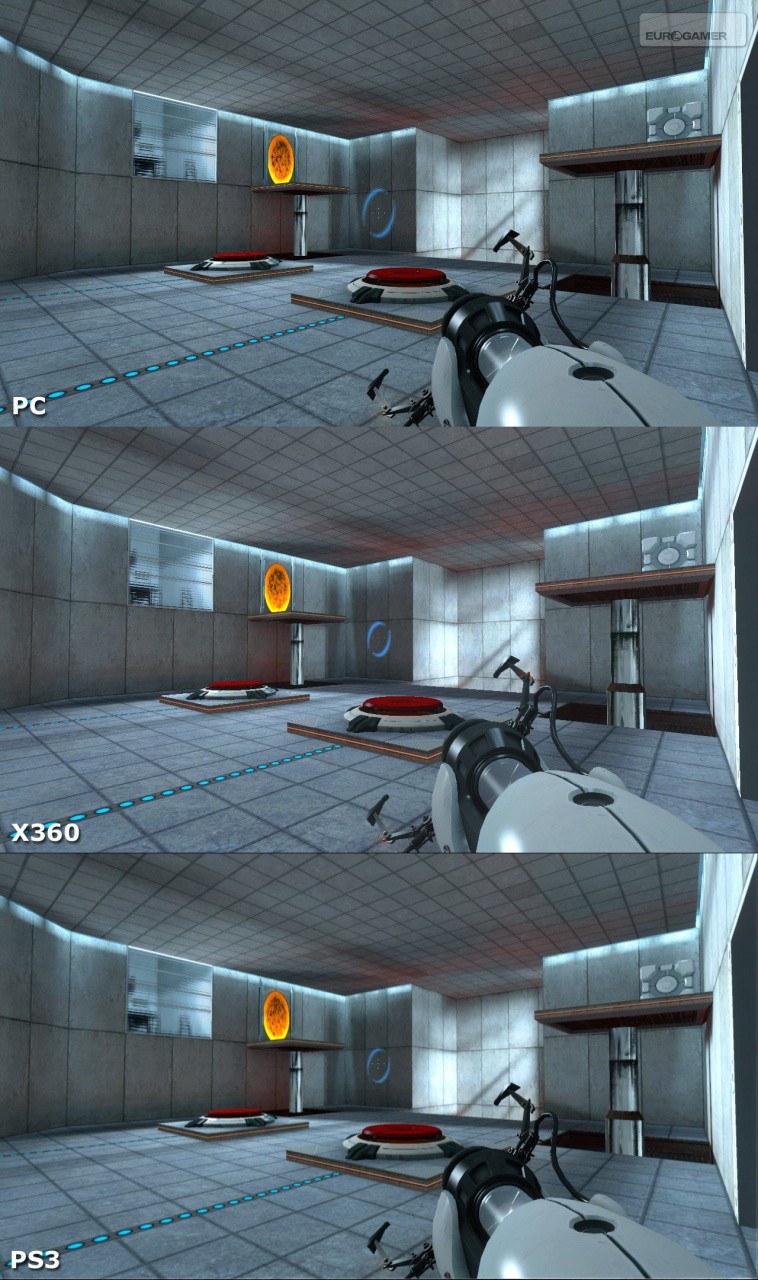
The first thing to note is that the console games are a total match for the original PC release in terms of geometry and textures and from what I could see, absolutely nothing is missing despite the RAM disadvantages of the Sony and Microsoft hardware. The fact that the game is pegged at 720p definitely helps here as it automatically limits the amount of texture memory the visuals require. However, there are variations in lighting and tone-mapping cross-platform, as you would expect.
Xbox 360 is a very close match for the complete balls-out PC experience, but the notable omission of anti-aliasing makes game considerably more 'jaggy' than any of the other versions. PlayStation 3 - frame rate issues apart - matches the PC game and is even anti-aliased.
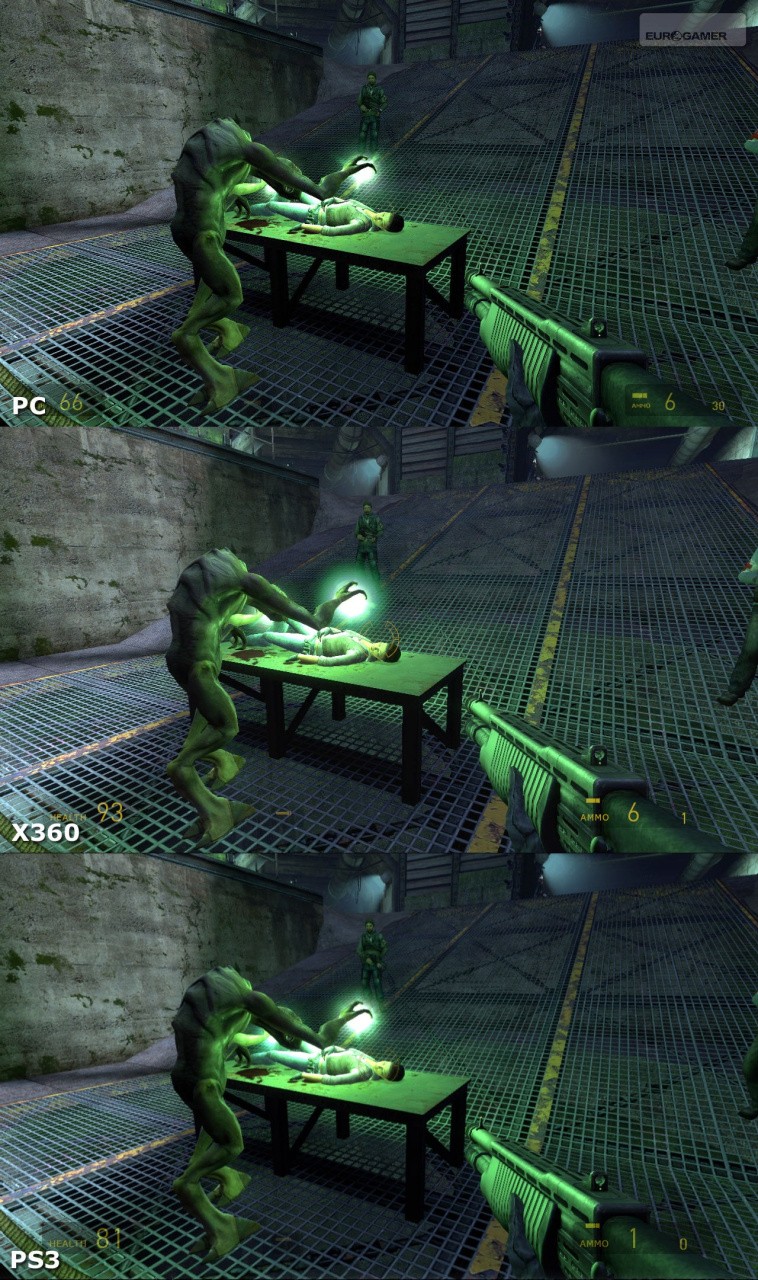
Unfortunately, someone somewhere within EA decided that the PS3 game should be afflicted with an all-pervading blur that masks much of the fine graphical detail. Its inclusion is completely inexplicable and the game looks a lot worse on a decent LCD panel. It's rather baffling as the same effect could have been achieved by lowering the resolution (thus increasing frame rate) then scaling it back up to 720p. Call of Duty 4 does this. Halo 3 does this. But weirdly, EA has opted for full-fat 720p and then blurred the whole screen anyway. Also, it appears that someone got rather carried away with the HDR lighting effects at certain parts of the game. Subtle and muted in most cases on PC, they've been ramped up a touch in places on 360, and occasionally pushed beyond the limits of taste on PlayStation 3. Again, very puzzling and utterly pointless.
Scores on the Doors
In putting together the face-off, one thing is supremely obvious. These are PC games that work best on the original platform. Get the game running on a decent LCD or Plasma, kit yourself out with a decent graphics card and you're going to get an experience that utterly annihilates both console versions. Indeed, even my lowly 1.5GHz dual core laptop with a low-power 128MB nVidia 8400M GS ran the resource draining Episode 2 fairly well once the video settings had been appropriately tweaked - astonishingly it actually performed better than the same game running on PlayStation 3. Also, having worked with the console versions for some weeks, returning to the PC version was a revelation; the level of precision afforded by the mouse and keyboard combo is untouchable and this is definitely the way the games were meant to be played.

The Xbox 360 game is inherently a compromise, but crucially it works. You never feel held back by the technology or the technical quality of the conversion, and the astonishing amount of content on offer is hugely impressive. Also worthy of note are the cunningly engineered Achievements. I've completed Half-Life 2 on both PC and original Xbox, but I did it again on 360 simply for the lure of the gamerscore, posing as it does an excellent array of additional challenges you simply wouldn't be bothered taking on if there weren't points at stake. On PC, only Team Fortress 2 and Portal have their own Achievements and disappointingly there are none at all on PlayStation 3.
Coming to an overall score for The Orange Box for PS3 is difficult. In terms of game content, everything (bar the Achievements) is there. Half-Life 2 is still an excellent game, even if it does feel overly long and a touch dated graphically. Episodes One and Two feel much more 'modern', faster-paced and more attractive, but the compromises in the PS3 version are simply unforgivable; Episode Two in particular is a savage testament of all that is wrong with cross-platform development - one of the worst examples as yet of developers simply not bothering to properly make use of the hardware available to them. Portal and Team Fortress are superb games, but the latter in particular emphasises that even the less technically challenging environments found in The Orange Box lack the polish found in the 360 game, and are lightyears away from the standards set by the original PC code.
Conclusion
So, an 'eight' it is for PS3 Orange Box then, but with it, the stark reality that most of that score is attributable to the superb quality of the core Valve games rather than the shoddy conversion work which sees one game out of the five ruined, and another badly compromised. That being the case, if you own a PC, even a relatively lightweight one, that version will almost certainly be the better - and definitely cheaper - purchase.

Comments 0
Wow, no comments yet... why not be the first?
Leave A Comment
Hold on there, you need to login to post a comment...