
 by
by As Koei Tecmo's first Switch 2-exclusive game in the Musou genre, Hyrule Warriors: Age of Imprisonment is an interesting test of Nintendo's current-gen CPU and GPU bandwidth on a power-limited platform. How does Nvidia's Tegra T239 chip handle the series' screen-filling onslaught of enemies and effects?
The best news is that Switch 2 is up to the task of rendering dozens-of-enemies combat inherent to the Musou genre. We're getting a somewhat steady 60 fps refresh in standard combat, with bursts of alpha particles and other intense effects dropping the refresh rate down to as low as the low 50s. In our testing thus far, HW:AoI's performance bottlenecks primarily attach to GPU-bound scenarios like flashy effects, as opposed to increased numbers of enemies. The T239's CPU does not appear to sweat either increased enemy logic or collision calculations, which is fantastic for a Princess Zelda-starring twist on the frenetic genre.
After analysing docked play and measuring sub-60 fps performance, we estimated similar frame rates in portable play. But as we have previously reported, only portable play on Switch 2 benefits from variable refresh rate (VRR) support, which is a shame, as this is a splendid game to enjoy in TV mode, and its frame rate rests comfortably in a VRR-friendly, 48 fps-and-up window.
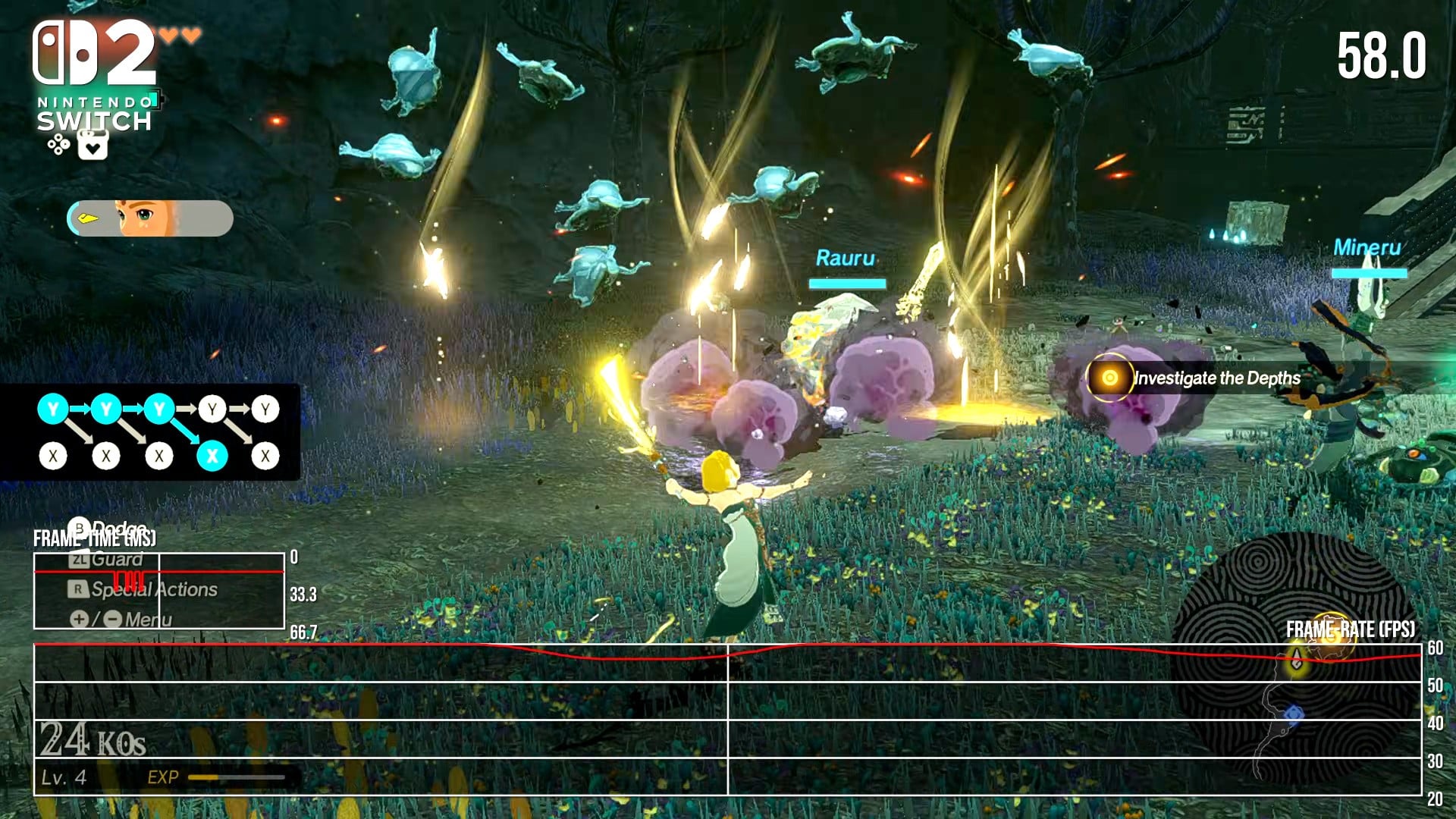
Still, the game's 60 fps target is largely reached in both modes, and Koei Tecmo accomplishes this in part by relying on dynamic resolution scaling (DRS). In docked mode, we see resolutions between 720p and 900p, while handheld mode scales between 468p and 648p. Koei Tecmo opts not to toggle Switch 2's optional DLSS mode for anti-aliasing or super-sampling, so we're left with a version of AMD's FSR 1.
At its worst, this leads to visible shimmering and stair-stepping lines, but it's a better and sharper trade-off for a high-action game like this than ghosting effects seen in other games. (And as we've previously reported, DLSS comes with its own per-frame rendering cost, which may have been a bit too much to fit into HW:AoI's close-to-60 refresh.)
Additionally, we see Switch 2 concessions like reduced ground detail, occasional low texture fidelity, and squint-to-see-it geometry pop-in. In select boss battles on pools of shallow water, the game's lack of screen-space reflections (SSR) is noticeable, while shadow fidelity can range from clear and fully animated to fuzzy and static, depending on distance from the camera.
Still, these notable downgrades do not diminish the utter strength of this game's performance and aesthetics. Complicated bosses, Tears of the Kingdom-caliber effects, screen-filling explosions wielded by the heroic duo of Princess Zelda and Mineru, crowds of foes to mindlessly blast through: It all looks a cut above every Hyrule Warriors game on Switch 1 thus far. (For a historical primer on how the game has looked over the years, check the above video.)
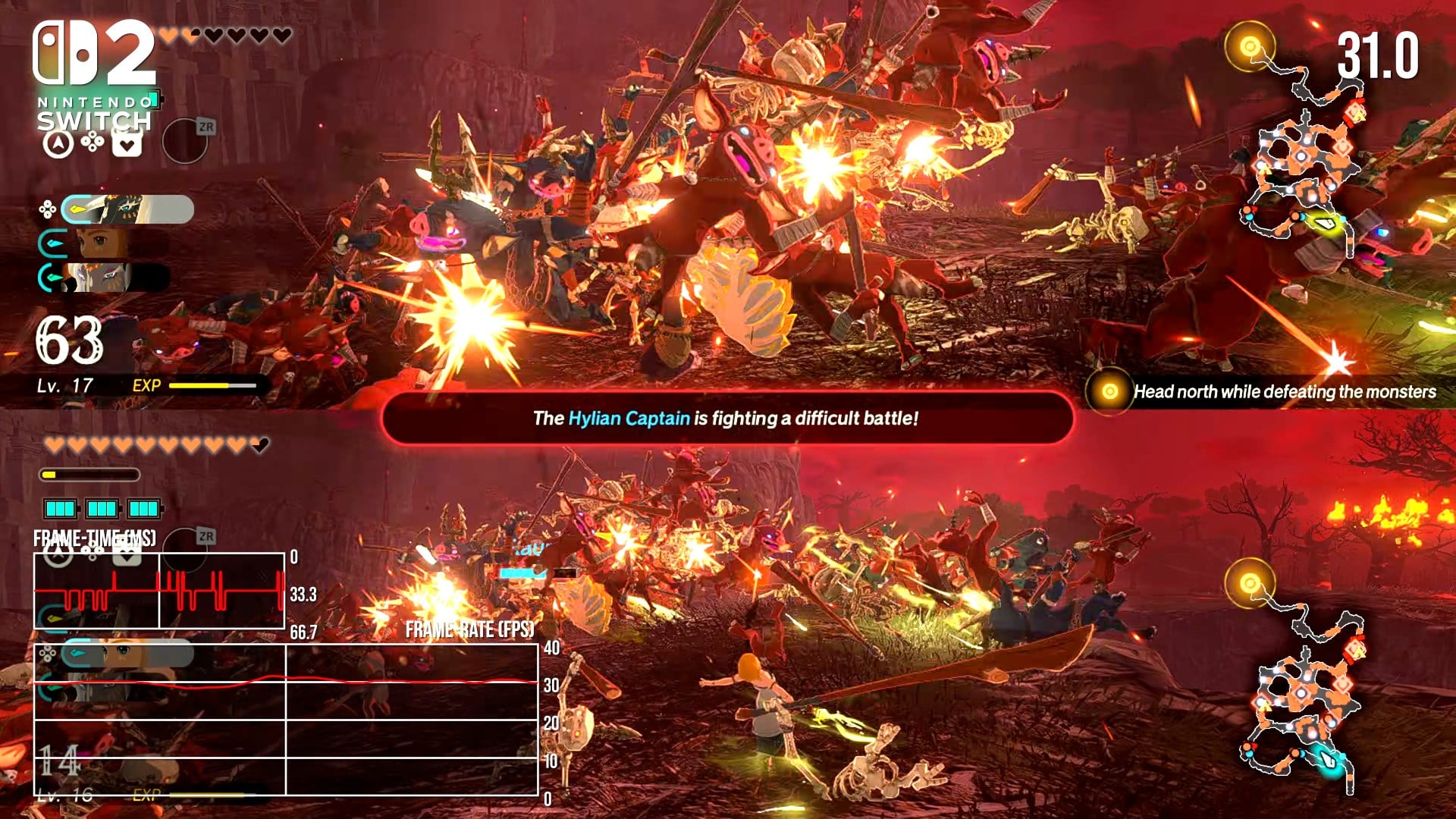
For two-player co-op action, series fans have two options: split-screen on one console, or GameShare on a pair of Switch 2s. The former sadly has inconsistent frame time pacing attached to its reduced 30 fps refresh, while the latter maintains the same mostly excellent performance found in solo play. Grab a second Switch, if you can.
Also, you may need to grab an additional microSD Express storage card for your Switch 2, as HW:AoI inflates its massive 42.7 GB install size with far too many pre-rendered cinema sequences. These clock in at a poorly frame paced 30 fps and come with banding and macroblocking artefacts. Due to their frequency in the course of the campaign, they're quite the blemish on an otherwise quality presentation. These sequences appear to be sourced from the default engine, and we would have loved to see them run in real time.
Ultimately, HW:AoI delivers a true showcase for what Switch 2 fans wanted from Nintendo's latest portable system: more CPU headroom for modern-calibre combat, and enough GPU power to embellish the action at levels that befit the source series.


Comments 11
The 30fps prerendered cutscenes are a disappointment. I wonder what rationale would make KT choose that over real-time / in-engine?
FSR 1...FSR 1...now that's a name i haven't heard in a long time. Quite dissapointed though as i am confident Switch 2 DLSS will be better than it. At least it runs well.
the resolutions are quite low but it is a 60 game
First vid I watched on the new site. Solid work as always!
@Leon_93 Of course I know him, he's me!
@JJtheTexan I wonder if the cutscenes were generated using the BOTW/TOTK engine rather than KT's tech
@Leon_93 Most of Nintendo developed or published titles continue to use FSR 1
@JJtheTexan I have a feeling this is one of those games that started life as a Switch 1 game but then moved to Switch 2 mid development. It explains why cutscenes are video files and just look lower quality than the game itself and why the game is on FSR1
@Solid_Python it occurs to me after watching the DF video in full that the cutscenes may have been directed and animated separately, perhaps by Nintendo internally, then dropped into the game, allowing AAA Game Studio to focus on gameplay and performance.
@Silver6477 I suspect you are correct. Nintendo may have done it all themselves and just had AAA GS drop it in later
I’m a little confused that using GameShare fixes multiplayer frame pacing issues. I was under the impression that when using GameShare the second player is seeing a video stream from player one. If that’s the case, it seems like the machine isn’t doing any less work than in split screen multiplayer?
Show Comments
Leave A Comment
Hold on there, you need to login to post a comment...