
 by
by Final Fantasy 7 Remake Intergrade’s arrival on Xbox platforms has brought some interesting discoveries, particularly regarding how the Series S manages its visuals compared to both the more powerful Series X and PlayStation counterparts and indeed to the Nintendo Switch 2 version, which launched on the same day.
It's all about the textures. The original PlayStation 4 version of Final Fantasy 7 Remake was excellent - but the diversity of quality in the presented textures was troublesome, culminating in the now infamous "door" that was presented with an almost hilariously low resolution asset. Beyond the next-gen Intergrade's many enhancements, texture quality was substantially improved - but even so, with the arrival of the Switch 2 version, the Nintendo hybrid seemed to serve up a mixture of assets that looked similar to both PS4 and PS5.
What's fascinating about Final Fantasy 7's arrival on Xbox Series S is that you get the full asset range and quality of the PS5 and Xbox Series X versions, despite the steep deficit in available memory. It's understood that the junior Xbox has a little over 8GB of available RAM for games, up against 12.5GB on PS5, 13GB on Series X and - crucially - 9GB on Switch 2. The bottom line is that Series S presents full asset quality in a way that the Nintendo console does not, despite having less memory. Switch 2 often defaults to lower resolution texture variants, leading to a muddier and more uneven look.
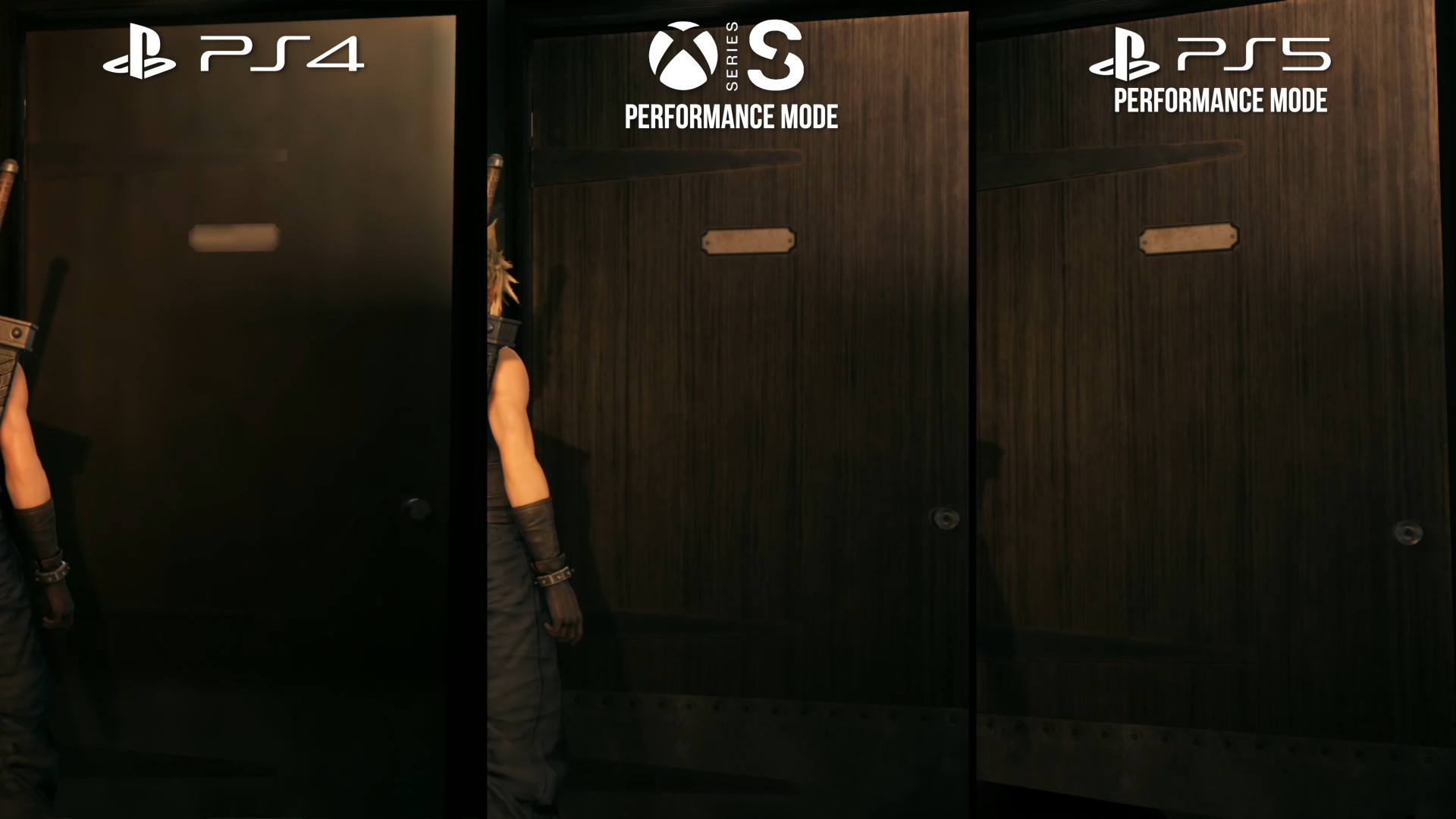
So, maybe the issue of Final Fantasy 7 Remake's texture quality is less about the sheer amount of memory available and more about texture streaming. As Series S retains similar CPU and storage capabilities to its bigger Series X brother, you don't get a compromised experience. Looking back though, it's somewhat disappointing that Square Enix never addressed the texture problems on the PS4 version of Final Fantasy 7 Remake. Even when "the door" evolved into full-on meme status, a fix was never introduced.
Looking at the game's overall visual make-up, Series S sits at a midpoint of sorts between PS4 and PS5. Shadow quality on Series S is significantly higher than the PS4 version, but not quite up to PS5/Series X quality. NPC draw distance is a match, however. In resolution terms, the Series S performance mode runs at 1080p, targeting 60 frames per second, with Unreal Engine 4's TAA solution on anti-aliasing duties. Graphics mode increases the pixel count to 1440p with a 30fps cap. Both pixel counts and frame-rates seem consistent across the duration of play.
It'll likely come as no surprise to discover that the Xbox Series X version of the game is a ringer for PlayStation 5, with the same 1512p resolution in the 60fps mode, with a native 4K at 30fps as the alternative - both delivered with consistent performance and a matching visual feature set. There are no complaints with loading times on Xbox consoles either: transitions between areas, fast travel, and reloading after a player death are all rapid and do not detract from the experience.
Ultimately, Final Fantasy 7 Remake Intergrade delivers exactly what we were expecting on Xbox Series X - and whether it's down to developer diligence or simply the fact that the core game originated on PS4, it's still a great experience on Series S. Xbox players get a full-featured, consistent and visually pleasing port - but let's hope that the Rebirth sequel arrives without quite as much of a time delay.


Comments 2
This is probably a stupid question, but does the Nintendo Switch 2's GameChat function have a memory requirement for all games? It doesn't seem like anyone would want to run GameChat in a single-player title like this, but it's never been clear to me if Nintendo requires developers to allow for it in all cases.
Great read, Rich. I was surprised to see our friends playing on Series S would be getting such a quality experience as that hasn’t been the standard in a lot of ways.
Side note, this article is going to confuse everyone who says you guys don’t like Xbox.
Show Comments
Leave A Comment
Hold on there, you need to login to post a comment...