
 by
by It seems that no matter the size and scale of the AMD processor, someone, somewhere is going to put it into a PC handheld. And that's what's happening right now with one of the most gigantic APUs ever made: the remarkable Ryzen 9 AI Max+ 395, also known by its codename: Strix Halo. Renowned handheld PC maker GPD sent me the GPD Win 5 containing this chip, and it's astonishing. For now and probably for a couple of years to follow, Strix Halo handhelds will be the closest thing you'll get to a portable PS5, putting them in a class of their own - and we've got the numbers to prove it.
On paper, the idea of Strix Halo working within a handheld is frankly nuts. Before I reel off the specs, just keep in mind that the PS5 Pro APU is circa 280mm2 on TSMC's 4nm (4NP) process. Strix Halo? Total silicon is around 440mm2, based around two 67mm2 Zen 5 CPU chiplets and a 308mm2 "SoC" die. It has 16 CPU cores, 40 RDNA 3.5 compute units and a 256-bit memory interface, good for 256GB/s of bandwidth. AMD has made nothing like it before - and it's a bit of a revelation.
However, being an APU, it's designed primarily for laptops, large tablets and small form factor PCs, with a typical max power draw of around 120W to 140W, depending on the device. And remarkably for a chip so large, there is pretty good efficiency scaling - the less power you give Strix Halo, proportionally the better performance you get. The efficiency sweet spot seems to sit at around 50W, with diminishing returns kicking in from there - there's little point pumping more power in beyond 85W. Even at 30W, you're getting almost twice the performance of the AMD Ryzen Z2 Extreme found in the ROG Xbox Ally X.
Enter the GDP Win 5, one of the most remarkable handhelds I've ever seen - and the starting point of Digital Foundry's Best Hardware 2025, embedded at the top of this page. Here, you can run Strix Halo at anything from 7W to 85W - and yet the device itself is much smaller than a ROG Xbox Ally X and less wide than a Switch 2. How? This is the cheeky part: the 80Wh battery is a separate unit you can either mount to the rear of the device or tether via cable. But why use a battery at all at home? GPD Win 5 ships with a 180W laptop power supply that connects to the top of the unit via a barrel-jack connector, ensuring consistent power delivery at high wattages - though USB-C charging is also supported.
Running with a 7-inch LCD panel supporting up to 120Hz with FreeSync VRR, the smaller size of the GPD Win 5 compared to most other modern high-end handhelds is quite remarkable - and I also enjoyed some of its PSP-like stylings, with its rounded edges and clicky d-pad. However, if we're going to be talking about Sony comparisons, it's really all about Strix Halo and its GPU-based party trick of delivering close to PS5 performance. This was first revealed when we looked at the GMKTec Evo X2 mini PC and while adjustments to performance will come from TDP changes, GPD Win 5 gets close to giving you PS5-class power on the go.
We'll look at this more closely in an upcoming review, but we make this determination by using our PS5/PS5 Pro Alan Wake 2 stress test. There are areas within the forest, most easily found in chapter two, that cause the game to drop beneath the frame-rate targets of the PS5 version of the game. Meanwhile, we have practically identical quality settings dialled into the PC version to match PS5 visuals. With extremely similar GPU loads in place on PlayStation and GPD Win 5, the testing can begin.
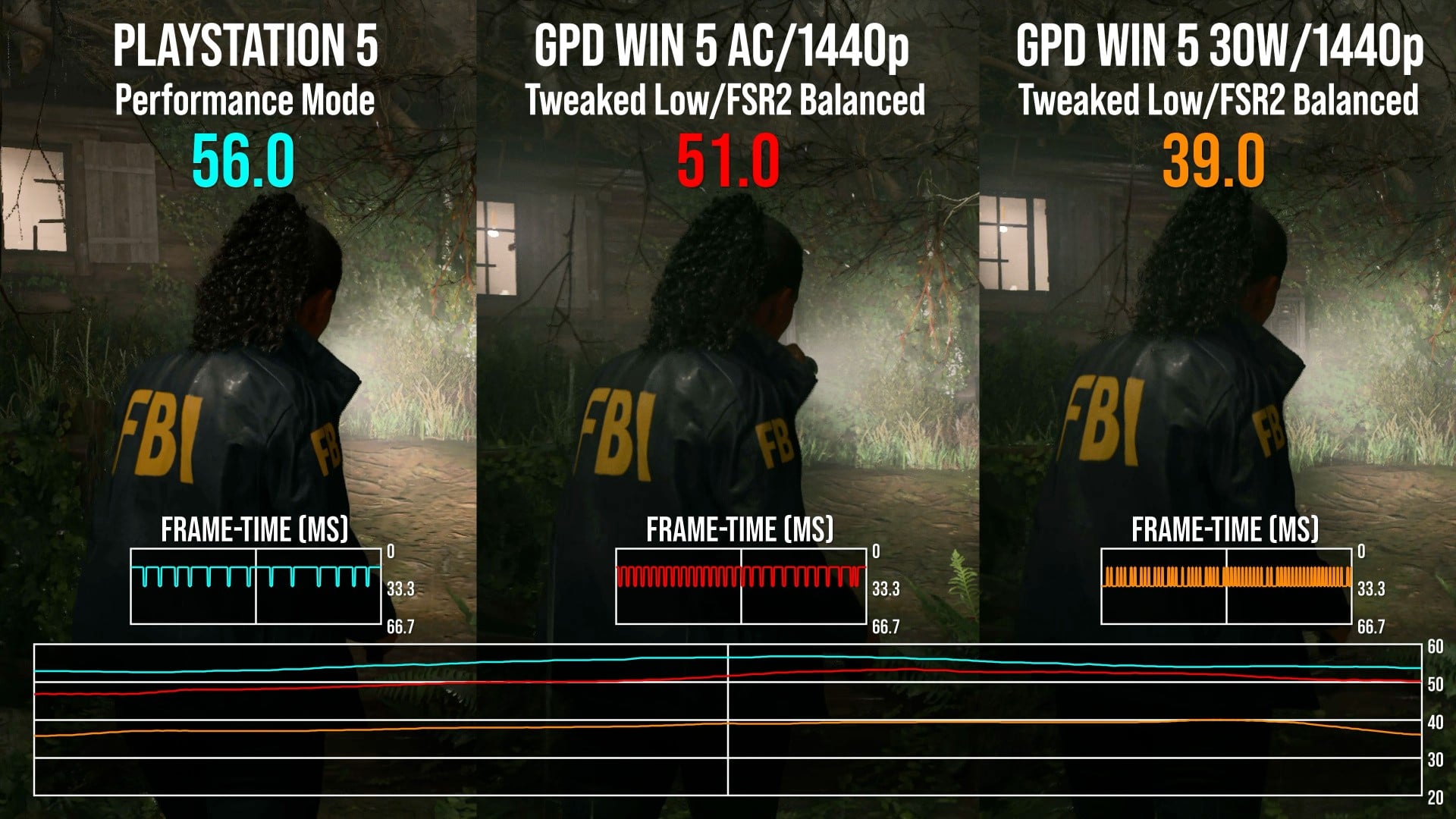
Actually, there are two tests. The first is to flood GPD Win 5 with all the power it can take, and run Alan Wake 2 at matching settings to PS5, up to an including output resolution. I targeted 60fps in performance mode, where the PC equivalent is basically a 1440p output running in FSR 2 balanced mode on low settings, with scattered object density on medium. GPD Win 5 running at circa 70W delivers 93.5 percent of PS5's frame-rate (51.65fps vs 55.25fps), but curiously, dropping power to 30W to mimic reasonable battery life saw that drop to 69.6 percent of PS5 output. That's an impressive result bearing in mind how much more power the PS5 draws from the wall.
The conclusion here is that in real world gaming conditions, running GPD Win 5 from the mains in a kind of "docked" configuration (if you like) does offer circa PS5 performance. While I've yet to test other games on GPD Win 5, I did on the Strix Halo-equipped GMKTec Evo X2 with similar results. But it's the 30W result I found interesting, because there's still a lot of performance there - but it's just not enough for a 1440p output. This is fine though as GPD Win 5 ships with a 1080p VRR panel, so targeting 1440p in the first place is not exactly a real-world type of handheld workload.
So, I ran the experiment again - the same Alan Wake 2 stress test, the same in-game quality settings, but with a 1080p output target instead at 30W, using FSR 2 balanced and performance modes. In effect, an "undocked" configuration. The target to beat is PS5's 55.25fps, remember.
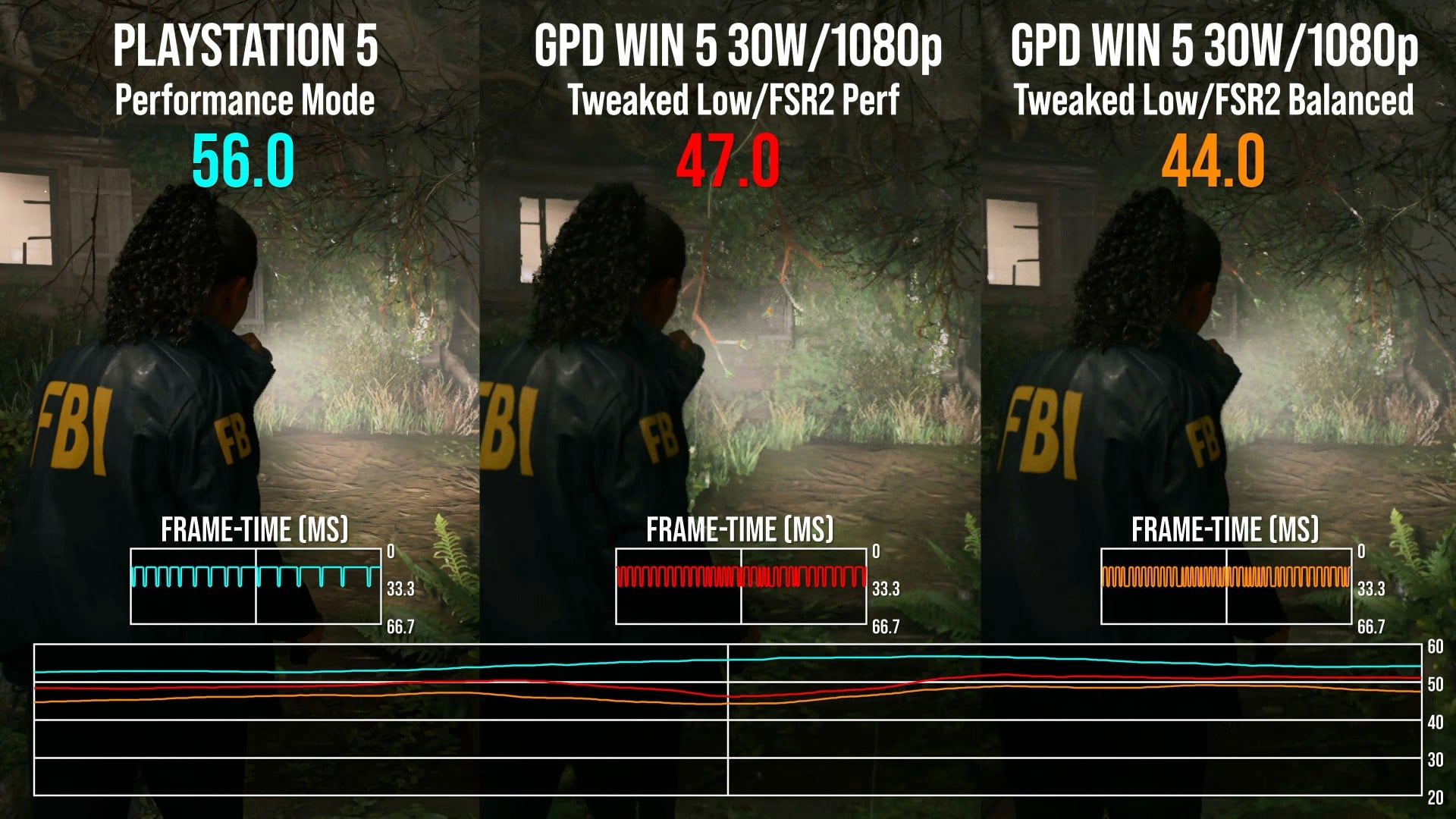
Running in FSR 2 balanced mode, we hit 47.3fps - 85.6 percent of PS5 output, which rises to 51.47fps (93.2 percent) in FSR 2 performance mode. I actually played Alan Wake 2 in FSR 2 quality mode outside of testing, which would obviously have had a bigger frame-rate differential than these results, but I didn't care - the GPD Win 5 has a VRR panel, remember, so it looked great and ran smoothly anyway.
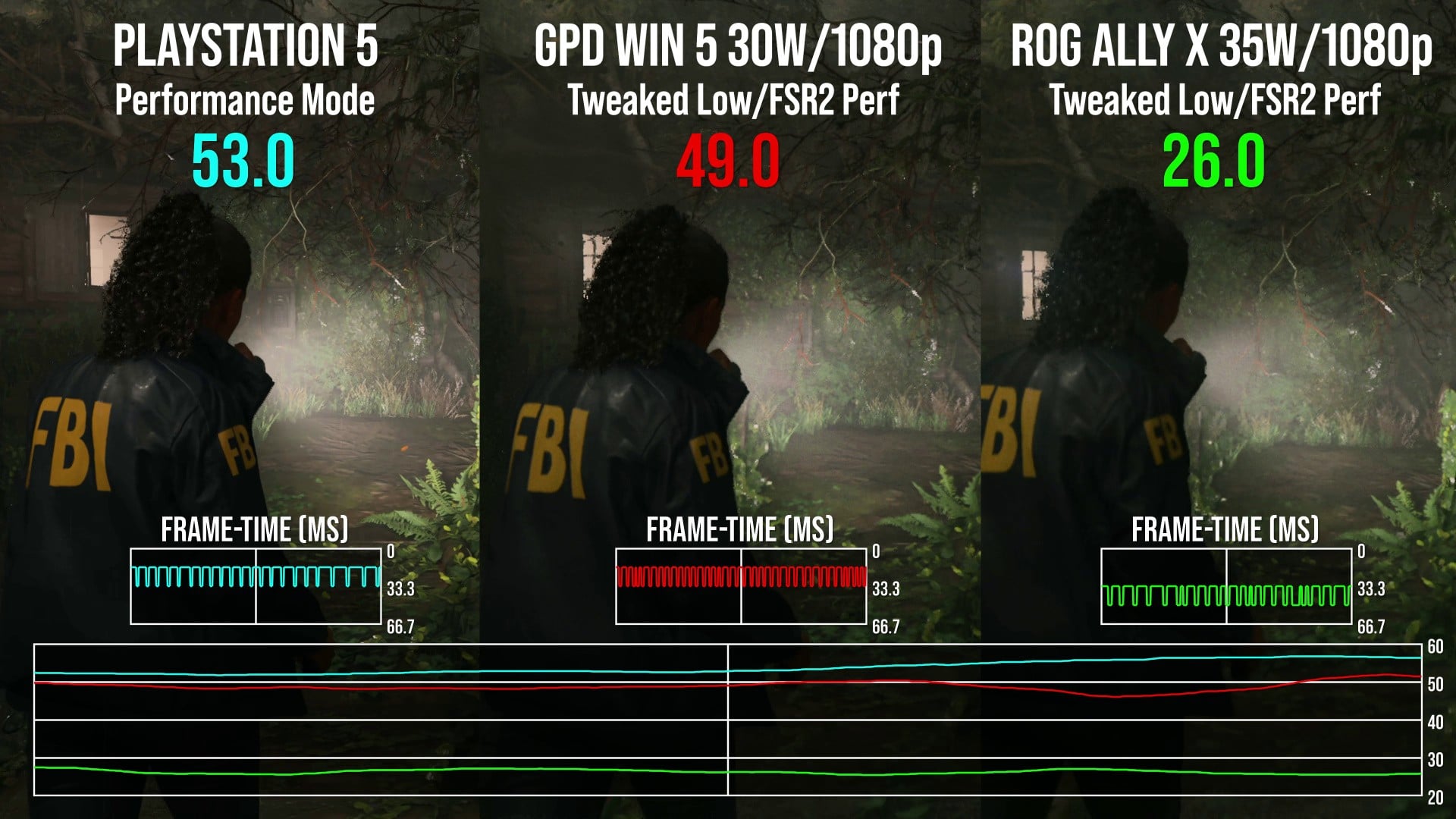
By the way, I also re-ran the same test at the same settings on a ROG Xbox Ally X with a 28.09fps average - 50.8 percent of PS5 frame-rate, 54.6 percent of GPD Win 5. The frame-rate is obviously lower, but image quality is worse too, even on the same settings. This is because temporal upscalers deliver better quality results at higher frame-rates. Xbox Ally X looked considerably grainier as well as jerkier. There's a big gap between Z2 Extreme and Strix Halo, then, and a bigger gap still compared to PS5, bearing in mind the resolution difference.
But it's GPD Win 5 and Strix Halo that's the real point of interest here. Lowering the resolution effectively gives us a PS5-like experience in quality terms while limiting TDP to 30W means that you should get around two hours of battery life playing the game with the 80Wh battery. Mission successful.
One final point: the choice of Alan Wake 2 as the test subject - why? First of all, beyond the console settings equivalency, once you have your save games set up, it's a test that's very easy to repeat. Secondly, not only is the game demanding, it's pushing modern features like mesh shaders - it's an actual current-gen title, not a cross-gen holdover. Ray tracing is off the table of course, but then again, it's a PS5 Pro-level feature any way.
But really, similar to Avatar: Frontiers of Pandora, the reason I chose Alan Wake 2 is because I've never really had a satisfactory experience with this title on any prior AMD handheld. Frame-rates are doggedly low, image quality looks poor and there's diminishing returns from more aggressive FSR 2 upscaling. And you can't lower settings that much further: console performance mode and the PC's low setting are already very close to the absolute minimum. Even stripped back to the core, the game's just too demanding, even for the Z2 Extreme APU.
But playing Alan Wake 2 on a handheld with reasonable battery life and actual console-like settings? It's been my internal litmus test for what I'd like to see from an RDNA 5-powered Sony handheld, which we may well see at some point in the next couple of years, RAMageddon willing. The only real criticisms I have of the GPD Win 5 come down to the rudimentary software and loud fan noise at max wattages - but even in its smaller-than-expected form factor, fan noise is fine at 30W.
Ultimately, Strix Halo in a handheld may seem like insanity - and whether it's the GPD Win 5, or alternatives from AyaNeo or OneXPlayer, you'll be paying a lot of money for one - but when you see this device flex its muscles, it very much feels like tomorrow's technology today, and I'm rather fond of it.


Comments 6
Great write up. I've often used the phrase "yesterday's technology tomorrow" to describe Nintendo's hardware in the past (though I am fond of ol'Ninty in other ways) so reading "tomorrow's technology today" was exciting to see.
It is a glimpse into the future and I can imagine a docked Strix Halo giving PS5-like visuals when docked on AC power, but then being able to pick up and play as a handheld with reduced settings. That's exciting. Though for now a RRP starting from around £1650 for this 395 model is outside my budget. Regardless I am excited about the future possibilities.
@themightyant Yeah, I can still see a use-case for my Steam Deck at that price. Sure it's nowhere near as powerful as this beast (And I am slightly jealous) but it's also close to a third of the price for the base OLED model.
Curious if you guys did any testing on the Win 5 (or Strix Halo in general) with some CPU cores disabled. AMD chose to go for broke on the CPU side, with two CCDs full of "real" fat Zen 5 cores with 512-bit AVX units and all. But - those take up a great deal of power, and for the vast majority of games, are totally unneeded. What happens when you completely disable one of the CCDs - taking it down to 8 cores/16 threads? This would not only match PS5 (and the rumored PS6 handheld) in cores/threads, but the real question is how much extra power could then be sent to the GPU to further boost framerates?
If humanity's tech accomplishments were an RPG character all it's stats would be between 8 and 9 except for the energy storage stat, that would be a 5. So sadly, power hungry devices like this will always feel compromised.
These devices are fascinating, but I wonder if AMD is secretly working on a "true" handheld chipset. Something that is designed for gaming and handheld usage from the ground up.
So far, all of the APUs that have been released for handhelds seem to be rebadged laptop parts. This isn't a bad thing, but it would be interesting to see a part optimized specifically for a handheld, and what type of performance it could achieve.
Maybe I'm missing an angle here, but the lack of a built in battery feels like a weird design choice. I want to like it (MOAR POWA = good!), but it just feels unbalanced as a handheld. And at that price!
And also maybe I'm just biased because I already have a high-end desktop for hi-fi gaming, and so for me, my Ally X is more of a simple pick-up-and-play device of convenience to play older/less demanding games in my backlog... as themightyant noted, this feels like it would be better implemented like a Switch; emphasizing low watt efficiency mode with a built-in 60-80wh battery in handheld mode, but can be let wild with a full power budget when docked.
I feel like this is where Strix Halo makes sense as a handheld chip vs. the Z lineup, which is a nice balance of power efficiency. I would happily buy this if it came with a Nintendo like dock solution for big screen play. Hopefully we will see some new handhelds with the new 388 chip at least!
Show Comments
Leave A Comment
Hold on there, you need to login to post a comment...