
 by
by Since the 2022 release of Steam Deck, and its growing maturity running native Windows games via Linux and SteamOS, we've wondered: could this successful handheld ecosystem one day lead to a satisfactory, console-like experience? Imagine it. The same stability and competent performance of Steam Deck, scaled up with more power to plug into whatever home screen we want, TV or otherwise, and deliver a more streamlined flavour of PC gaming than we've dealt with on Windows PCs as of late.
That's the apparent goal of the Steam Machine, a new Valve hardware initiative that looks to deliver competent and accessible PC gaming for the average living room (and, if it launches as soon as Valve has hinted, will beat MS to that punch). It's slated to launch in the relatively near future as a fixed-spec box manufactured and sold by Valve, and at first glance, its spec sheet suggests performance at some mid-way point between Xbox Series S and the standard PlayStation 5, perhaps skewing more closely to the Sony console, with a few caveats.
After a brief in-person demonstration of the system and its accompanying, updated Steam Controller (also available for sale separately), we're left quite impressed, and we think Valve has something here in terms of delivering (mostly) sufficient PC-gaming performance and further disrupting the Windows OS chokehold on gaming PCs. But we still have questions, not least of which is, how much is this system going to cost?
From many to one: Steam Machine's unified re-debut
We'll start by confirming that your memory does not deceive you. We've covered the concept of Steam Machines in the past, which launched at retail in 2015 as a line of 14 different gaming PCs made by 14 different OEMs, and they all only had a primitive version of SteamOS in common. AMD and Intel CPUs; Nvidia and AMD GPUs; and specs (and prices) at opposite extremes in every category imaginable. Their messy launch fizzled out, as native Linux games were required and they were few and far between.
Ten years later, Valve is reclaiming "Steam Machine" with a more focused vision. Valve's new Linux-based PC is now a single hardware spec as built into a square chassis (or, if you'd rather, a cube for games) with a massive heatsink, some wiggle room for swappable parts, and only two SKU options (either 512GB or 2TB of internal storage, as stored on M.2 2230 drives).
Digital Foundry's attention immediately turns towards the fixed spec to start, with thoughts on the design, aesthetics, controller and SteamOS experience to follow.
Steam Machine Specs
Valve has not given specific model numbers for its choice of CPU and GPU, instead describing each as "semi-custom."
- CPU
- AMD Zen 4 CPU clocked at "up to" 4.8GHz, 6 cores, 12 threads
- Graphics Core
- AMD RDNA 3 with 28 compute units up to 2.45GHz, 8 GB DDR6 VRAM
- Power Draw
- 30W TDP (CPU), 110W TDP (GPU)
- Memory
- 16GB DDR5 RAM
- Storage
- 512GB or 2TB M.2 2230 storage
- Output
- DisplayPort 1.4, up to 4K/240Hz or 8K/120 Hz; HDMI "2.0," up to 4K/120 Hz
- OS
- SteamOS
Steam Machine supports M.2 storage replacements in both 2230 and 2280 form factors along with hot-swapping microSD cards used in other SteamOS devices. Additionally, Valve engineers confirm that select HDMI 2.1 features like HDR and AMD FreeSync are active, despite the official spec listing HDMI 2.0.
Since the AMD CPU and GPU in the above spec sheet are listed as "semi-custom," we must read between the lines to determine which existing parts they most closely resemble, seeing as neither is the debut of an entirely new AMD chipset line. Instead, based on a combination of prior leaks and Valve's official numbers, we suspect (but cannot yet confirm) that Steam Machine's CPU is derived from a Phoenix or Hawk Point APU with two cores disabled and its integrated GPU fused off.
GPU-wise, meanwhile, we direct our attention to the most comparable RDNA 3 GPU made by AMD: the Navi 33 processor, as found in the two-year-old RX 7600, with a cut-down in specs from 32 CUs to only 28. This GPU is likely operating on a 128-bit bus, as per official Navi 33 specs (again, unconfirmed as of this article's publication). TDP is also lower. The spec suggests 110W, while staff Valve spoke of a wider 110W-130W window. For reference, the fully enabled Navi 33 in the RX 7600 has a 165W TDP.
8GB of VRAM: the key concern with Steam Machine's spec
In comments about Steam Machine to Digital Foundry, Valve staffers repeatedly suggested a general performance target of 4K resolution and 60fps frame-rates, albeit with AMD's FSR engaged to resolve a 4K image from lower base pixel counts. On the CPU front, we believe the system's Zen 4 architecture at the stated clock speeds should clear the 60fps target on a wide range of software, despite its relatively low TDP and origins as a mobile- and laptop-minded chip.
Valve's chosen GPU for Steam Machine, on the other hand, leaves us less confident in that target, where the fully enabled RX 7600 is typically associated with 1080p to 1440p gaming, often requiring the use of upscaling on more demanding games. The decision to opt for 8GB of GDDR6 memory has been proven to be a limiting factor on many modern mainstream triple-A games and falls short of the maximum VRAM pools and memory bandwidth available on both Xbox Series X and base PS5. To accommodate 8GB on affected games, paring back settings (particularly texture quality) and steering clear of ray tracing is frequently required.
Valve engineers suggested that the system's 8GB VRAM amount was a matter of "affordability" - the same argument put forward by Nvidia and AMD for its recent 8GB GPU offerings - so we'd hope to see this reflected in favourable pricing, but MSRPs have yet to be revealed at the time of writing. Steam Machine comes with two available SKUs, based on 512GB and 2TB SSDs. Options for 8GB or 16GB of VRAM may have been a more meaningful choice for those looking for a more future-proof configuration.
Interestingly, Valve's philosophy about Steam Machine's specs boils down to their use of the Steam Hardware Survey as a guideline. "We picked a point where for most people on Steam, this would be actually an upgrade," one Valve engineer said. That mindset may work out when designing for affordability, but we worry it leaves users behind in the present and near future of PC gaming realities, between VRAM issues and RDNA 3's diminishing RT returns.
Factoring out the growing wave of triple-A titles that do present best with more VRAM, there is certainly an argument that 8GB will be fine for the vast majority of the current Steam library, but explicitly laying out a 4K 60fps FSR target for the hardware reminds us of similar claims made by console manufacturers in the past. It's a claim that can only fall short when games have so much scalability built in and where every title has its own level of baseline performance. We'd need to go hands-on, obviously, but experience of what this level of horsepower achieves based on our GPU reviews suggests that expectations should be tempered in this regard.
In good news for current and upcoming games, Valve confirms that developers will have access to an API that can help their games recognise Steam Machine hardware and automatically adjust in-game settings, just like the current Steam Deck API. Such tweaks would have to deploy rapidly across the massive Steam ecosystem of games to render our concerns moot. But, hey, it happened to a certain extent for Steam Deck.
The new Steam Controller, as tested on... two games
Of the titles available to play at Steam Machines' debut event, we opted for a game we know extremely well: Cyberpunk 2077. (No, we were not allowed to click through our testing unit and search for hidden builds of the highly rumoured Half-Life 3. Sorry to the Gordon Freeman faithful; Gaben did not provide.) We went through CP77's menus to set most options at relatively high values, with all ray tracing disabled, and reached an apparently steady 60fps performance level with FSR upscaling to 1440p resolution.
With the same settings and resolution, we then turned on RT sun shadows and RT reflections and saw CP77's frame-rates dip into a jittery 30fps range. (Oddly, Valve didn't connect our Steam Machine to a VRR-enabled display, which would have smoothed off the experience to a certain extent. Steam Machine is VRR-compatible, we've been told.)
Valve engineers have suggested that they're heads-down on refining the process of compiling RT acceleration structures on the driver level. Their goal is to have SteamOS's translation layer fully tap into the RT capabilities of Steam Machine's GPU by the time it launches. This information was offered outside of our CP77 demo, however, so it's unclear what kind of performance gains we might expect the next time we test CP77 on a Steam Machine, or whether we might really expect magic on the hardware's RT-strained RDNA 3 architecture.
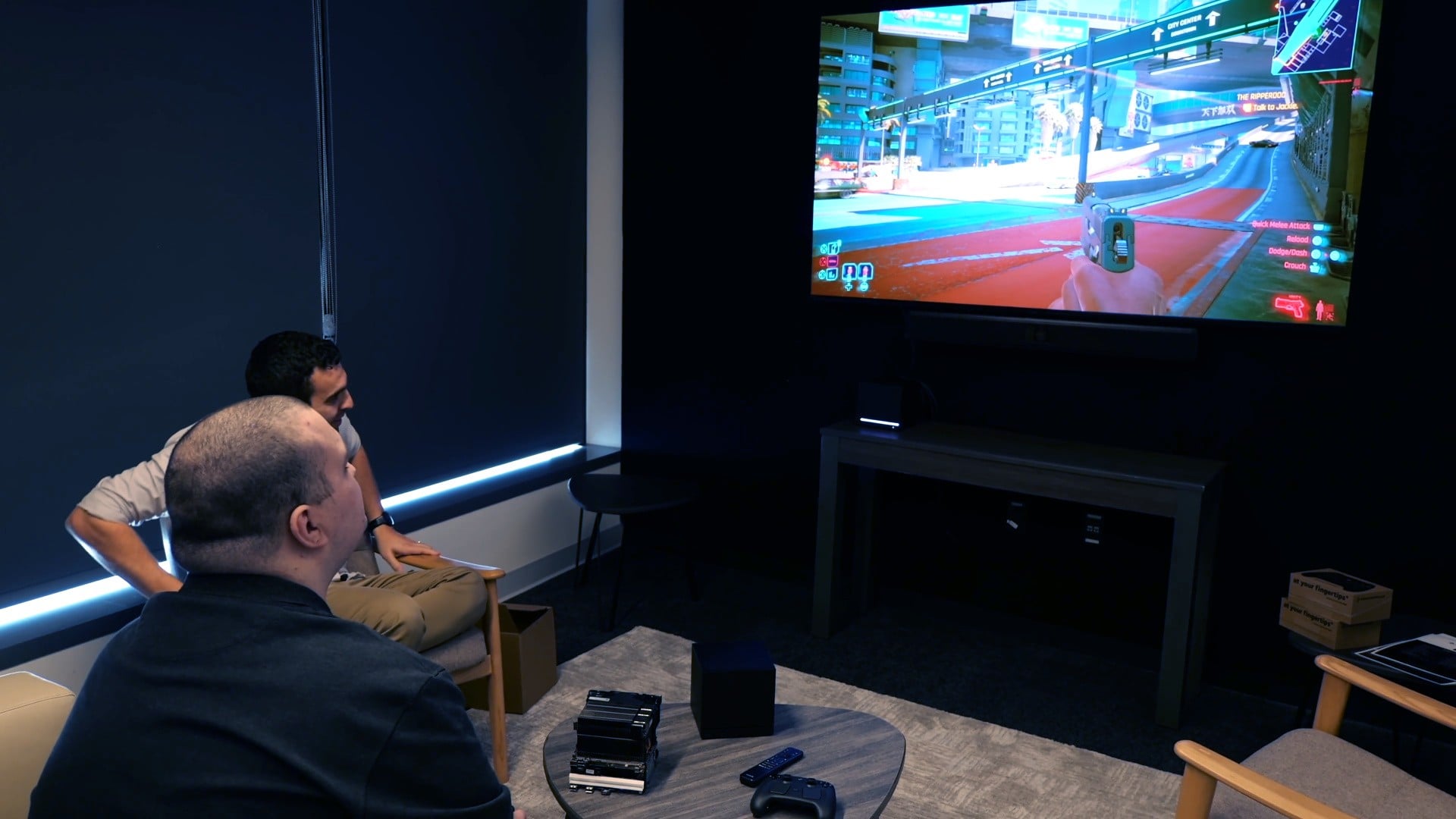
Our gameplay test was conducted using the brand-new Steam Controller, which we have far fewer nitpicks about. This sleek, comfortable gamepad has been tuned to be a great pack-in with your Steam Machine, and it sports enough tweaks to make it a cool option, if not an obvious purchase for anyone already happy with their favorite DualShock, DualSense or Xbox Series gamepads on PC.
Unlike 2015's trackpad-centric Steam Controller, this one essentially mirrors what you'll find on a Steam Deck: joysticks, d-pad, face buttons, triggers, grip buttons and mouse-emulating trackpads. We also played Balatro using this gamepad and found that the trackpads indeed felt nice and allowed us to comfortably pick up and drop that game's selection of playing cards.
In one big change from Steam Deck, Valve is taking joystick lifespans seriously by upgrading the new Steam Controller's sticks to Tunneling Magnetoresistance (TMR) sensors, or as one Valve rep put it, a "next-gen Hall Effect sensor." Valve suggests that these both reduce power draw and work with a reduced "dead zone" size, thus increasing their default responsiveness, and should outlast most other joysticks on the market.
Additionally, Steam Controller comes with a new function called "Grip Sense," which is essentially an expansion of the capacitive sensor functionality on Steam Deck's joysticks. When this feature is enabled in a game like a first-person shooter, place your fingers on the Steam Controller's grip to turn on gyroscopic motion control. Then, when your hand feels like it's out of real-world alignment, take your fingers off the grip so you can disable gyro and reposition your hands. Then re-grip the controller to go back to motion control.
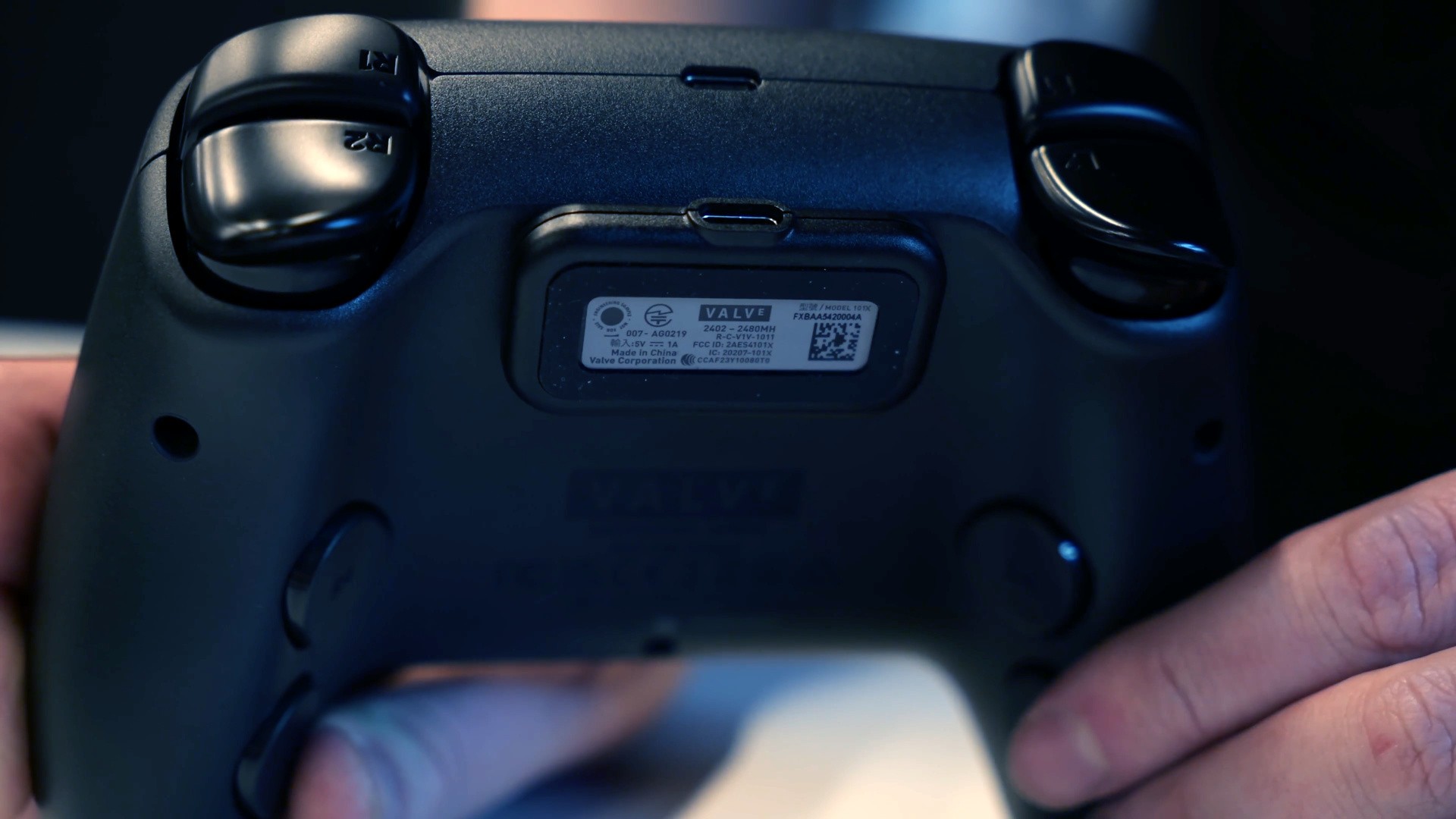
On a connectivity level, Steam Controller borrows from the Xbox Wireless Adapter concept and comes with its own "puck." This customised charging station doubles as a 2.4GHz receiver and can wirelessly connect to up to four Steam Controllers, as plugged to any PC via USB Type-A. (If you'd rather connect Steam Controller to an existing PC with Bluetooth, that works by default, as well.)
Valve builds that very wireless receiver directly into Steam Machine, so that its included Steam Controller will just work. In great news, the Steam Controller can wirelessly power on any synced Steam Machine with a press of its Steam button, or also wake the device from sleep, since Machine supports the same "freeze a game in sleep mode" feature as Steam Deck.
In our brief testing, the Steam Controller feels great. Its touchpads are canted compared to their Steam Deck equivalents, so they now land nicely against thumbs, and its joysticks have both a noticeable smoothness to full rotation and satisfying sensitivity when pressed subtly. The rebindable grip buttons feel a little firm, which will be a matter of taste, as far as whether a user prefers them being a bit firmer to press for the sake of fewer accidental taps.
A cube for your living room games
We didn't bring a ruler to measure the cuboid Steam Machine and are still awaiting exact measurements from Valve, but it resembles the size of an Xbox Series X, if its tower chassis had been chopped down to a cube. Meaning, maybe a bit bigger than 15 cm (5.9") on all sides.
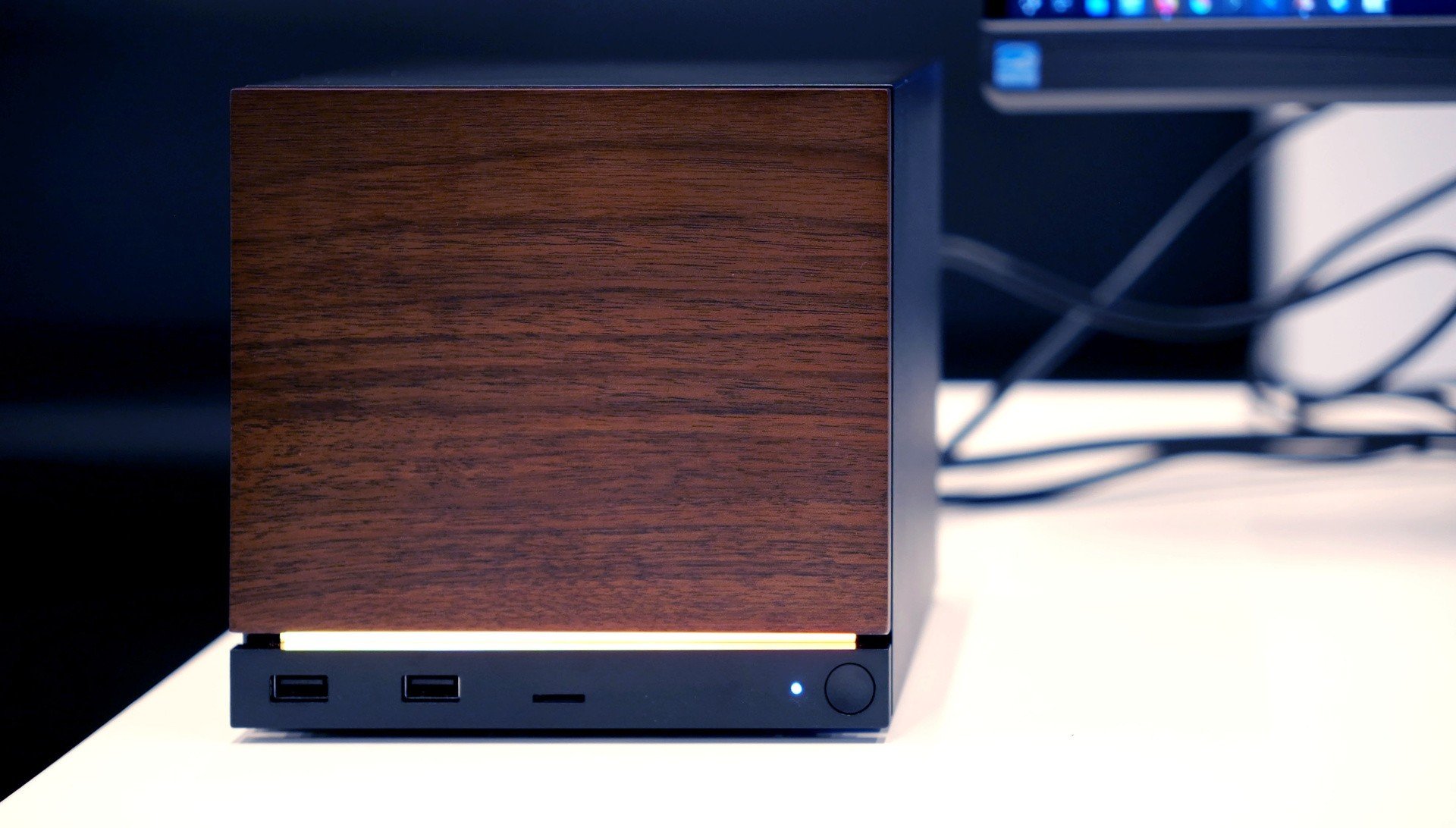
In a very cute touch, Valve showed us replaceable Steam Machine covers, as enabled by magnetic mounts. We got to see a few options that looked great - and that Valve would not commit to necessarily making and selling to customers. That's is a shame, because these included a handsome wood-grain cover and a trippy, customisable e-ink display (that one they were firm on not making and selling). Valve will release 3D CAD files for the sake of users making their own.
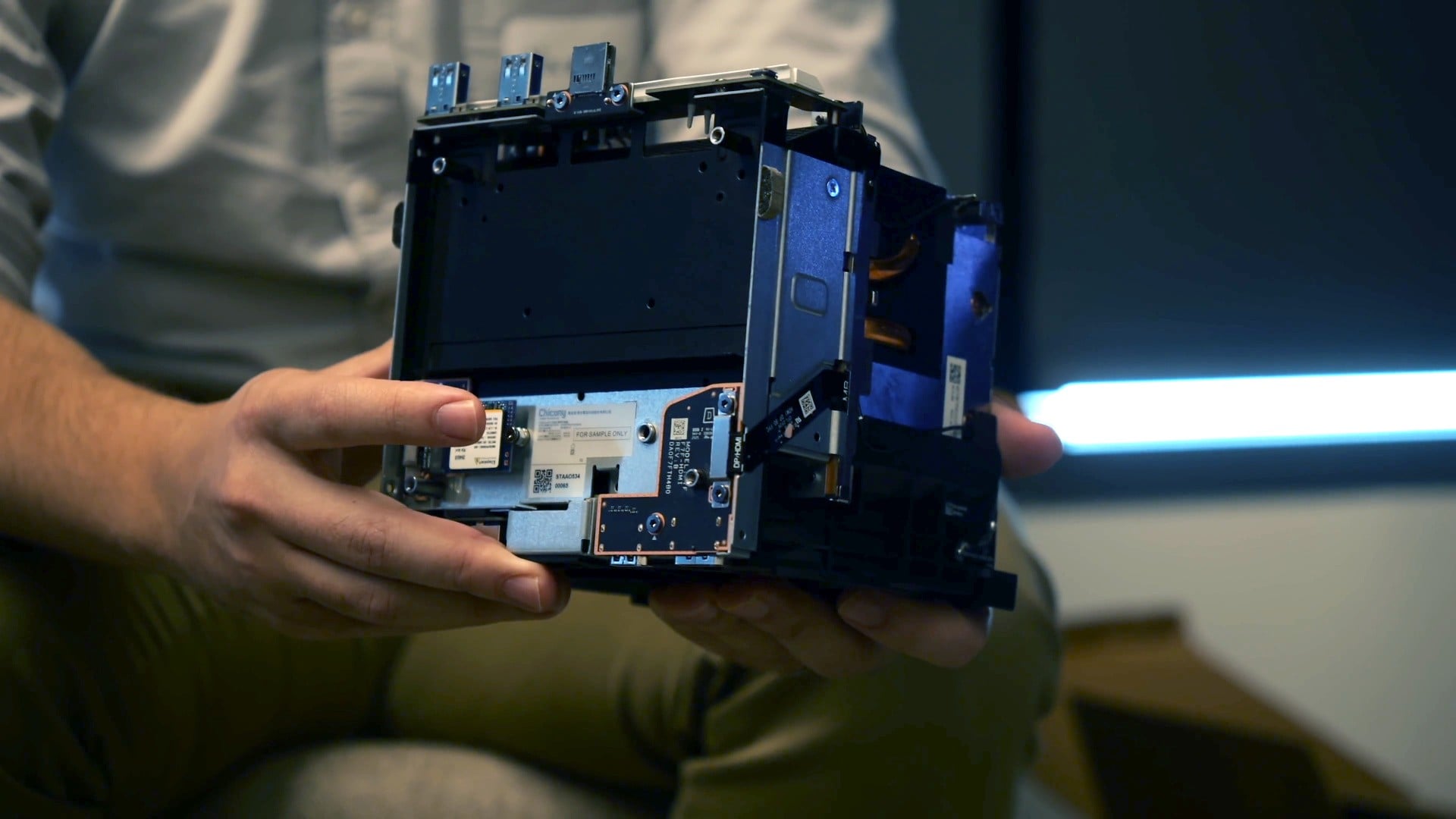
Valve was generous enough to pop the hood on Steam Machine and show us a remarkable attribute: its gargantuan thermal module. This thing takes up a whopping 70 percent of the system's internal volume, and Valve reps say its copper heat pipe design was inspired by server thermal modules.
And to some extent, Steam Machine's cuboid shape was set in stone by the engineering decision to have one fan mechanism cool every component. As one hardware engineer put it: "It was not like, oh, we want to make a cube. It was really like, how can you cool all these things with a single fan in the smallest form factor possible?"
Clearly, heat dissipation and reduced noise are a priority for Valve's engineers, and they have designed Steam Machine with an expectation that it will land in closed-off living room entertainment centres, where airflow isn't guaranteed. "We have more CFD [Computational Fluid Dynamics] hours on this thing than an F1 team," another Valve rep joked. We look forward to testing how smoothly and quietly it functions.
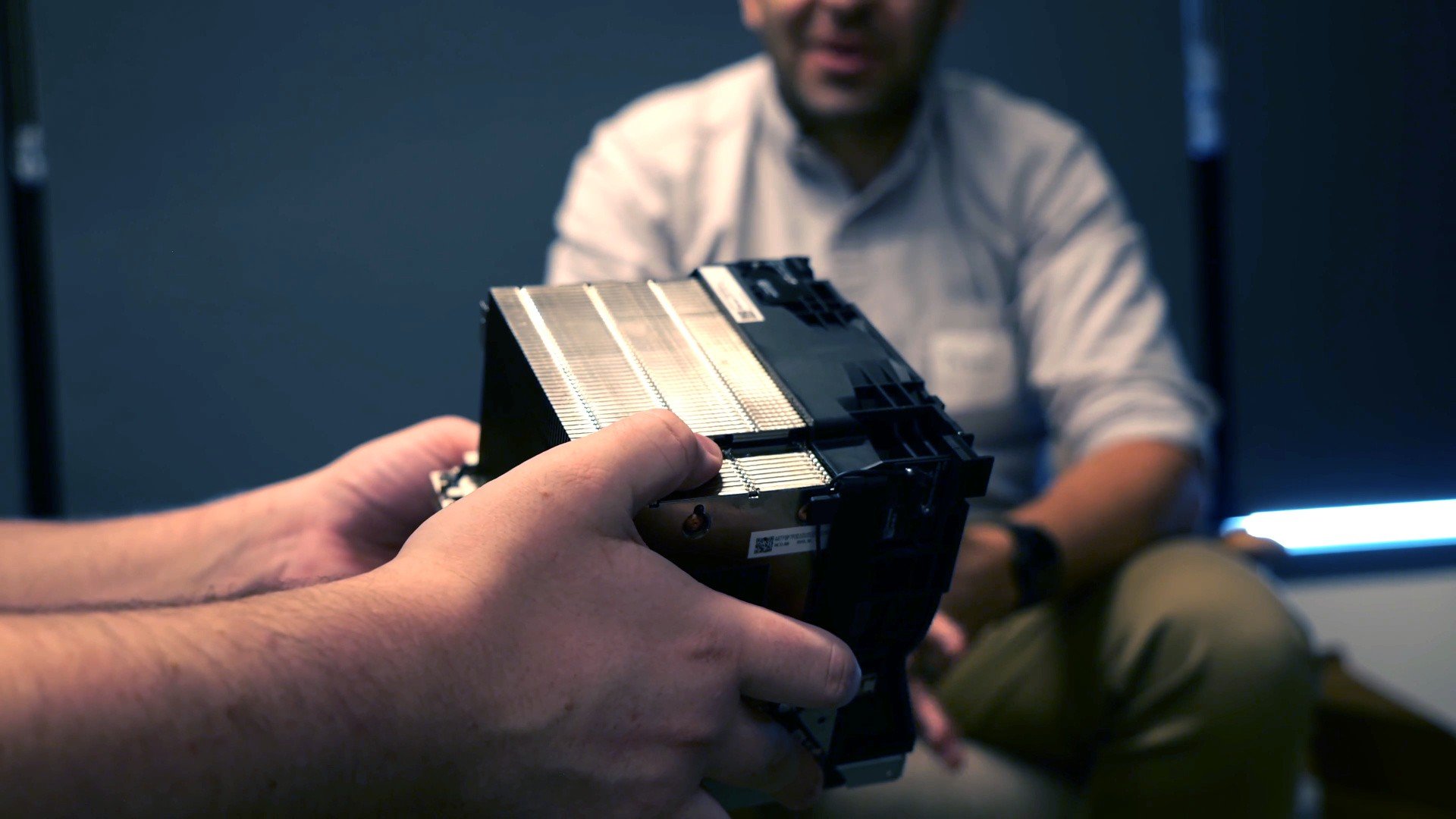
Valve has confirmed that users will be able to manually upgrade Steam Machine's built-in storage, and the motherboard's M.2 slot supports both 2230 and 2280 form factors. Both of the system's SODIMM RAM modules are also user-replaceable, though these will be trickier to access, and we're not 100 percent sure that Valve won't eventually add any kind of warranty-voiding stickers to its motherboards on that front.
We confirm a few other things - but not price
FSR 4 support has not yet been formally announced for RDNA 3 GPUs, and Valve representatives had nothing to add to that beyond their own hopes that Steam Machine will indeed receive driver-level FSR 4 support from AMD. We sure hope so, especially after having tested the upcoming upscaling technology on RDNA 3 GPUs via a leaked build - and finding its improved fidelity being worth an added performance cost compared to FSR 3.
For a power-limited system like Steam Machine, built-in, wholly supported FSR 4, especially with Steam Machine-optimised settings, could go a long way towards making the system's fixed ecosystem more attractive. We do expect it to work at some point, bearing in mind that the same leaked FSR 4 build has already been modded into Steam Deck. But if this is to be a living room-friendly, console-like device, we really hope Valve goes to lengths to make sure features like FSR 4 don't force device owners to tinker endlessly.
Somewhat related: as it's done for Steam Deck, Valve is moving forward with a Steam Machine Verified tag for games sold via Steam. This tag will encompass compatibility with the Proton translation layer and formal support for the new Steam Controller, since Valve expects Machine owners to default to its included gamepad.
For those who plan to use Steam Machine as an all-in-one living room box, be warned. Your favourite streaming service will need to function on Linux web browsers. Valve has no plans to offer bespoke media-streaming app downloads via the default SteamOS interface, and as you can currently test on Steam Deck, some streaming services' DRM implementations block access to Linux-based browsers by default.
We still don't know what Steam Machine will cost, and that number will likely colour our future impressions and thoughts. $399 for this combination of specs would go down a lot more smoothly than prices that reach or exceed current-gen consoles with, at least on paper, seemingly superior specs. We don't envy Valve or, really, any gaming hardware manufacturer that has to reckon with rising component prices in 2025, and there's a chance that number will be higher than consumers and Valve alike won't love.
If the price gets quite high, then it will be up to Valve's own software engineering efforts and optimisations to earn that price tag. A good-enough Steam Machine that can contend with the biggest 8GB VRAM offenders, exceed Windows performance on like-for-like hardware and squeeze out competent RT performance in select games would certainly be dreamy - but it's a dream at this point, not a reality we can test.
For more on today's Steam Hardware blitz of news, be sure to check out our extensive report on the new Steam Frame VR system - and its incredible magic trick of translating x86 code to ARM64 architecture.

Comments 37
What specific hardware component in the Steam Machine do you guys think is the biggest limiting factor for achieving Valve's stated 4K/60fps performance target?
You would think they might have tried a little harder with the GPU. The thing is supposed to be semi custom isn't it? People go to AMD because they have all the parts you can knock together, they have the best custom silicon team after years of console and NUC experience. I wouldn't expect a high end machine, because that was always the preserve of the PC market. However it seems like a missed opportunity to have something with 10/12GB of video memory at a minimum. Where's the 3GB GDDR7 memory modules for example? It seems a perfect fit for a machine like this.
Sounds very interesting but I can’t help feel like I’d rather pay a bit more or even double and just get a decent PC instead.
if i hadnt just bought a steamdeck, id probably hold out for this! but, no regrets I love my steamdeck! 🥰
the controller OTOH is a day one, exactly what i dreamt of when i imagined a new steam controller. so pumped!
Not really supprised by this but i would of wanted better specs to be honest. Love the new site , and thank Sam for the article.
Price will be all important. For the specs it SHOULD be cheaper than PS5 but will it be? Also only having an 8GB VRAM option is disappointing for 2 reasons.
1. It will prolong 8GB being base level
2. It will limit what this can do.
Either way it's pretty exciting, but personally i'd want higher specs.
UPDATE Steve from Gamers Nexus said Valve hinted it would be priced more like an entry level PC than a console.
I left PC gaming behind about 15 years ago as I began to value not being at a desk in my free time and limited myself to consoles. This would appeal to me, to open the door to PC gaming in that space, but not at specs that are less than the now fairly old PS5 that already resides there. Surely there must be a niche for a fairly expensive version of this. Maybe that's what we'll see with the next X-Box.
The way I see it, it's a device like Steam Deck, in which we work with its constraints. But for a desktop/tv target.
Now, it's unfortunate its gpu has 8GB of VRAM, but the rest seems quite interesting.
The thing I'm wondering is, if Wifi/Bluetooth is built in or on a M.2 pcie slot.
Also, perhaps it's the blueprint of a desktop/tv experience for SteamOS 3, and going forward, we could build some PC beyond this Steam Machine, with SteamOS.
Question for Phil Spencer: is this a Xbox?
If yes it is a GREAT one thanks Phil!
Seriously I'd buy a pro / next gen version of this to be my main TV console. Coming from owning XSX, PS 5, Switch, aging HTPC, my future setup could be :
PS 6 being an option for faster access to Sony exclusives, but honestly at this point I never play games at releases so it feels a bit unnecessary.
@NandoCalrissian They suggested OEMs might build different specifications. But hopefully they release Steam OS and we can build our own systems with better specs but still take advantage of things like boot/instant on from the controller and immediate resume, like Steam Deck.
They mention the average Steam user's GPU - shouldn't it be the average upgrade? People aren't replacing their 3060 to get an AMD equivalent, so what's the average upgrade look like? That should be the target.
Perfect time for DF to have its new website. Some lovely traffic today with all the great coverage.
Damn, I'm pretty hyped up for this thing but it seems a bit too underpowered for 4K60 gaming.
Hopefully it gets priced around the $500-600 mark, if not it's kinda DOA for me.
I think this could kill the Xbox entirely.
Really interesting to see Valve taking another shot at this. The specs look solid somewhere between Series S and PS5 is a decent sweet spot for a living room box. My main concern is the price though. If they can keep it competitive with consoles while delivering that PC flexibility and SteamOS maturity, this could actually work this time around. The original Steam Machines were a mess with 14 different manufacturers, so at least having one unified spec makes way more sense.
I’m struggling to work out who the target audience for this is? Is it PS4 users who have yet to make the next gen leap (why would they leave the PS ecosystem system?). It can’t be existing PS5 or X/SX owners. Surely a PC enthusiast looking for a similar build would just…. build their own and probably do it with better specs? Sure they would be still tied to Windows and wouldn’t be benefitting from Steam OS.
I’m failing to understand the love DF are having for this ‘console’? Am I missing something?!
As something of a PC dunce (I built my last rig in 2015; I now use an employer-supplied laptop), my #1 question is: what existing console does this most-closely resemble, in terms of capability? Xbox Series S? PS5?
As a listener of your podcast, I was flabbergasted to hear the (imo disingenuous) episode on Playstation Portal, and found the surprise podcast on the new Steam Machine to be rosetinted. Not great for the overall credibility of the new DF.
I am left wondering:
Is it true that this piece of tech punches below the weight of an PS5? The PS5 was conceived 7 years ago, releasing 5 years ago..
Is it a coincident that the podcast earlier dumped on PS Portal using old data, and promoting a whole other streaming product with DF knowing that were going to push the marketing of a streaming console the very next day?
It is funny that people are saying it is coming for Xbox and Playstation. Xbox is already dead, killed by PlayStation and the first Steam Machine compared to the juggernaut that is Playstation didn't seem to fare much better.
Lastly, where are the games specifically for the Steam Machine? Are they relying on Xbox and PS for their content?
Should have had a 10 or 12gb GPU.
8gb won't last much longer, even at 1080p.
It will already struggle with demanding titles, especially UE5 games.
Even Switch 2 have between 9-10gb available.
At $399, sure, but higher than that, nope.
I expected much better specs...
But if this sells, maybe they'll make a "Pro" model.
@eFYIPS Have you actually used a Playstation Portal for an extended period of time? The latency with that device is terrible, and those who say there's none are just the type of folks who will never notice it. DF's analysis of the device is fair.
SteamOS faces more than just one challenge. Games with anti-cheat (call of duty, battlefield, fortnite). There are also many games with issues such as crashes, graphical bugs, and FPS drops, because DirectX calls are not properly translated. And I think this will only get worse over time, especially with the increasing use of specific technologies (ray tracing, DLSS, upcoming Auto SR, …). Studios develop natively for Windows, not for SteamOS, and that’s not going to change anytime soon, for a very simple reason: a PC is not just for gaming, and Linux will never be able to rival Windows in terms of versatility and software compatibility. This is both a strength for Windows and a challenge in terms of performance. So I don’t see the masses switching to Linux just for gaming.
And I’m not even talking about modding, which is very complicated on Linux, while many PC gamers are very attached to it. Or other gaming-related tools like Streamlabs, XSplit (no Linux equivalent), etc.
Many launchers don'y play well: epic, Xbox app, battle.net, EA app, ubsifit connect, rockstar games launcher, GOG, etc.... No native support for Game Pass.
Many recent DirectX 12 games run very poorly on SteamOS: The First Descendant, Final Fantasy VII Rebirth (Epic version), Forspoken, Starfield, Elden Ring (especially at launch), Star Wars Jedi: Fallen Order, Red Dead Redemption 2 (a game that often crashes on SteamOS), Cyberpunk 2077, etc.
I don’t even want to imagine GTA 6 when it comes out , it’s almost certain it will be nearly unplayable on SteamOS.
And I’m not even mentioning the weak power of the machine or their controller, which I really don’t like at all.
@JJtheTexan The specs suggest it would perform somewhere below a PS5, but better than a Series S. That said, the CPU should be a decent amount more performant than that found in any of the current consoles. The main concern is the GPU performance.
@LooneyMango thanks! That's about what I expected. Surely this is going to be marketed as a sort of entry-level living room PC that can play most Steam games competently, with that sort of performance.
I'm guessing around $500? Maybe less
We're settled on calling this the Gabecube, right?
Would like a more powerful option. Steam Machine Pro, anyone? Ha.
I wonder how much this thing is going to cost. If it’s something like $799+, they’re going to have a lot of people thinking “eh, I’ll just get a PC.”
But there are advantages to having a dedicated Steam box. I’d like to see it do well. The specs seem good enough, if the price is right. I'm sure they've put a lot of thought and research into it.
I have 400+ games on Steam.
I dont need to pay to play all my games online with premium quality.
I dont need to pay to have cloud save.
When you buy a game on Steam Store, the game is yours forever. You dont need to buy the same game again, or pay a fee to play the same game on a new hardware.
The games are cheaper. The best prices are on Steam.
I´ll buy Steam Machine Day - 1.
Today I play 80% Steam Games, 20% Nintendo Games.
I play Steam Games on: Gamer PC, Steam Deck Oled, Rog Ally X, Ipad Pro (steam Link) and TV (rog ally x or Steam Deck).
But I´ll have Steam Machine, so I can take it to play my 400+ games with my friends easily anywhere I go.
Steam is the winner here. I love Steam. The best thing in this game industry.
@Bigmanupstairs
I wouldn't criticize them if I hadn't experienced something a lot better. If you actually read my comment, you might realize they are judging it on old data.
The experience has improved with the new update, and they didn't bother finding out.
That being said - take Vanisher's: Ghosts of New Eden. If played on a PS5 Pro it is absolutely amazing and the handheld cannot keep up nor would you expect it to.
I'm mostly worried about the 8GBs of Vram, I don't play that many graphically intensive games, but it would be nice to have for more modern titles.
I've also had alot of compatibility issues on my Steam Deck, but that might be because I play alot of mid range / AA japanese games that usually don't run optimally to begin with. so I kinda wonder how it will be on the Steam Machine 2: GabeN Boogaloo.
@GrizzleyPete at least for me personally, I’m someone who has historically been a console gamer who occasionally plays an old pc game on whatever laptop I’m using at the time (any pc gaming I did died when I switched to MacBook). Currently I own a ps5, switch 2, and steam deck (and don’t pay for Nintendo online or ps plus), and my steam deck has quickly become my go to for playing games to the point that my ps5 and switch 2 are getting used less and less. The steam machine would be the perfect fit for me as someone who 1) wants to move away from consoles altogether since I get multiplayer and cloud saves for free, plus ps exclusives on pc, and 2) doesn’t want to touch a windows pc. Yea the specs could be better, but the trade off for something that’s closer to the convenience of a console while still being a pc is worth it.
@SodaPop8456 Only if Microsoft don't manage to kill it first!
Advertising this as "4k, 60fps with FSR" capable is incredibly disingenuous. I expected more honesty from Valve.
@SteamyDeck I guess that’s cool if you’re happy playing old PC games. But I still think you’re a niche and not representing the majority. As a PS5 and Switch 2 owner, you’d surely use the PS5 to continue to buy current gen and Sony exclusive games over the Steam console unless you’re willing to wait for the PC PS5 exclusives or play your games at a lower spec. Your Switch 2 is surely there to play the Nintendo exclusives… maybe a game like Cyberpunk which again is going to run better but be more expensive?
I mean you’re still shelling out the £400+ to play Steam discounted games, that £400 could still be put towards a lot of games on the PS5/Switch 2.
But heh, each to their own, if you’re excited about out it, smashing
Automatically beats out current gen consoles. Simply for the fact that the steam library is incredibly vast and based on the steam desk, we can access higher frame rates, unlike games on consoles where the developer has to make a patch. This sucks though at the same time because physical game collectors are stuck with the worst versions of the games.
@GrizzleyPete Since buying the steam deck I've been buying all third party games on steam, and even many new releases are steam deck verified so I don't feel like I'm cut off from newer games. I know I'm trading performance for portability, but I don't mind. Right now I've been playing Persona 3 Reload and Death Stranding, and I can also play my top multiplayer games with friends (Overwatch, Phasmaphobia, Deep Rock Galactic, etc.). Gaming is where I do most of my socializing, so being able to play multiplayer without paying for an online subscription through Nintendo or Sony is a big deal, and offsets the cost of a steam machine pretty quickly.
I have a few Sony exclusives on my PS5, but I don't buy games at launch and I'm always working through a backlog, so I have no problem waiting until they launch on PC. By the time I bought God of War Ragnarok it'd been on steam for at least a year.
Nintendo is weird because I grew up loving their franchises, but I've either grown indifferent or actively don't like the direction they've taken certain series. I barely used my Switch 1, and I thought the extra horsepower and bigger screen would get me to play my Switch 2 more, and that has not been the case. I'm cautiously optimistic about Metroid Prime 4, but otherwise I can't muster any enthusiasm for their other exclusives and think I'll stick to emulating my favorite games.
So yeah, still certainly niche, but a great fit for me for the above reaons.
Can we assume that it's going to run Half-Life 3 at 4K 60fps with FSR upscaling?
I'm very excited by this machine - I know I don't need one but there's something about the gamecubesque form factor that appeals to my inner nostalgic lizard brain.
Show Comments
Leave A Comment
Hold on there, you need to login to post a comment...