
 by
by 
In what may be the Video Game History Foundation's largest combined release of preserved software and data since its founding, the American non-profit has released a haul of 144 previously unavailable Sega Mega Drive and Genesis ROMs connected to the Sega Channel - one of the world's first formal game-download services.
This subscription service functioned exclusively in North America in the 1990s as a partnership with cable television providers, and it employed a special Genesis cartridge that connected via coaxial cable to a data network. Paying subscribers could download a variety of games via its limited on-board memory, with those games cycling into and out of availability until the service was shut down in 1998. A few Sega Channel games have been preserved over the years, and the same goes for games from other early game-download services, such as the Super Famicom's Japan-exclusive BS Satellaview.
But unlike Satellaview, Sega Channel's adapter cartridge didn't locally save data, which has made preservation of its contents much tricker. That makes this week's treasure trove all the more remarkable, as it appears to cover something approaching the entirety of the service - not just games but apps and general Sega Channel interfaces in both final and prototype forms.
Some of the games had only existed on Sega Channel and previously evaded being "dumped" as offline, standalone ROMs. We can finally see how the "Lost Levels" add-on pack for Garfield: Caught in the Act worked, which bundles three levels that had been cut from that game's console versions and pairs each with a brief "director's commentary" explanation. Contemporarily, its Sega Channel-exclusive launch made sense - a subscription-service value-add that would have been a non-starter as a pricier retail cartridge.
Other previously undumped Sega Channel games include a Mega Drive port of the Ocean-published Flintstones-movie platformer, a MD-specific port of Alexey Pajitnov's puzzle game Breakthru, the first-person tank-combat game Iron Hammer - which had ties to the unreleased Sega VR headset - and a Berenstain Bears game port from the edu-tainment Sega Pico console to Mega Drive. The latter can crash when played on certain Genesis and Mega Drive emulators, since they parse the ROM as native Pico software instead of reading their MD-specific code.
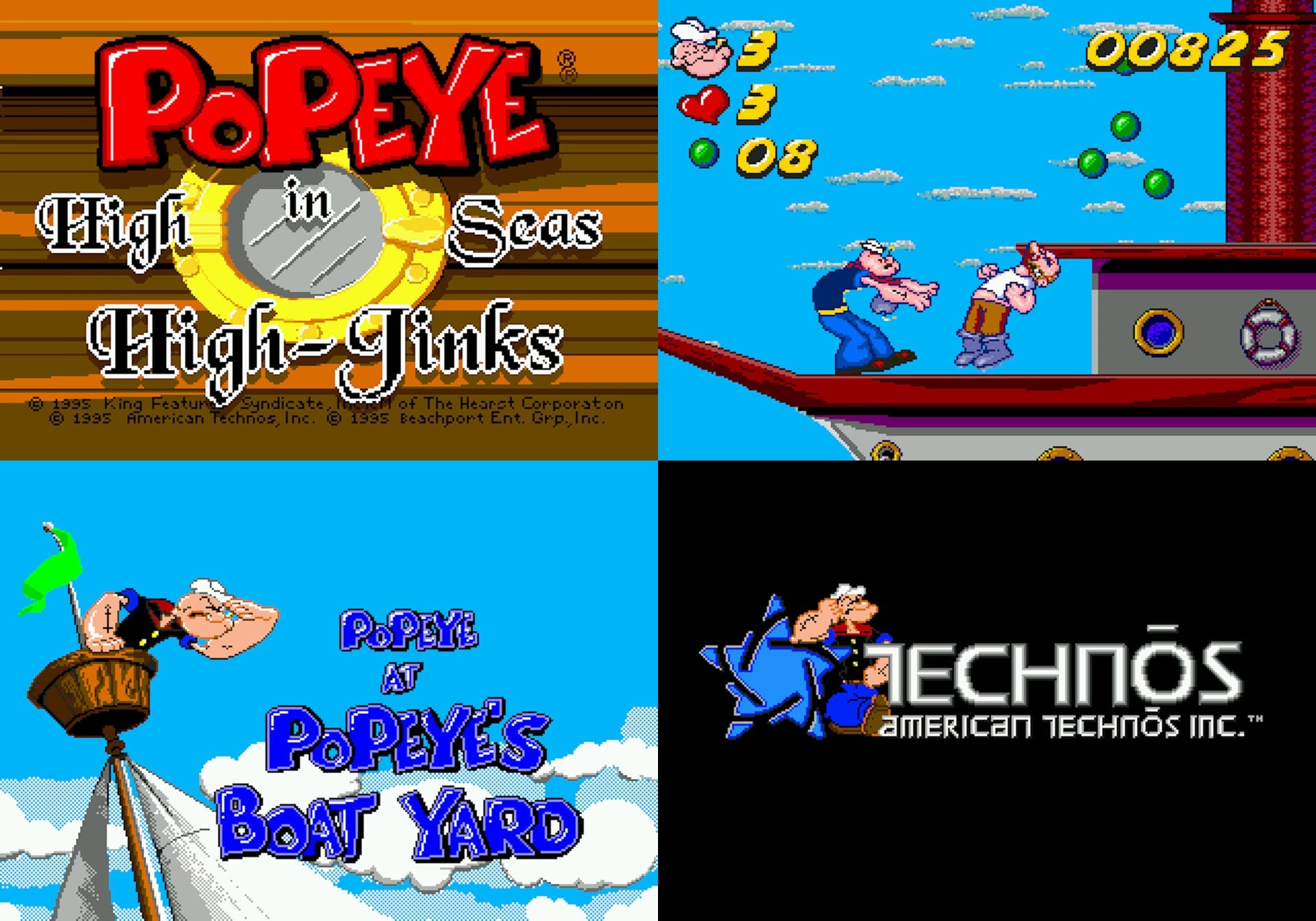
The prototype ROMs in this week's collection have not previously existed in public or playable form. The side-scrolling action game Popeye in High-Seas High-Jinks by American Technos, Ltd stands out due to its near-complete status, handsome graphics, complete cutscene panels and generally solid gameplay. UK developer Images Software also appear in the dump with a previously unknown game titled of Shadows of the Wind, and it's in a clearly unfinished pre-alpha state with so much missing content that it may have been used to pitch the project to publishers.
Recovery across the Sega Channel collection came in multiple forms, according to VGHF Library Director Phil Salvador, such as debug cartridges, CDs and tape backups. These materials were largely provided by former Sega VP of Programming Michael Shorrock and the pseudonymous VGHF community member Sega Channel Guy. At one point, data recovery efforts were slowed by a struggle to parse one of Sega's ancient file formats, up until another parallel data-recovery effort turned up a Sega Channel-specific decryption tool that had been anonymously uploaded to Github in 2017 - hiding in plain sight.
Arguably the most surprising discovery in VGHF's latest collection is a previously unannounced app called the Sega Channel Genesis Web Blaster. This fully functional web browser may have been the first ever on a gaming console, and it was developed for eventual Sega Channel implementation but never went live for subscribers. As provided by the VGHF, the Web Blaster ROM includes a home page and offline downloads of its hyperlinks' code and images in order to support rudimentary "browsing" through family-friendly links and content.
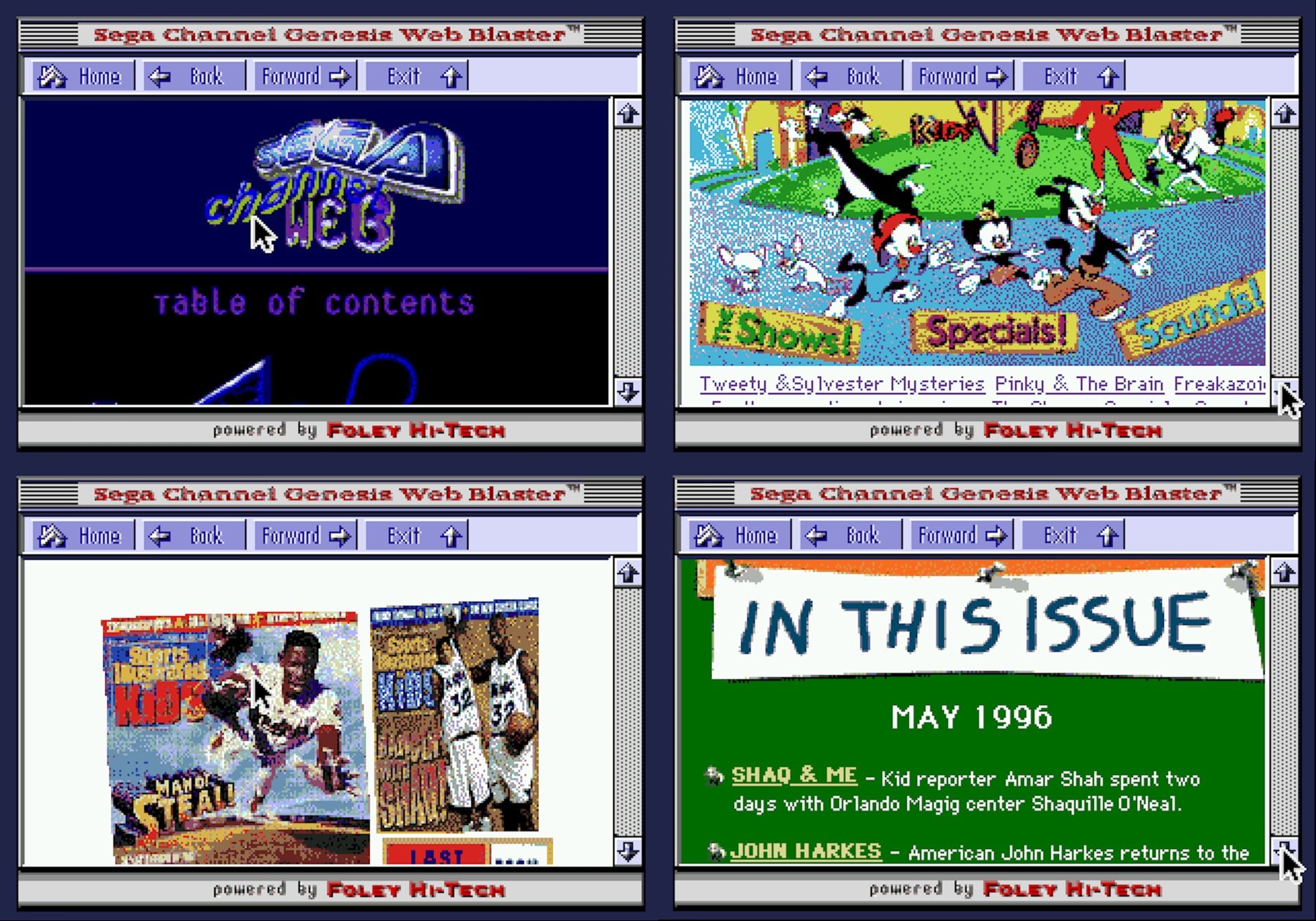
What's more, the Web Blaster ROM includes a debug menu that points to the same framework used in 1994 Mega Drive game Michael Jordan: Chaos in the Windy City. That game's studio, Foley High-Tech, are credited for Web Blaster's development, as well, but it's still interesting to see web page rendering and basketball-tossing action built upon a possibly identical same codebase.
Other ROMs include standalone apps that never saw public launches, which include pre-launch GUI tests with more cartoony elements, a mock-up for a Sega Channel "magazine" called HookedIn and a screensaver app with screen-filling animation options like a virtual fish tank. And while the Sega Channel rollout was quite limited geographically, the data dump includes test ROMs that could have rolled out in Chile and Argentina.
Some of the recovered data comes in the form of "videohints" ROMs - where a game plays itself via pre-recorded inputs to demonstrate tips and techniques in games like Earthworm Jim. Speaking of, one Earthworm Jim ROM variant includes a contest that asks players to hunt for a secret code, then call a Sega phone number to report the code and claim a prize. Checking that ROM's source code reveals what that secret code is, but VGHF has yet to figure out how to trigger the code in the customised version of the game. By the time you read this, early downloaders and testers may have already found the puzzle's solution.
Due to Sega Channel's 3MB ROM size limit during its operating period, some popular games were split in half, either putting single-player campaign progress behind a password in the second ROM or having a fighting game's roster divided between two downloads. Now, we can access every one of these data-sparing ROMs. This leads to awkward roster-splits in Mortal Kombat 3 - where Liu Kang cannot fight Sub-Zero - and Super Street Fighter II - whose Sega Channel-exclusive version outright deleted Ken. Yes, Ken!
In an email interview with Digital Foundry, Salvador confirms that the foundation has tested the full selection of ROMs on both original Genesis hardware and software emulators, though he notes that a few of the ROMs did not immediately function properly on hardware emulation options like the Analogue NT Mini.
For more on the VGHF's recent discoveries, visit the non-profit's blog post or access the 140-plus ROMs as hosted by Gaming Alexandria. We're also keeping our eyes on the VGHF's announcement from last week about its work restoring and completing a nearly-finished Chris Oberth NES game for retail release in early 2026, which is currently available for preorder as a physical cart with all proceeds going to VGHF.

Comments 6
I grew up in Upstate NY in the 90's and my mom worked for Time Warner Cable. We were one of the first in our area to test out the Sega Channel concept--It was amazing!
What a trove! Amazing work again from VGHF!
Maybe Salvador meant the Analogue Mega SG? The NT Mini is a Famicom and NES FPGA console.
This is a fantastic news for game preservation. Love it.
This is fantastic and great article, exactly the kind of stuff I love.
Especially as I've never experienced Sega Channel firsthand and have for years been extremely curious how the whole thing worked. Yeah just amazing preservation and very cool, reminds me a bit of the eXoWin9x project.
I love any mention of the Pico. I had one as a kid and it almost feels like a fever dream because no one ever talks about it. Do cool to see more stuff preserved.
Show Comments
Leave A Comment
Hold on there, you need to login to post a comment...