
 by
by Originally envisaged as one third of a Valve hardware push that included a new Steam Machine and Steam Frame, the Steam Controller instead arrives alone on the 4th of May for £85 or $99. It's a chunk of change more than your typical first-party Xbox or PlayStation controller, but the new Steam Controller rolls in a unique PC-focused feature set that pushes mouse-like inputs to the forefront while still offering the pro features and classic console controls kids crave.
Out of the box, the Steam Controller presents a minimalist, practical ethos. The controller ships with a dedicated 2.4 GHz wireless puck that acts as both receiver and charging base when connected to a PC, while a USB-C to USB-A cable is included but USB‑C to USB‑C cable is absent. Setup is intended to be seamless: plug the puck into your PC and press the Steam button on the controller to pair. While standard Bluetooth remains an option, Valve's own wireless puck is explicitly designed to deliver a higher‑quality, lower‑latency link, particularly important in RF‑noisy environments where Bluetooth may struggle with interference from Wi‑Fi or multiple connected devices.
Ergonomically, the design leans heavily on the established strengths of the Steam Deck while refining it for standalone use. The layout offers a familiar suite of controls - d‑pad, face buttons, shoulder buttons, triggers and rear paddles - but the analogue sticks are placed in a symmetrical, slightly elevated configuration reminiscent of a PlayStation pad rather than the staggered Xbox arrangement. These sticks use TMR (tunnelling magnetoresistance) sensing rather than traditional potentiometers, which dramatically improves long‑term durability and resistance to stick drift, while drawing less power than Hall Effect alternatives. The shell itself is relatively large but feels lighter than you might expect, with a more overtly ergonomic grip than the Steam Deck in typical gaming positions.
The controller's standout hardware feature is its pair of haptic trackpads, mounted low on the face and angled naturally towards the thumbs. These pads provide detailed tactile feedback both as the thumb glides across the surface and when clicked, creating a precise sense of positional awareness without the need to look at the screen.
Face buttons, shoulder buttons and the the d‑pad employ a soft travel rather than a sharp mechanical click, echoing Sony's approach. The triggers feature a comparatively long throw, but there are no adaptive trigger haptics, resistance mechanisms or specialised trigger vibration. The four rear buttons have a firmer, clickier feel with moderate travel, sitting somewhere between soft paddles and short‑throw microswitches.
In conventional controller‑focused titles - eg racing games, shooters, and open‑world action games - the Steam Controller performs convincingly. Steam Input recognises the controller and generally loads workable profiles automatically, with community layouts built for the Steam Deck transferring neatly due to the near‑identical control schema. Titles built around Xbox or PlayStation pads, such as various racing games, Doom: The Dark Ages, Grand Theft Auto V and Cyberpunk 2077, all run without significant friction.
Nonetheless, there are caveats. The lack of vibration triggers weakens the tactile experience in driving games, and the overall rumble implementation remains comparatively coarse. Standard Xbox rumble data is translated into the controller's haptic motors, rather than exploiting ultra‑fine control in the style of PlayStation 5's DualSense, resulting in feedback that is effective but not especially nuanced.
The real step change appears in genres that traditionally demand mouse input, particularly PC MMOs and strategy‑leaning experiences. In World of Warcraft, for example, a controller‑oriented interface mod can shift most interactions onto buttons and sticks, but historically the remaining mouse‑driven elements have limited the practicality of couch play. Here, the dual trackpads finally bridge that gap.
Positioned under the thumbs and enhanced with detailed haptic feedback, they provide a far more accurate and comfortable cursor control method than the single top‑mounted touchpad of a PS4 or PS5 controller. This makes low‑to‑mid intensity content - questing, casual dungeons, general world navigation - genuinely viable on a controller. The same strengths naturally extend to desktop navigation and web browsing, where the Steam Controller functions as a credible stand‑in for a laptop trackpad while retaining full gamepad ergonomics.
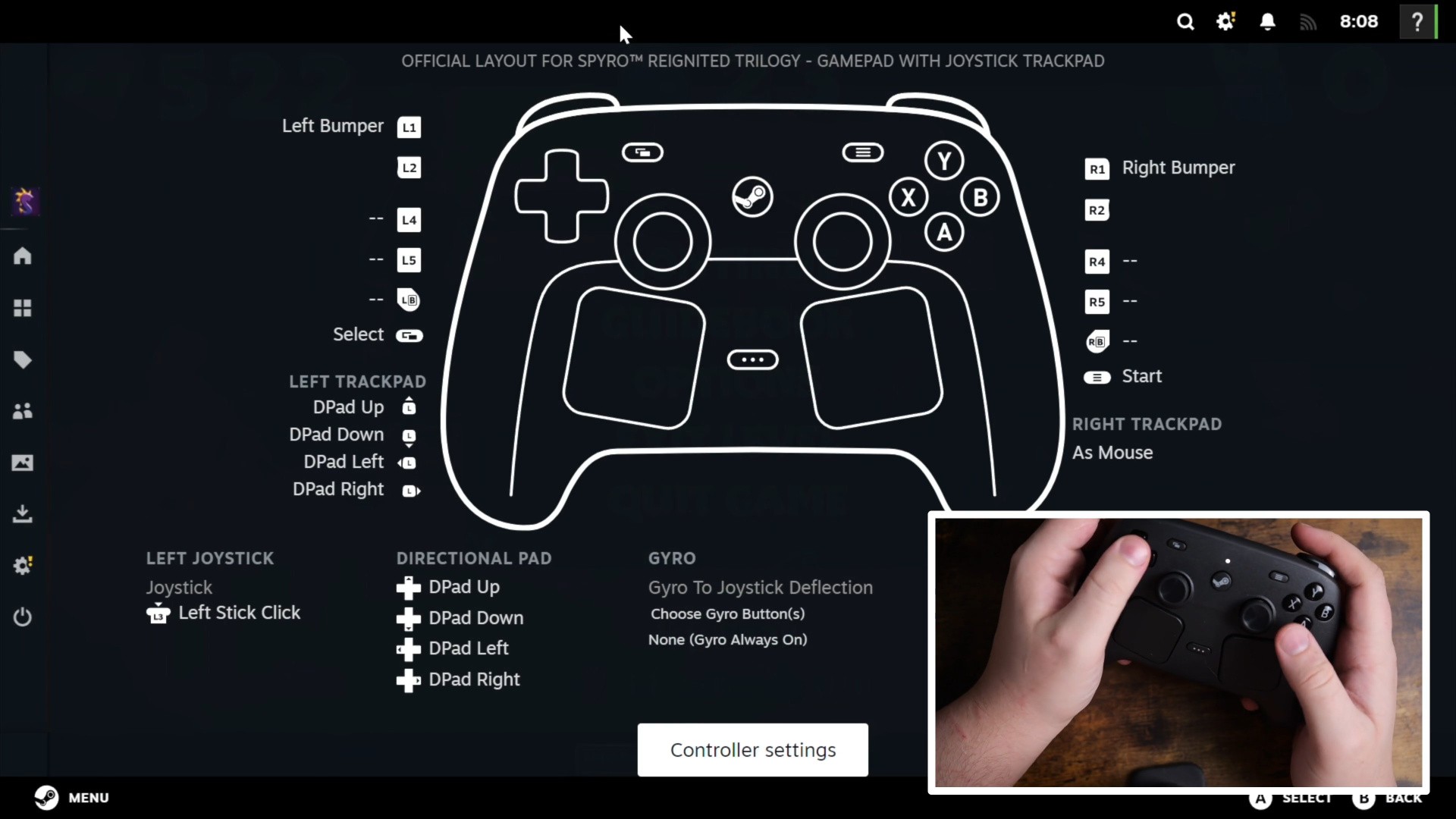
These advantages are underpinned by deliberate architectural choices that tie the controller closely to Steam's ecosystem. On Windows, the device identifies itself primarily as a composite keyboard, mouse and trackpad, rather than as a straightforward XInput gamepad. This is ideal for general OS navigation and non‑game tasks, but it does mean that titles must be launched through Steam - either natively or as non‑Steam shortcuts - to exploit Steam Input's remapping and advanced feature support. This approach is expected to cover the overwhelming majority of games, but certain categories, such as older UWP titles, may prove more problematic.
Valve's rationale for the decision is that exposing the controller purely as an XInput pad would effectively discard the trackpads, rear buttons and other extended features, since XInput assumes a standardised Xbox layout, and adding a way to toggle it on would increase the complexity and cost of the device without any huge pay-off.
Cost was clearly a big motivator, too. The $99 price point puts the Steam Controller between standard (~$55) and Elite-style (~$150-200) console controllers, but in terms of features it's much closer to the latter. Instead of focusing on console features or even compatibility though, the new Steam Controller feels like a genuine first-party pro controller for the majority of PC players that use Steam as their primary gaming interface.
For those who mainly want a familiar pad for standard console‑style games, an Xbox controller remains a safe and compelling choice, supported by years of ingrained muscle memory and broad OS‑level compatibility. The Steam Controller can't match that and requires a short acclimatisation period. The symmetrical PlayStation-style sticks may feel particularly unfamiliar to those accustomed to staggered layouts, and it's possible to press the rear buttons unintentionally at first depending on your grip style - though the rear buttons smartly aren't bound to anything by default to prevent exactly these mishaps. This is a device that requires some level of physical and conceptual adjustment then, but that's no bad thing.
On the technical front, the controller offers functionality that reinforces its enthusiast credentials without fully entering ultra‑premium territory. Up to four controllers can connect to a single puck, and up to sixteen across four pucks, which is more than sufficient for local multiplayer setups or complex environments. The polling rate of 250Hz is robust and perfectly adequate for most competitive scenarios, even if some specialist esports hardware goes higher with 1000Hz or even 8000Hz pads. Independent measurement from outlets such as Gamers Nexus indicates around 20ms of end‑to‑end latency, which is solid for a wireless pad given that a top 1000Hz mouse, the Asus ROG Keris mouse, scored 15ms in the same test.
Yet some premium expectations remain unmet. There is no 3.5 mm headphone jack for direct audio passthrough via the controller, obliging users to rely on the PC's own audio routing or external wireless headsets. Nor does the unit offer trigger stops, modular thumbsticks or the deep physical customisation associated with the most expensive elite controllers.
However, that's largely made up for by the fact that durability, serviceability and long‑term sustainability have been clearly prioritised. The controller's shell is held together by a modest number of Torx screws, allowing straightforward disassembly.
Once opened, the battery is immediately accessible and can be removed and replaced without desoldering, using simple contact points rather than a permanently wired connection. While the thumbsticks are not designed as hot‑swappable modules, TMR sticks ought to require less frequent maintenance anyway. Combined with high‑quality materials and careful internal layout, this focus on repairability pre‑empts many of the complaints levelled at modern gamepads.
Overall, the Steam Controller emerges as a thoughtfully engineered, high‑quality device aimed squarely at PC players who want a seamless bridge between traditional gamepad play and mouse‑driven PC experiences - but it requires users to have, or to cultivate, use cases that make meaningful use of its unique strengths.