The performance lead in the GPU market tends to be Nvidia's to lose. By staying ahead of the curve technologically with architectures like Kepler, the cutting edge in GPU design is often held by the green corner, with the competition left to compete on value. However, the emergence of AMD's new high-end duo - the R9 290X and R290 - impacts this pattern of top-end dominance. Remarkably, both lead the tables for single GPU performance despite the latter selling for as little as £300, usurping both Titan and GTX 780 regardless of this disparity in cost. A quick response was needed, and in the Nvidia GTX 780 Ti edition, we have it - but at a launch price of around £550 this new product can't simply draw level; it must take a substantial lead to justify its immense price premium.
A quick look at the specs tells us that Nvidia is taking the resurgent AMD challenge seriously. GTX 780 and Titan were both based on Nvidia's GK110 chip, but each was pared back in its own ways. With the arrival of the 780 Ti, Nvidia has finally brought the full power of the chip to bear, meaning more performance than Titan, but with the most substantial gains found when compared with the vanilla GTX 780. The core clock rises from 863MHz to 876MHz, while GPU Boost has shifted from 876MHz to 928MHz when power and temperatures allow. These are relatively minor tweaks in the grand scheme, but it's just one part of the equation - more importantly, we get a huge jump to 2880 stream processors and 240 texture units.
Additionally, there's the crucial matter of RAM: the card's memory clock gets bumped to a phenomenal 7GHz effective, where its predecessor ran at just over 6GHz. Despite a smaller 384-bit memory bus, and the lesser 3GB GDDR5 capacity compared to its 512-bit and 4GB-sized AMD competition, the 780 Ti still manages to deliver the fastest bandwidth in the field at 336GB/s (compared to the 320GB/s of the 290X). Through this, the floodgates are opened for gaming at resolutions far beyond 1080p, though the question remains whether this is sufficient for fluid 4K gameplay.
Nvidia GTX 780 Ti specs
Based on Nvidia's latest Kepler chipset, the GK110, this Ti edition makes several marked improvements to the GTX 780, including core clock, memory clock and a boosted stream processor count. The price mark-up is still considerable at present though, going from circa £390 of the original GTX 780 to £550 as of writing.
876MHz Core Engine clock (928MHz boost)
3GB GDDR5 memory
1750MHz Memory Clock (7GHz effective)
384-bit memory bus
336GB/s memory bandwidth
5.63 TFLOPs Single Precision compute power
48 ROPs (2880 Stream Processors)
240 Compute Units
So all told, this is an exceptionally fast card that beats out the GTX Titan in every category. But more to the point, it also pips the AMD front-runner in almost all stats - the exception being 48 ROPs up against AMD's 64. In theory there are few reasons why Nvidia's latest shouldn't have an edge here over every other GPU on the market. This is the top-end Kepler finally unleashed, with improvements in RAM speed designed to counter AMD's ultra-wide 512-bit memory bus.
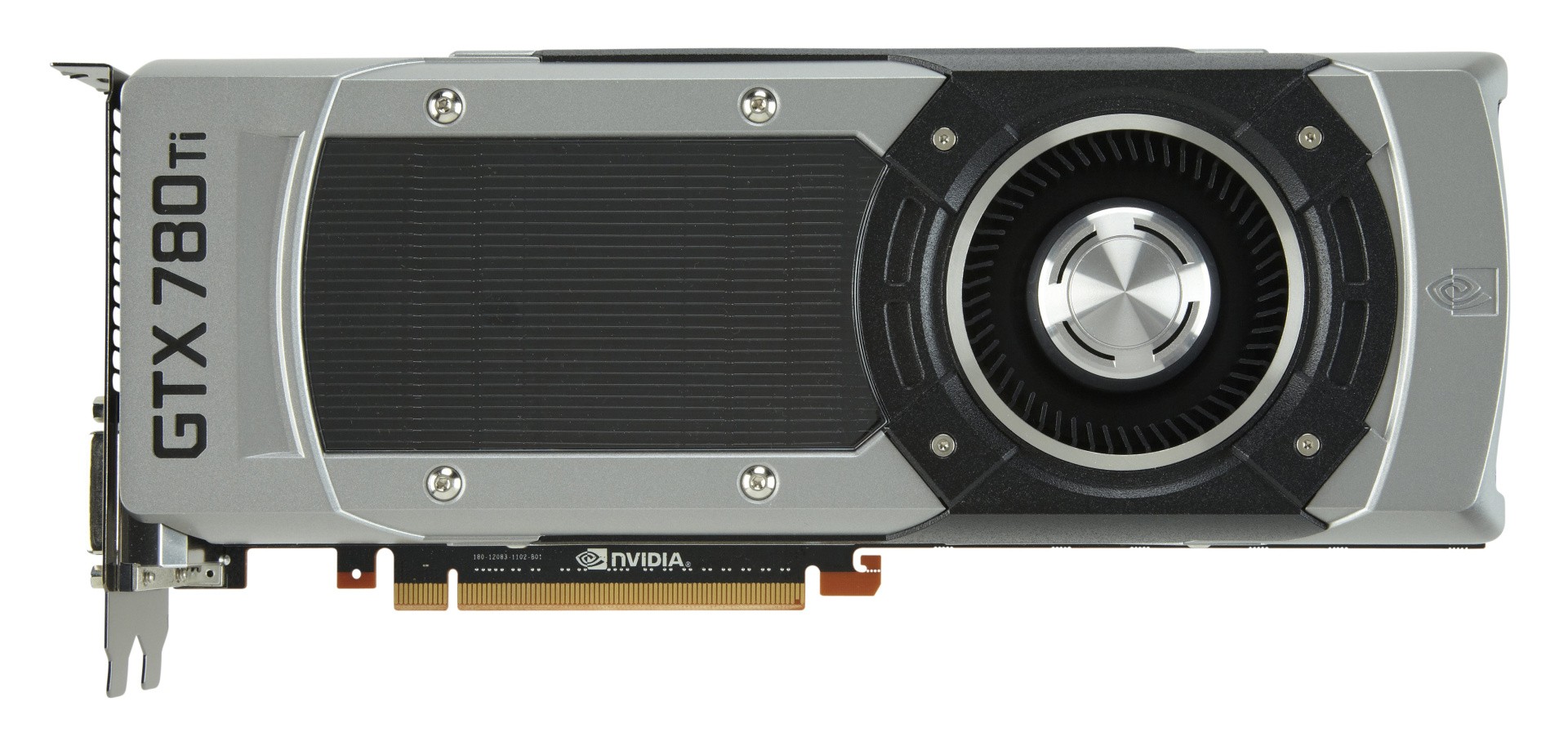
In terms of physical design, there are few surprises: the GTX 780 Ti is a single Kepler GPU housed in a double-slot form factor case, the total sum weighing in at 0.87kg. Much like the GTX 780, it sports a snazzy aluminium exterior with a dark fin array at its centre, plus grills to either end for divided airflow. For the money, it's a design that leaves the impression of a premium quality product overall, especially compared to the cheaper matte plastics used across the R9 290X. Meanwhile, the connections are standard fare: there are two DVI-D slots, DisplayPort (capable of reaching 4K resolutions at 60Hz), plus a single HDMI output.
Rounding off the connection list are the power inputs on its top edge, the card demanding both 8-pin and 6-pin PCIe connectors to juice it. This is typical for cards of this bracket, where a maximum thermal design power (TDP) of 250 watts is also an expected concession. Fortunately, the high power requirement doesn't have a negative bearing on its heat and noise output in operation - certainly in comparison to its immediate AMD rivals. The cooling system stays largely inaudible even at peak performance, the fan speed subtly adjusting to avoid sudden, jarring changes in sound signature. This is a huge point in its favour compared to the obtrusive noise and heat of the R9 290 models, which are designed to stick to their maximum temperature of 95 degrees Celsius, resulting in a lot of fan noise.
"Titan-level performance translates into a very similar gameplay experience across all the high-end cards we tested. The major comparison point is Nvidia's refinement and features versus AMD's raw value."
In the case of the GTX 780 Ti's temperatures, that maximum is instead a more reassuring 82 degrees at peak. Even after running through the Metro Last Light benchmark test on maximum settings, with 2560x1440 resolution selected, this is the stubborn limit after an hour - with the fan constantly adjusting its velocity to keep these thermals in check. While it remains to be seen how temperatures affect the longevity of cards like the 290X, it does suggest that there's some headroom for this Nvidia GPU when it comes to overclocking the card.
Moving onto the tests, we plant the card in our default PC build, featuring an Intel i7-3770k CPU clocked to 4.3GHz, plus 16GB of 1600MHz RAM. All Nvidia drivers are kept fully updated to 331.82, and we're sure to run the 64-bit variant of games like Battlefield 4 to take full advantage of our expansive pool of memory. With the game locked on ultra settings and v-sync engaged, we compare the card side-by-side with the R9 290 and 290X, where impressions are something of a mixed bag.
Looking purely at scripted sequences, the 780 Ti advantage is difficult to distinguish at 1080p. A monotone 60fps is the order of the day for most battles; the wider advantage becoming evident once the game's bigger explosions sound off - amounting to minor hiccups from that mark while the AMD cards fall to 50fps. Approaching the first open area of the Fishing in Baku stage gives Nvidia's card a clear advantage of up to 6fps too, whereas the two AMD cards are largely inseparable at the 40fps mark. It's a solid performance all-round from all three, and the divides in performance are expectedly at their most prominent in these wider areas, rather than in the straight corridors of later levels.
"While these cards generally excel at 2560x1440, it's worth noting that top-end games at 1080p can still give all of these Titan-level cards a bit of a pummelling."
For a card with such an exceptionally high fill-rate, you'd expect a clear advantage once the resolution is bumped up to 2560x1440. We have 4x MSAA enabled by default on Battlefield 4 to really push this bandwidth too, and the end result in this case is no greater than before. Driving a car in pursuit of a nemesis chopper plays the results out best; the 780 Ti taking lead at 50fps, the cheaper R9 290 at 45fps, and the 290X edition falling between the two.
It's an advantage that broadly favours the 780 Ti's strengths in memory clock and access bandwidth, rather than the larger ROP count of the AMD cards - which for a game like this passes the point of diminishing returns at 64 ROPs. This is true of Crysis 3 to a lesser extent, where all three cards are locked at likewise numbers during both synchronised cut-scenes and free-form gameplay at 1080p.
However, playing at 1440p tells a different story. With Crysis 3's settings and texture quality set to very high, a 2fps slither of a lead over the 290X is apparent during early cut-scenes in our Welcome to the Jungle test scene. This divide only increases once you arrive at an open marshland, where the Nvidia GPU lurks at just north of 40fps, while the two AMD cards trail at just below; this also being true of the explosive on-rails sequence closing out the stage. At best, it amounts to a five per cent advantage in Crysis 3 at this resolution - not really enough to truly justify the 32 per cent price hike from the £420 of the 290X to the GTX 780 Ti at £550.
"After witnessing the GTX Titan take a hit from both the R9 290 and 290X, the GTX 780 Ti sees the top-end performance crown returning to Nvidia."
1920x1080
GTX 780 Ti
R9 290
R9 290X
GTX 780
GTX Titan
BioShock Infinite, DX11 Ultra DDOF
111.5fps
91.0fps
95.2fps
98.7fps
101.1fps
Tomb Raider, Ultra, FXAA
141.0fps
124.5fps
135.3fps
119.2fps
130.2fps
Metro 2033, Very High, 4x MSAA
51.8fps
44.1fps
51.5fps
47.5fps
49.0fps
Metro: Last Light, Very High, SSAA
48.9fps
43.2fps
46.6fps
40.7fps
43.0fps
Hitman: Absolution, Ultra, 8x MSAA
53.0fps
52.3fps
55.2fps
47.0fps
49.8fps
Sleeping Dogs, Extreme
72.0fps
64.8fps
67.8fps
61.0fps
66.5fps
But how does the card match up to its Kepler lineage? Through scripted benchmark tests at 1080p across a variety of games, we uncheck the v-sync toggle to allow frame-rates to run unbounded from the usual 60Hz limit. We also select the highest possible settings, where we see the 780 Ti offers a marked advantage over its predecessors with games like Tomb Raider giving us the widest lead over the default 780, with a huge 22fps margin on average.
The GTX Titan is also comprehensively bettered, though the 780 Ti does come undone in a rare instance against the AMD cards for Hitman: Absolution running at 8x MSAA. The AMD advantage with this game has become a long-running trend thanks to Nixxes' specific optimisation for these cards, though the 780 Ti comes exceptionally close by brute force courtesy of its higher RAM speeds. Nevertheless, it's a minor one-off victory, where in every other case Nvidia's latest wins out.
Looking to stretch the memory bandwidth in particular, we next tee up our 1440p tests. The immediate result is surprising: earlier Nvidia cards show a similar delta in fps as the 1080p numbers. However, the advantage in Hitman: Absolution across the 290X and 290 is much more pronounced this time, giving these GPUs up to a 5fps advantage. This gap also narrows significantly across the other tests, between the GTX 780 Ti and the R9 290X in particular, for games like Metro: Last Light and the open-world Sleeping Dogs.
"The GTX 780 Ti inches ahead of the 290X - the question is whether better overclocking, cooler temperatures, improved build quality and exclusive Nvidia tech are worth the premium price-point."
2560x1440
GTX 780 Ti
R9 290
R9 290X
GTX 780
GTX Titan
BioShock Infinite, Very High
107.8fps
96.8fps
101.1fps
91.5fps
97.4fps
Tomb Raider, High, FXAA
132.4fps
112.1fps
118.0fps
114.6fps
119.3fps
Metro 2033, High, 4x MSAA
41.9fps
42.1fps
40.8fps
39.5fps
41.2fps
Metro: Last Light, High, No SSAA
58.9fps
55.7fps
59.0fps
50.0fps
53.0fps
Hitman: Absolution, High, 8x MSAA/2x MSAA
35.1fps/ 63.3fps
38.9fps/ 64.7fps
41.0fps/ 68.2fps
32.0fps/ 57.2fps
34.3fps/ 59.5fps
Sleeping Dogs, High
79.3fps
75.7fps
78.4fps
69.4fps
73.2fps
The suggestion is that the higher your intended playing resolution, the slighter the apparent gains in performance are going to be with the GTX 780 Ti. To take this theory to its natural conclusion, we next push the cards to their absolute limits with 4K benchmarks. It's rare to achieve flattering performance at this grade of resolution on a single GPU, so we carry on using the next rung down from maximum settings for each game as a starting point for optimising the experience.
It's a positive outlook for the likes of Tomb Raider on high settings, and BioShock Infinite, which almost clears the 60fps line. For the remainder of the games, such as Hitman: Absolution, it's better to drop most graphics presets to medium settings or lower, and elect a post-processing anti-aliasing method. A 30fps cap wouldn't go amiss here either though, as performance befitting a full 60Hz refresh is still far off.
As for 4K comparisons with the 290X, the lead across the Tomb Raider benchmark is once again palpable at 11fps - though this is perhaps something of an anomaly as much of the test reveals an uncomplicated ocean horizon. This means any lead the GTX 780 Ti has here is accentuated to an extent, whereas other tests show the true nature of the power advantage: typically around 4fps in games like Metro: Last Light or Sleeping Dogs. Impressively, Nvidia's card pulls through at this resolution for Hitman: Absolution too, where for once it has the AMD cards trailing by a 2fps margin.
"The GTX 780 Ti rules the roost at 4K - but realistically you're looking at moderating quality settings and locking to 30fps for the best overall gaming experience."
3840x2160 (4K)
GTX 780 Ti
R9 290
R9 290X
GTX 780
GTX Titan
BioShock Infinite, Very High
53.0fps
48.5fps
50.7fps
43.1fps
48.2fps
Tomb Raider, High, FXAA
67.0fps
56.5fps
59.4fps
56.3fps
60.2fps
Metro 2033, High, 4x MSAA
20.1fps
19.5fps
20.7fps
17.5fps
18.2fps
Metro: Last Light, High, No SSAA
31.5fps
29.0fps
30.4fps
27.1fps
28.2fps
Hitman: Absolution, High, 8x MSAA/2x MSAA
15.5fps/ 33.3fps
18.6fps/ 34.2fps
19.5fps/ 35.7fps
13.7fps/ 28.5fps
15.3fps/ 31.3fps
Sleeping Dogs, High
41.5fps
35.8fps
38.4fps
34.2fps
37.4fps
Nvidia GeForce GTX 780 Ti: the Digital Foundry verdict
The status quo is restored. Nvidia's 780 Ti reclaims the top spot as a single GPU across an overwhelming majority of our benchmarks - though this does come at the premium price tag of £550, compared to £420 and lower for AMD's cards. To the credit of the R9 290X and its cut-down sibling, there's no doubt these are the better buys in terms of value, with performance differences being imperceptible in practice for Crysis 3 and Battlefield 4.
However, it must be said that taking the Nvidia route affords certain comforts. For starters, the R9 290X is stretching to make itself competitive in the terms of processing power, with heat and noise ramped up to the limits of tolerance to achieve competitive results. Running at a conservative peak temperature of 82 degrees Celsius, Nvidia's card is nicely tuned for its intended level of performance. Add to that an overall lacking finish to the 280X's plastic casing, compared to the aluminium design of Nvidia's front-runner, and it's clear the 780 Ti is the more luxurious proposition.
Looking to the future, the rivalry is proving to be less driven by raw specs alone, and more by features exclusively tied to each brand. A potential AMD lead in Frostbite Engine games such as Battlefield 4 could be a game-changer once the Mantle-optimised PC version releases. However, with DICE's attention fixed on resolving the unstable PS4 and Xbox One versions, it's uncertain whether this is still on track for release this year. On the other hand, Nvidia's perks have their own appeal: there's support for upcoming G-sync monitors, 3D Vision, plus its Shadowplay feature - allowing players to record gameplay at a low CPU cost at 60fps, with live-streaming support due early next year. Combine all of that with technologies like PhysX and TXAA and it's clear that an investment in the Nvidia ecosystem can make a difference beyond performance.
In all, if you're willing to pay the excess to be at the top of the GPU pile, the GTX 780 Ti fits the bill. That's precisely the play that Nvidia has made here: that absolute top-end performance attracts a customer that doesn't mind spending a small fortune to be sure of the best product. The GTX 780 Ti is faster than the competition, much cooler and more power efficient. If money is no object, it's an absolute no-brainer. But AMD deserves kudos for bringing comparable performance to gamers with much more sensible budgets. From a utilitarian standpoint, the cut-back AMD R9 290 remains our value-minded pick - just be sure to bundle in some decent headphones with that purchase.
An obsessive of all things cutting-edge in graphics technology, Tom’s been writing reviews for Digital Foundry and Eurogamer since 2011. His all-time favourite games include Gitaroo Man, Hades and Street Fighter 6.

 by
by 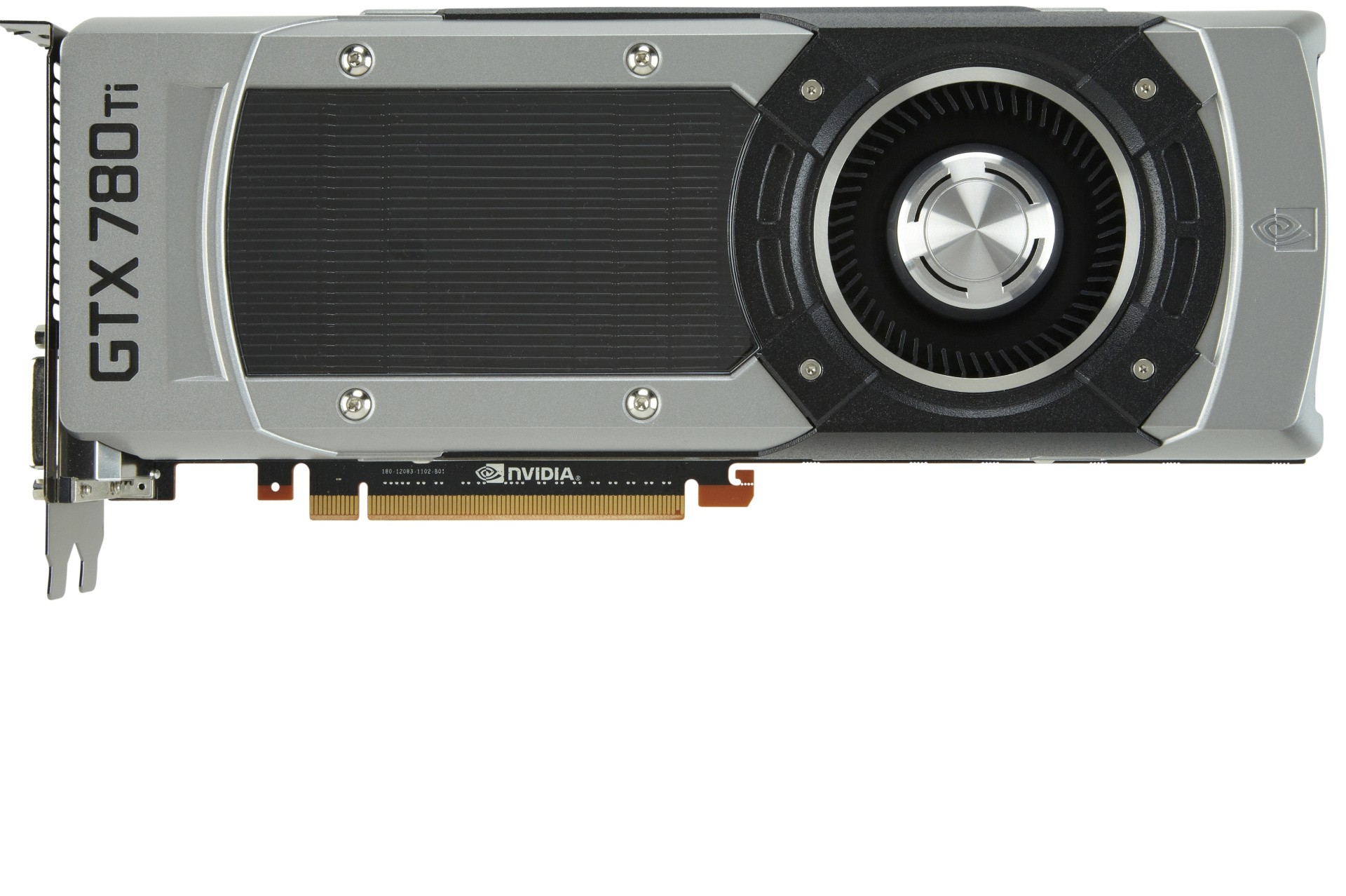


Comments 0
Wow, no comments yet... why not be the first?
Leave A Comment
Hold on there, you need to login to post a comment...