
 by
by In July, Sony confirmed rumours that a new "power saver" mode would arrive on PlayStation 5 consoles later this year, meant to reduce overall system power draw. That time is now, with game updates rolling out thick and fast. Thus far, across two testing sessions, we've looked at a total of four compatible games: Demon's Souls, Days Gone Remastered, Death Stranding: Director's Cut and Death Stranding 2: On The Beach.
What does the power saver mode actually do? Essentially, it sets up a virtual PlayStation device that runs on PS5 and PS5 Pro hardware. It takes the existing PlayStation 5 spec and runs memory at half-speed, cuts the CPU's eight cores and 16 threads down to four cores and eight threads, and downclocks the GPU to what Sony internal documents describe as the "base clock." That exact base clock count remains unclear at this point, but all 36 compute units are active. PS5 Pro runs the same "device," with the same 36 compute units, meaning that the Pro's additional 24 CUs are dormant.
With those reduced resources, developers then refactor and patch their existing PS5 games for the new specification. Some games are cut back in a basic manner, while others see more innovative approaches. In all cases, there is at least a 50 percent drop to power consumption, and sometimes higher.
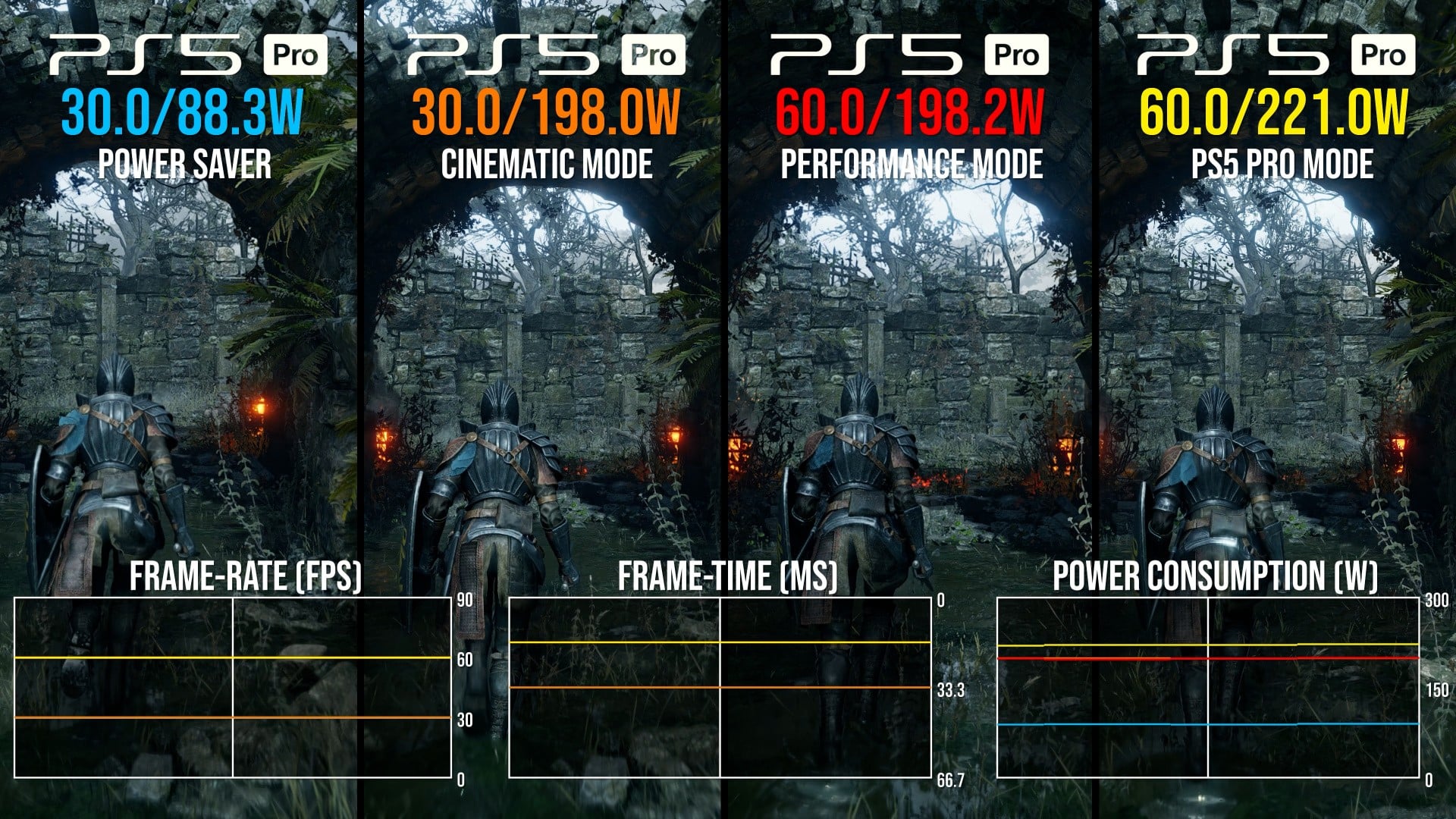
Sony advertises this optional mode as a way for PlayStation owners to join Sony's "Road to Zero" initiative to reach net zero greenhouse gas emissions by the year 2040. Sure enough, we're seeing significant drops in average wattage in affected games. Hypothetically, this mode could also be our first glimpse of how PS5 games might run on a power-limited platform like a highly rumoured upcoming portable PlayStation console.
To put it bluntly, the performance impact is significant. Demon's Souls removes all support for a 60 fps refresh, instead enforcing a 30 fps cap while dropping base pixel resolution to 1440p and additionally limiting visual settings to the original game's "performance" preset. Thus, power saver players can expect reduced visual fidelity such as more dithered volumetric effects around the Nexus.
That 30 fps cap isn't quite as locked as on a full-power PS5, with frame rate drops tied to higher numbers of on-screen enemies. (Interestingly, these frame rate drops lead to sound distortion, an issue found on the game's original PS3 version, as well.)
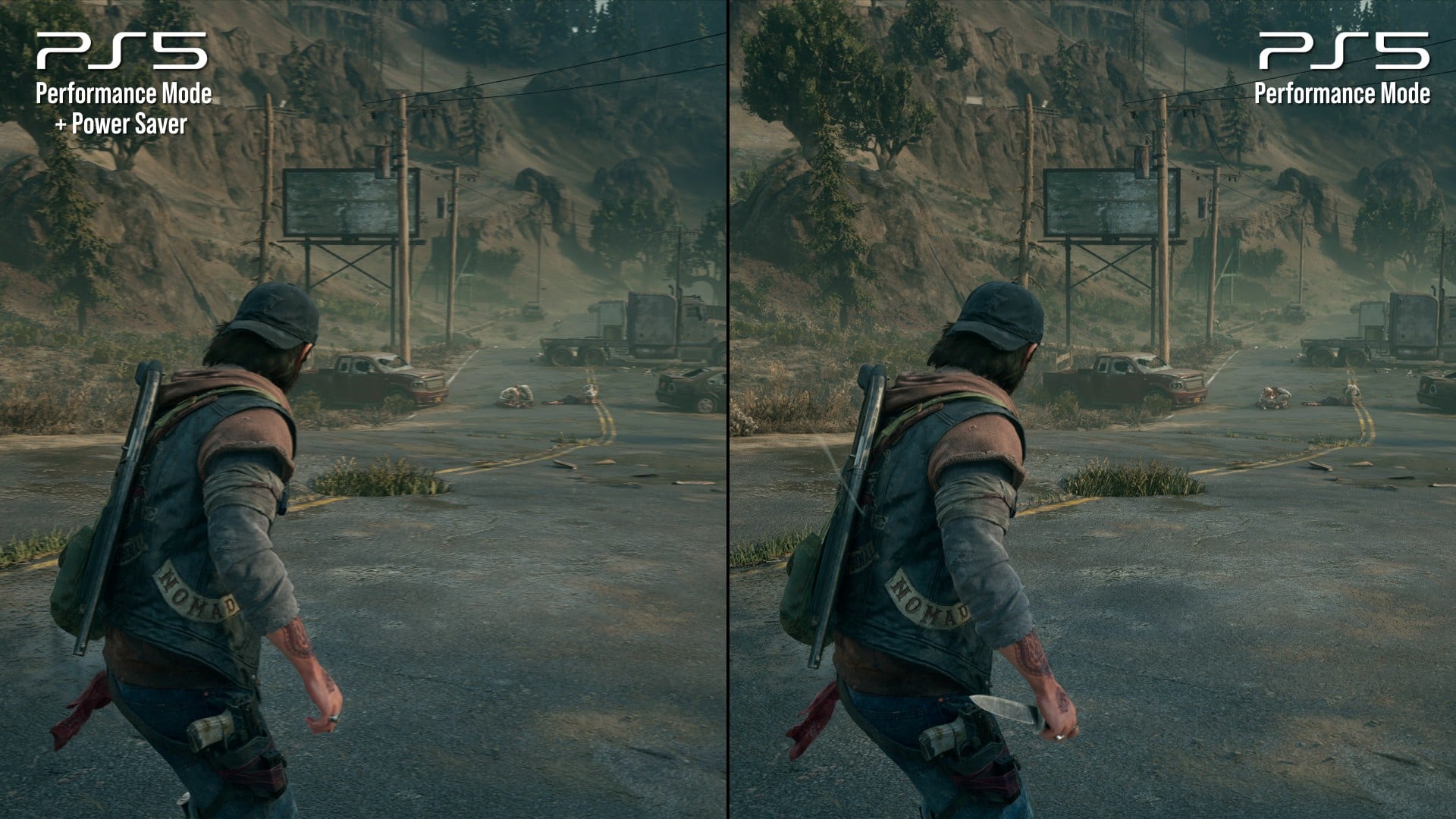
Days Gone Remastered's origins as a PS4 game arguably give it more breathing room in power saver mode, yet it too faces significant cutbacks to reach lower wattage. Both its 60 fps performance mode and 30 fps quality mode see base horizontal resolutions slashed nearly in half: as low as 1920x2160 and 1280x1440, respectively, along with slight-but-noticeable cutbacks to foliage draw distance and ambient occlusion.
On a performance level, the 60 fps mode chokes more consistently; the above video includes clear examples of large zombie crowds and massive explosions bringing the frame rate tumbling to the mid-40s. (A portable console with a variable refresh rate [VRR] display would certainly help with such an issue.)
In both games, and on both tiers of PS5 consoles, wattage drops over 50 percent, with Demon's Souls going from a range of 200-220W down to 80-90W on PS5 Pro and 90-95W on base PS5. For Days Gone Remastered, 230-240W becomes 110-115W on base PS5, while on PS5 Pro, there is a drop from near 240W to just below 110W.
After completing work on our initial testing, Kojima Productions released new updates for its brace of Death Stranding titles, and the results there are certainly intriguing. The power consumption metrics are similar indeed to the higher power draw seen in Days Gone Remastered, but the developers opt for very different power saver mode strategies for each game.
Perhaps owing to its genesis as a PlayStation 4 game, the power saver cutbacks to the first game in the series are relatively slight. The 1800p60 performance mode gives way to a 1440p60 alternative in power saver mode, with no 30 fps alternative here. The end result is that the impact of power saver is limited: just a slightly coarser image.
Death Stranding 2: On The Beach sees Kojima Productions effectively cherry-pick features from the existing modes to create the new power saver alternative. The 1440p resolution of the original performance mode is used, alongside the 30 fps performance target of the quality mode. Dynamic resolution scaling is used to stabilise performance.
On the face of it, power saver mode is the performance mode running at half the frame rate. However, it's a little more complicated than that, as the improved terrain quality and tessellation from the original quality mode make their way to the power saver mode.
It's clear that a lot of work has gone into PS5 consoles' power saver mode, with developer documentation making clear that while Sony wants to see it widely adopted, it is not mandatory. Are these power saver modes setting the table for the upcoming PlayStation handheld?
1440p resolution targets would be very high for a handheld, and even with the advantages of a more modern architecture paired with a mooted 3nm, tuning as much as 115W of power consumption down to circa 25W would be quite the feat. On the flip side, the sheer amount of effort gone into a mode unlikely to see much use from gamers suggests this is perhaps part of a wider project. We'll report back when more details emerge.


Comments 0
Wow, no comments yet... why not be the first?
Leave A Comment
Hold on there, you need to login to post a comment...