
 by
by How can the proliferation of Unreal Engine 5 lead to truly next-generation visuals, the kinds that take the promise of real-time path tracing to the next visual level? This week, the RTX branch of Unreal Engine version 5.6.1 gives us the clearest look yet by offering a downloadable, real-time demo of Nvidia's RTX Mega Geometry.
This innovative technology, which is currently an exclusive toggle for Nvidia's RTX line of GPUs, was originally showcased at January's CES in Las Vegas, and it was advertised as a system that traces a massive variety of rays (primary, shadow, reflection, and global illumination) against "full-quality Nanite geometry." We can now more intensely examine its promise in the new UE5 "Bonsai" demo, and this appears to be the highest state of the art for path traced visuals in real-time 3D graphics.
Until now, the default "hardware Lumen" global illumination model on UE5 has hinged on select shortcuts to achieve its version of realistic lighting. It traces against lower-fidelity geometry than the rest of the real-time Nanite world in a game, which leads to degraded fidelity in common path tracing examples like reflections. And its ray tracing doesn't work for direct-lighting scenarios without visible issues popping up.
The new Bonsai demo's upgrades from UE5's hardware Lumen model are immediately apparent: higher-fidelity geometry in reflections; pixel-perfect direct shadows; reflections with much more detail, such as mirrored reflections that feature deep levels of recursion; and transmission shadows that include accurate colours bleeding through the other side and tinting their shadows (evidenced in this demo by a prominent stained glass element).
While Nvidia suggests that this demo features path tracing, and we see signs of path tracing in its direct and indirect lighting, we're not as confident about this applying to its handling of primary visibility (and Nvidia's developer guide to Bonsai doesn't clarify).
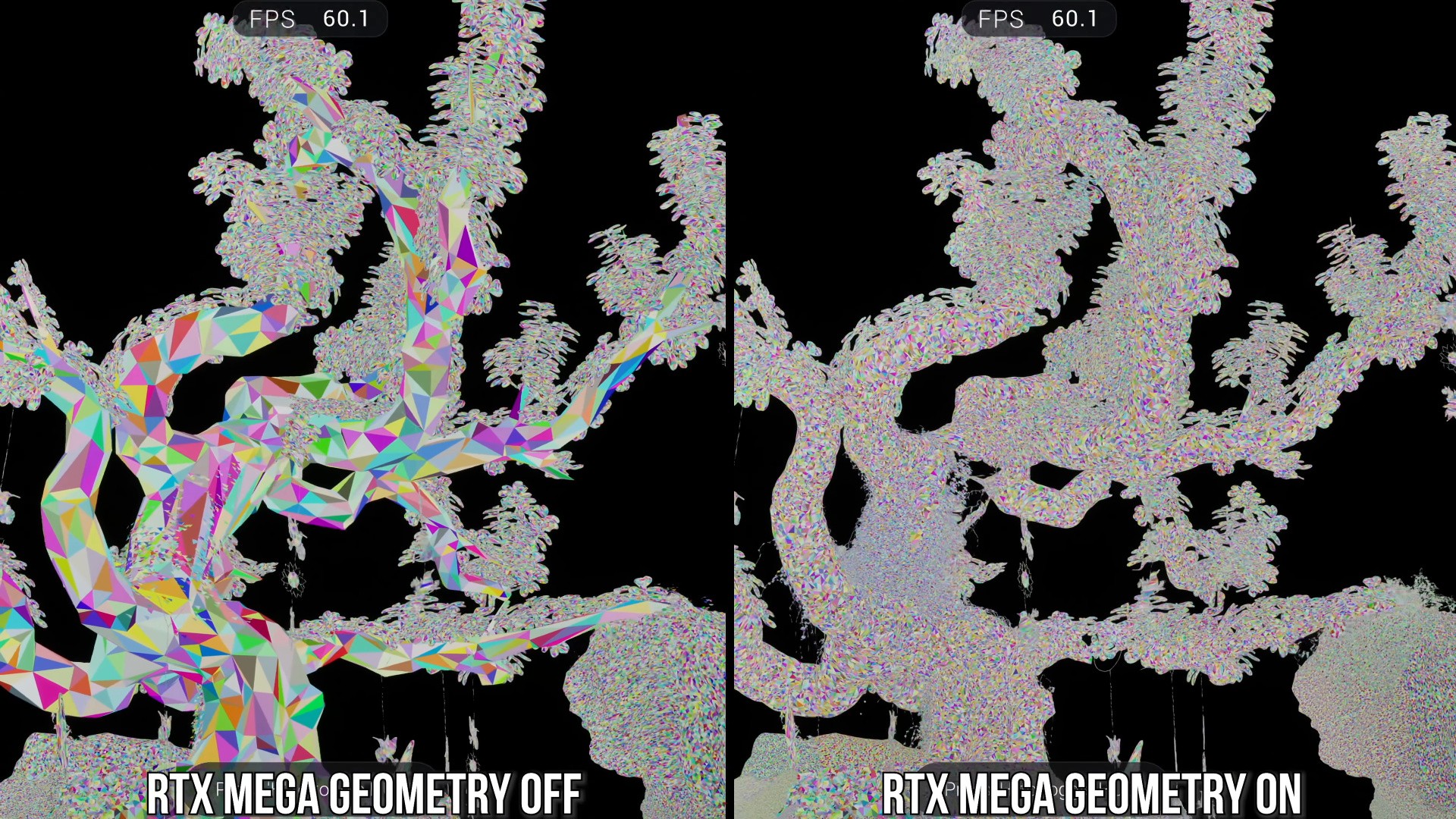
In a side-by-side comparison of RTX Mega Geometry being enabled and disabled, we can toggle a "debug" display of the triangle-face overlay, revealing the amount of geometry rendered when RTX Mega Geometry is turned on or off. This debug view gives us a peek at RTX Mega Geometry not only applying far more dense geometrical detail to objects in view but also selectively culling geometry of distant objects -though the Bonsai demo admittedly has a flatter camera distance, so its visible shrinking and expanding of geometric detail is harder to spot as its camera pans over the scene.
Thus, this debug view lets us confirm the key selling point of RTX Mega Geometry: making sure UE5 can actively change the geometry in the Bounding Volume Hierarchy (BVH) without having to constantly rebuild the BVH. Thus, UE5 no longer has to rely on a misaligned proxy fallback mesh, the way it typically does for hardware Lumen's global illumination approximation.
The caveat as of our initial testing is RTX Mega Geometry's high rendering cost. Our tests reached a 60 fps refresh at 2160p, upscaled from base 1080p via DLSS's Performance preset, and required an RTX 5090 to achieve such rates.
It's a keen reminder that this transformative step in beautiful, geometry-accurate path tracing will need to be met by quite the jump in next-gen console power to run on whatever devices companies like Sony and Microsoft may have in store, let alone the reality of this currently being an Nvidia-exclusive fork of UE5. Meaning, consoles that lean on AMD architecture may need even more time and/or power to approximate what we're seeing here.
From the look of Nvidia's development literature, bringing an existing UE5 game forward to work with RTX Mega Geometry may not have technical hurdles for projects that are already on the latest UE5 version, but rather art-pipeline ones, as this model breaks the kinds of work modeled to run via standard Lumen or Virtual Shadow Maps (VSMs).
In the above video, Alex Battaglia further explores RTX Mega Geometry and the Nvidia Bonsai demo, showing off the additional impact of ray reconstruction on RTX Mega Geometry elements like bounce lighting on indirect surfaces and recurring mirror images. Our video also examines hints we've seen in a development branch of UE5, particularly something that looks like lower-end non-Lumen RTGI coming to Unreal Engine 5.7 and beyond, and why we think Nintendo Switch 2 is the target platform for such a change.
Comments 1
The YouTube embed didn't work for me; would be nice to make explicit what the referenced content is (in this case, a clip from DF Direct 237 extracted and uploaded separately), as sometimes embedded content gets caught in firewalls or privacy extensions (even after I added explicit exceptions for digitalfoundry.net)
...That said, thanks Sam for the extensive text writeup on the subject - on more technical topics, I definitely benefit from multiple vectors of information delivery!
Show Comments
Leave A Comment
Hold on there, you need to login to post a comment...