
 by
by Assassin's Creed Shadows saw Ubisoft transition its Anvil Engine to current-gen consoles with a range of forward-looking features, a fact that we've covered extensively - so where does this leave Nintendo's Switch 2 console hybrid? On the one hand, the hardware lacks the raw horsepower of its Sony and Microsoft rivals, but at the same time, Ubisoft defied expectations with its Star Wars Outlaws port. Could AC Shadows balance its ray-traced visual makeup and other demanding features with Switch 2's inherent limitations?
Put simply, the cutbacks are clearly evident and yet the overall achievement remains very impressive.
This ambitious port succeeds by starting from the cut-down Xbox Series S visual feature set then finding tasteful ways to further cut the game's visual settings, while somehow maintaining AC Shadows' essential character. From there, DLSS helps the game present well by upsampling from low base resolutions to reach surprisingly decent image fidelity.
That said, at least as of launch, AC Shadows is best played in portable mode. How you view the docked mode depends on your sensitivity to inconsistent frame-pacing. Some people don't notice the uneven update, but for those that do, it can be annoying.
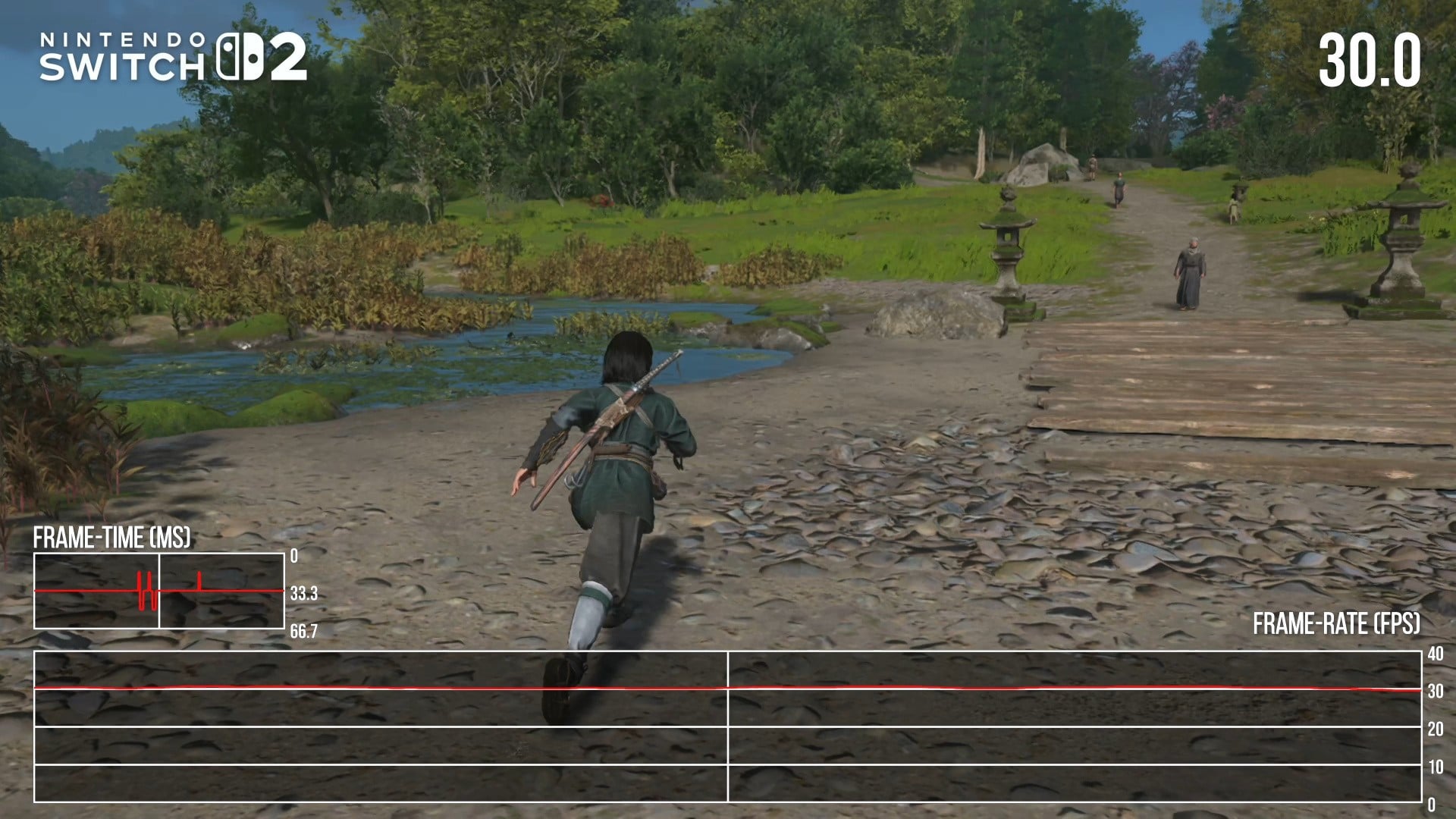
Ahead of this week's port, Ubisoft described its efforts to ensure that this port would benefit from Switch 2's variable refresh rate (VRR) support in portable mode, even while operating in a 30fps range. From what we can tell, the Anvil Engine pulls this off, as frame-rates generally hover around the 30fps mark while rendering in what we suspect is a 120Hz Switch 2 container. Kyoto traversal or battle sequences can drive frame-rates beneath the game’s 30fps target, but the action still reads smoothly thanks to VRR with low frame-rate compensation (LFC).
Docking AC Shadows on Switch 2 is a different matter, as gameplay sequences approaching a "stable" 30fps update are often interrupted by a steady flurry of incorrectly paced frames. A consistent 30fps delivers new frames every 33ms, but Shadows can peak and trough between 16ms and 50ms too, producing noticeable stutter. This is joined by further 16ms spikes, which really does suggest some kind of problem with the game's 30fps cap.
There can be proper drops to performance too: docked play in the same aforementioned regions drops to the mid-20s with a 20fps nadir, and we wonder if adding per-object motion blur would help smooth out their presentation in docked mode. But more than anything, we hope the docked mode's uneven frame-times are addressed in a future patch as the first order of business.
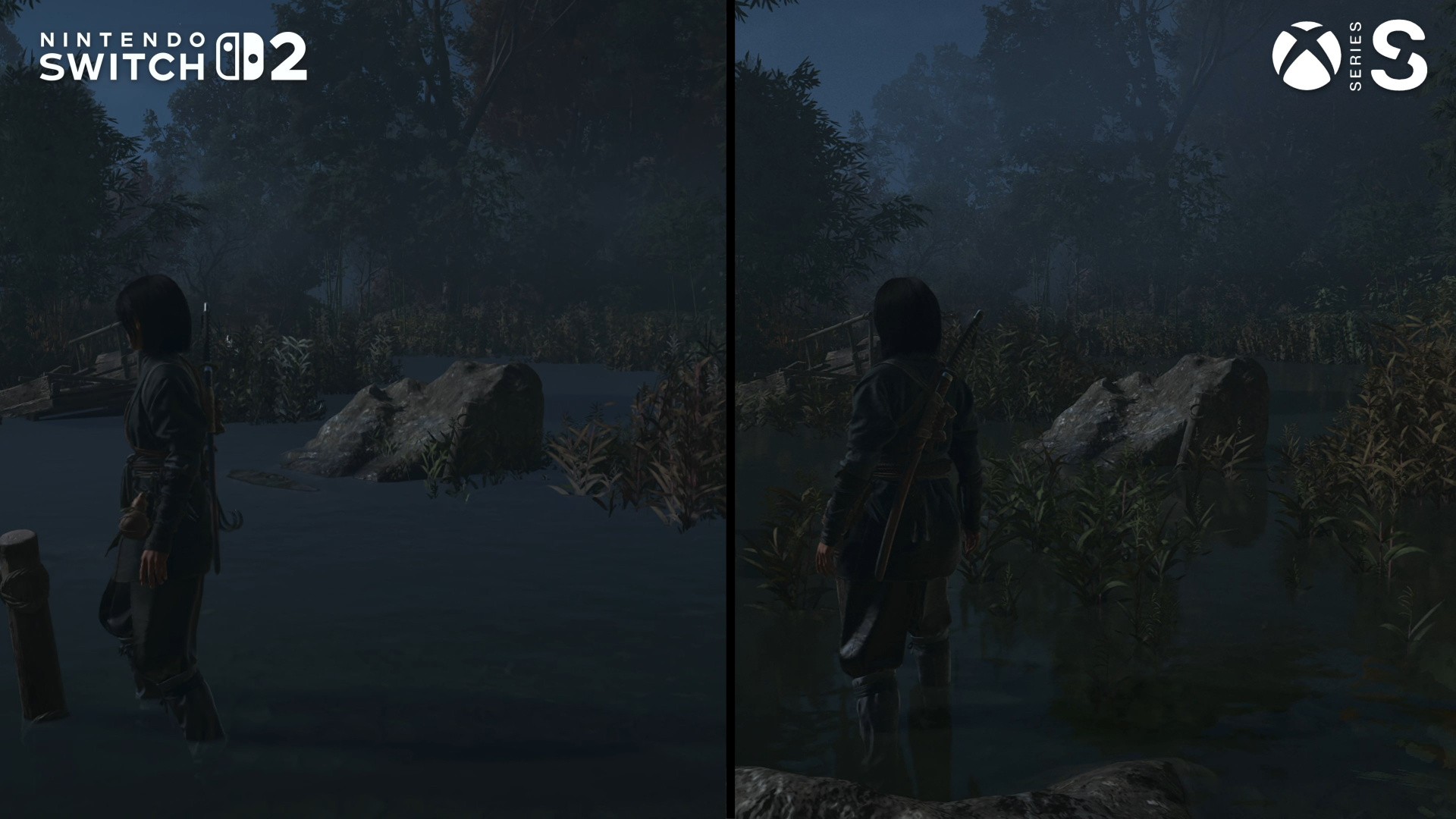
In reviewing the game's visual feature set across all platforms, Ubisoft already laid the groundwork for Switch 2 with key cutbacks made for Xbox Series S. However, the Switch 2 port of Assassin’s Creed Shadows differs from another recent Ubisoft port, Star Wars Outlaws, in one key respect. Outlaws featured ray-traced lighting as a core visual feature, which is present in all versions of the game. Shadows features similar lighting tech on powerful machines, but has more performant alternatives for weaker platforms, like Series S, low-spec PCs and now, Switch 2.
Among visual attributes missing on both Series S and Switch 2, strand-based hair and ray-traced global illumination (RTGI) don't make the cut, with the latter being replaced by the same baked, probe-based lighting solution seen on Series S. The lighting quality further suffers on Switch 2 due to an apparent downgrade to its screen-space ambient occlusion (SSAO) setting. And while Series S sneaks in an RTGI pass in AC Shadows' "hideout" hub zone, Switch 2 does not.
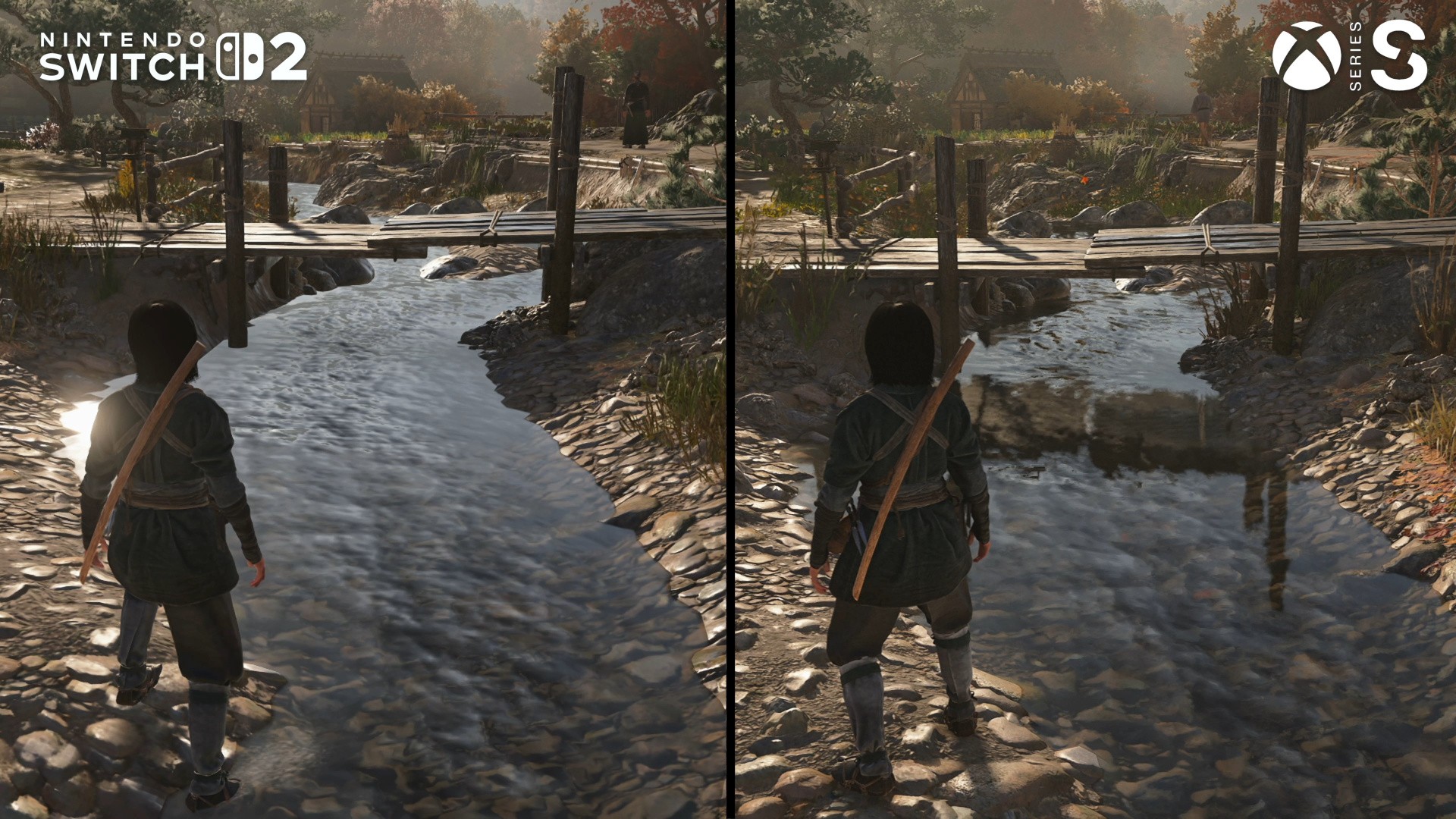
The cuts go deeper for Nintendo's portable-docked hybrid system. Screen-space reflections (SSR) are replaced by cube maps as a fallback - and we're not sure why these look different than on other consoles. Water and cloth simulations are pared back, with steps through water no longer creating ripples and clothing moving and reacting to stimuli more subtly than on Series S.
Foliage appears at lower density levels or even disappears entirely compared to Series S, with reduced animation effects and fewer distant-tree details, as well. Textures and shadows render at lower resolutions, with shadows employing a more aggressive middle-of-screen drop-off. And cutscenes inherit these and other downgrades, including under-occluded, "glowing" faces and a different, deeper, depth of field effect.
There are also additional visual settings downgrades in portable play to account for Switch 2's reduced GPU clocks and memory bandwidth, including more intense LOD culling of foliage and shadows.
Yet in spite of these and other downgrades, AC Shadows turns in what we consider an acceptable visual result. It retains the impressive virtualised geometry system that limits level-of-detail (LOD) pop-in for most distant geometry. Its handling of destruction - walls, boxes, barrels and more - looks quite similar. And quite often, its admittedly soft pixel presentation still resolves with more clarity and fewer disocclusion artefacts than Series S's TAAU technique, owing in part to a DLSS uplift from base 648p resolution in docked mode and base 400p in portable play. The latter's smaller screen also makes some of its visual compromises harder to spot in the course of gameplay.
Ultimately, with one or two exceptions, Ubisoft made the right calls in adapting Assassin's Creed Shadows for Switch 2 and it is pleasantly surprising to see the game transition with this level of success, bearing in mind the resources available. We would like to see improvements - fixing frame-pacing in docked mode, for example but this is twice in a row now that Ubisoft has faced off against the power-limited Tegra T239 processor and come out on top - and has done so with decidedly different approaches each time.

Comments 4
I hope they release patches soon to address some issues. It’s such a beautiful game that it deserves some extra love, really. Performance and water enhancements are in my wish list.
Thanks Sam and DF for continuing to cover Nintendo Switch 2 releases so thoroughly!
Switch 2 ports vs Steam deck would make for interesting comparisons where possible.
I agree the handheld version was impressive but so so so blurry, I traded it in and went for the PC version on the rog xbox ally x instead, FSR 3.1 balanced looks way better at 1080p on the handheld screen and the frame rate is over double.
Show Comments
Leave A Comment
Hold on there, you need to login to post a comment...