
 by
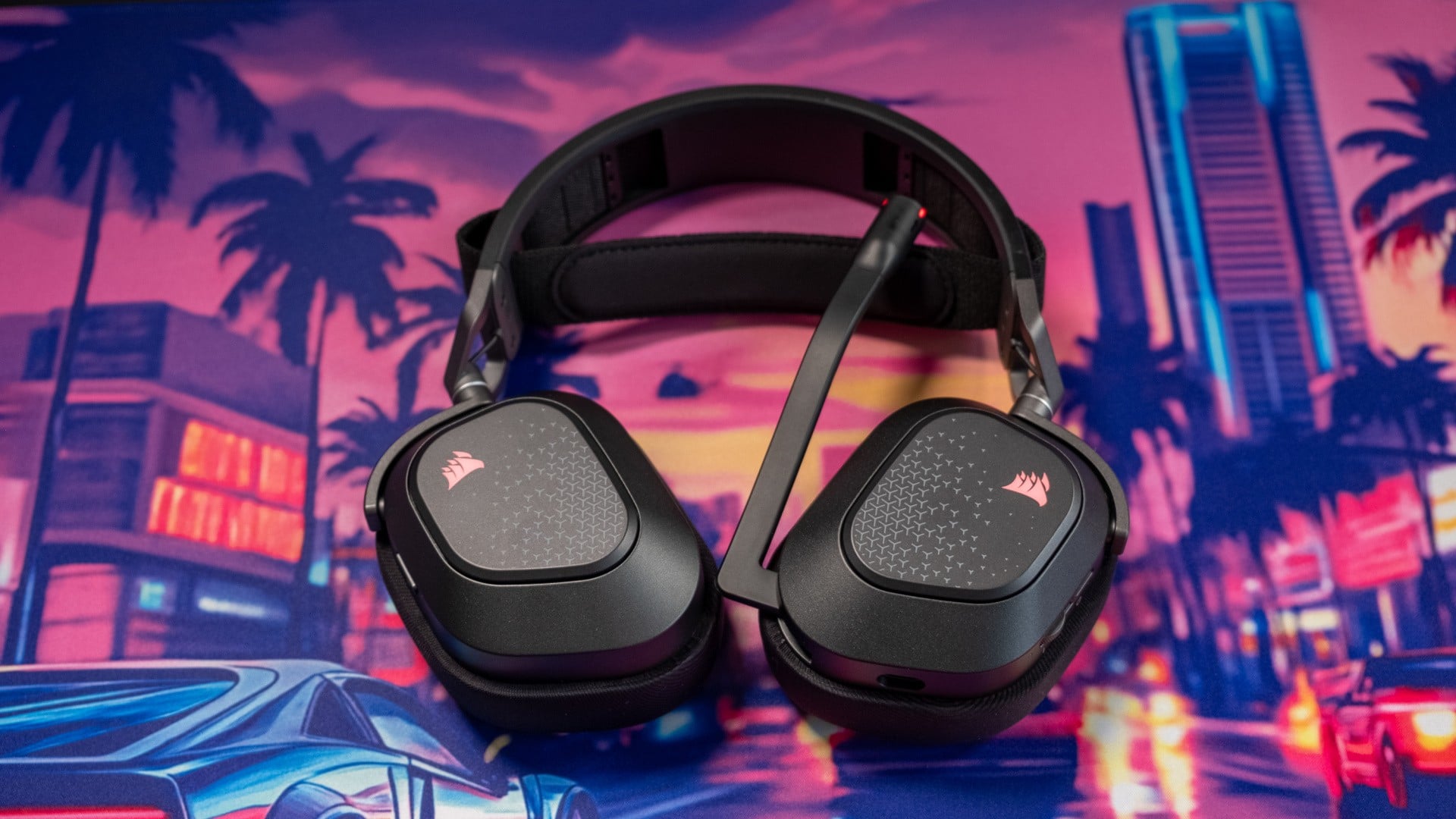
For £170/$200, the Corsair HS80 V2 Max is a high-end headset that doesn't do quite enough to distinguish itself from its more full-featured competitors - or earlier HS80 models. Still, a massive 110 hours of 2.4GHz battery life, upgraded "non-newtonian" drivers for competitive gaming and a comfortable design do at least deliver reliable performance, save for a few oddities.
The HS80 V2 Max is also a near-universal solution, with support for PC, Switch and PlayStation consoles, plus mobiles and tablets, thanks to the inclusion of simultaneous 2.4GHz wireless and Bluetooth. The only platform missing here is Xbox, which requires a proprietary codec that isn't part of the HS80 V2 Max offering.
The HS80 V2 Max's design is very easy to live with, with thick athletic fibre ear cushions, strong metal yokes, an auto-adjusting ski goggle headband and easily locatable controls. The tri-wing patterning on the ear cups means that the included RGB can be disabled without the headset looking too bland, and the gunmetal grey frame and black accents form an attractive colour scheme. Apart from the flexible plastic headband and the rotating hinges that let the cups lie flat, there's little in the way of give anywhere, and the headset is robustly constructed. At 370g, it's also not a particularly heavy headset, and it feels well-balanced enough to be comfortable for long gaming sessions. The only discomfort I experienced was when wearing a thick beanie with the headset - where it felt like the strap couldn't expand wide enough to accommodate the extra girth.
The 50mm non-Newtonian laminate drivers used here are meant to fix "acoustic ghosting", a phenomenon that means gamers can miss important cues like footsteps in the milliseconds it takes an ordinary headset to stop wobbling after the previous sound. The NNL drivers return to silence seven percent faster on average at 60dB, according to Corsair's testing, though this advantage can reach 16 percent at certain mid ranges - corresponding to a sound fading 10ms sooner. In-game, the HS80 V2 Max was fine, delivering good stereo separation and excellent passive noise isolation - though I missed ANC - but I didn't feel it provided a competitive advantage above something like the AceZone A-Spire, Razer BlackShark V2 Pro or other (cheaper!) gaming headsets tuned for esports.
The headset produces a warm, v-shaped sound, which is perfectly fine for a gaming headset, but the mids tend to run together and it's harder to pick out individual instruments in the mix compared to other headsets at this price range. The 2.4GHz connection sounds a bit fuller than the BT one, which makes sense given that the headset only supports the basic SBC, AAC or LC3 codecs rather than aptX or LDAC.
Oddly, the headset is extremely loud in Windows with iCUE open - at 1/100 it was already perfectly loud enough, 4/100 is borderline, and I would have regularly used 0.5/100 if I had the option. It's extremely weird that having the "flat" audio profile in iCUE changes the volume and balance so significantly versus having iCUE closed, and I have to imagine this is a bug - as I can't think of any other gaming headset that requires the software to be open at all times to deliver the intended "default" sound profile. I also kept experiencing a bug where the headset got extremely loud for a fraction of a second when it hadn't played sound for a little while (but not long enough for the headset to go asleep), even at 3/100 in Windows, which genuinely hurt my ears and I stopped my testing prematurely as a result.
Of course, on console there's no iCUE, and you'll get noticeably quieter sound as a result. On Windows, you do get Dolby Atmos for headphones, which I personally didn't like to use - your mileage may vary.
The flip-to-mute microphone has been upgraded to a new model, which produces flat but adequate results when updated to the latest firmware - definitely usable for multiplayer gaming and Zoom calls but I wouldn't record a podcast or conduct an interview with it. There is a faint hiss evident which can be eliminated with Nvidia Broadcast - which is included with the microphone but requires a 2.7GB download (and can be also applied to any other mic outside of iCUE). On the plus side, the breathy "mic on!" confirmation when you flip down the mic leaves very little doubt as to whether or not the mic is on - though if you don't use iCUE, this is replaced with a tone instead.
As well as the audio upgrades, connectivity also seems to have been boosted, and I found that the HS80 V2 Max was able to consistently maintain connection to my PC even if I was on a different floor or way out at the street taking back my recycling bins. Of course, if you're using Bluetooth to connect to your phone, then that connection will be maintained more easily if you take your phone with you.
Connecting to BT is easy enough, but I missed having separate on/off buttons for Bluetooth and 2.4GHz as there are on the SteelSeries Arctis Nova headsets. Here, turning off the headset turns off both connections. Similarly, the volume wheel always controls the 2.4GHz volume if this is connected, so you have to find your phone to adjust the volume there if needed. It feels a bit like Corsair's first rodeo with simultaneous audio, yet it's been five years since the tech debuted on the Virtuoso XT, so I'm a little confused why these quality-of-life features haven't been addressed. Finally, there's no 3.5mm input, and you can't use the USB connection for anything other than charging.
For me, the HS80 V2 Max is too feature-poor and too buggy to be a successful high-end headset in what is an increasingly competitive market. The addition of PureVector DPI personalisation to Corsair's top gaming mouse is enough to put it into the conversation versus the best mice from Razer, SteelSeries and Logitech, but here the only unique element here is the non-Newtonian laminate drivers - which don't give a demonstrable advantage over headsets with a more traditional construction.
And while you can make a great headset without a totally unique feature, the SteelSeries Arctis Nova 7X Gen 2 offers Xbox compatibility and a mobile app for console EQs, plus the same simultaneous wireless/BT and a more comfortable design for £10 more - or the Logitech Astro A50 Lightspeed includes a charging dock with three inputs for £20 more. Neither of them behaved weirdly in Windows or randomly deafened me either.
If you have some confidence that these bugs will be fixed - and you're willing to pursue a refund if they don't - then the HS80 V2 Max does have some redeeming features. For example, if you're invested into the Corsair ecosystem and you want a headset with best-in-class battery life and solid build quality, the HS80 V2 Max is a decent option at £170/$200.
That said, I'd also suggest looking at the original HS80 Max, which offers only 65 hours of battery life via 2.4GHz but it is significantly cheaper (especially in the US) at £139/$120. The aforementioned $170/£180 SteelSeries Arctis Nova 7X Gen 2 is also worth a look.
Please note that some external links on this page are affiliate links, which means if you click them and make a purchase we may receive a small percentage of the sale. Please read our FTC Disclosure for more information.


Comments 0
Wow, no comments yet... why not be the first?
Leave A Comment
Hold on there, you need to login to post a comment...