
 by
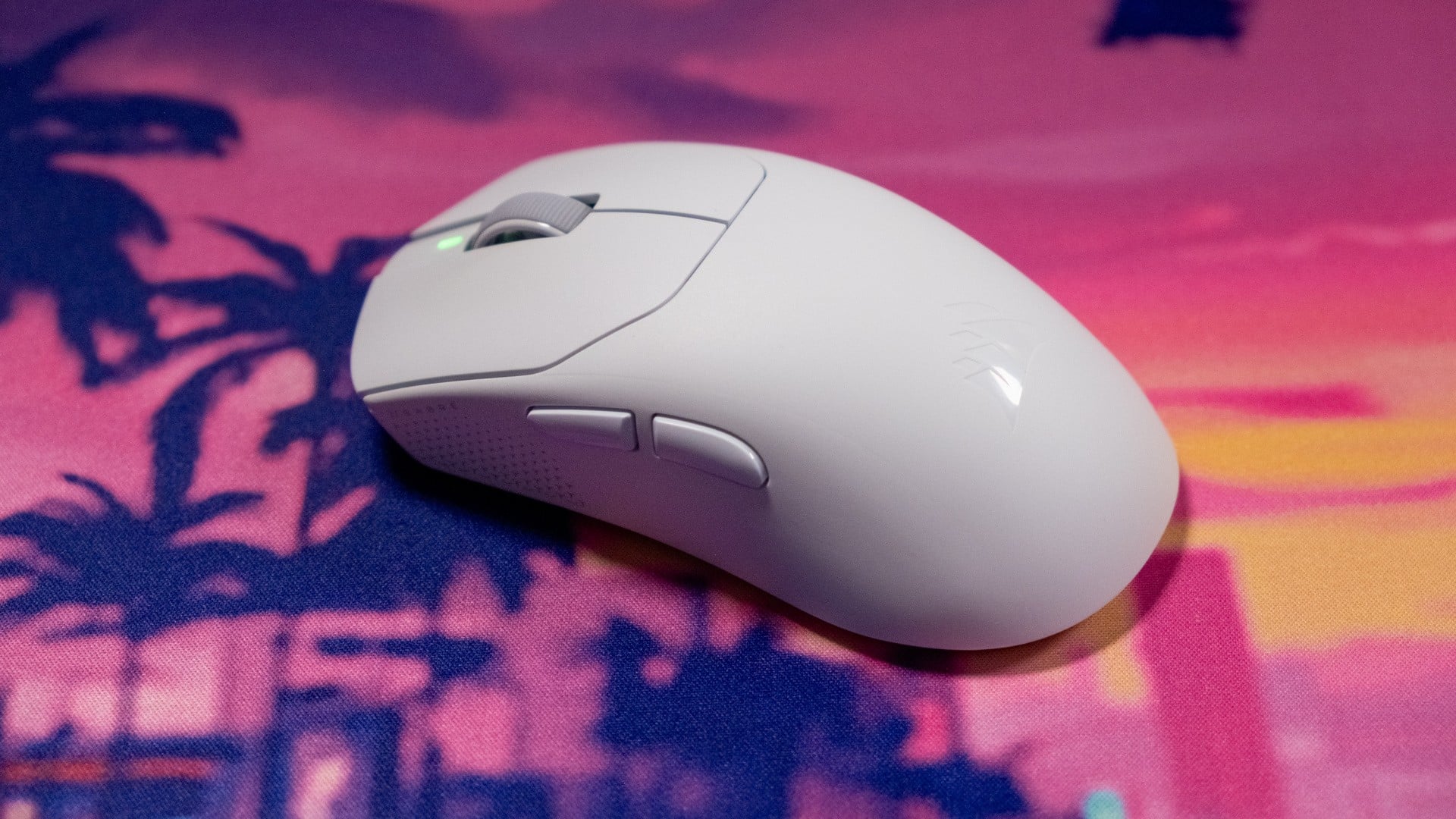
As high-end optical sensors, lightweight designs and reliable wireless have become table stakes for even budget gaming mice, brands are getting more experimental and experiential when it comes to making their flagships stand out. Logitech developed a whole new haptic mouse click, SteelSeries brought swappable batteries and ultra-wideband, and now it's Corsair's turn to shake things up.
Corsair's idea is that mouse sensitivity shouldn't be represented with a single DPI number; it should be custom for every player, and specific to eight different directions. By going through a short calibration process in aim training software, the mouse can work out your directional biases, and adjust the DPI accordingly so that every direction is equally viable - thereby improving your aim speed, accuracy and consistency. Your resulting "PureVector" profile is stored on the mouse too, so it can be used in any game or application, on any computer, and without any software running.
It's far from the easiest concept to explain - at least versus "you can swap batteries instead of recharging" - but after testing the system for the past two weeks, I'm convinced that this feature would benefit basically any mouse out there - and for players of aim-focused titles like Counter-Strike 2, Valorant and Call of Duty: MW4, this could be a bit of a game-changer. For instance, I typically do well flicking and tracking side-to-side, but tend to undershoot aiming upwards, so the DPI for moving up can be set higher to compensate.
Beyond its headline feature, the Sabre V3 Pro is also a legitimate challenger to the likes of the Razer Viper V4 Pro and SteelSeries Rival Pro, with a comfortable symmetric shape, reliable wireless and high-end components - though it's not without its drawbacks either.
Outwardly, the Sabre V3 Pro closely resembles the Sabre V2 Pro CF we looked at earlier this year, and the V3 Pro line is similarly available in multiple materials - though we have the standard plastic model (37g) instead of the more exotic magnesium alloy (49g) and carbon fiber (48g) variants, which come at a £20 and £50 premium respectively. As well as different materials, you can also get the Sabre V3 Pro in a an ergonomic/asymmetric shape that weighs 41g to 55g depending on material. The mouse comes with quite small UPE skates, but a larger alternative is in the box, along with black grip tape and an alcohol pad.
Internally, the optical sensor has changed to a new flagship model with a 42K maximum DPI, optical microswitches have replaced the mechanical ones in the V2 Pro, and a new microcontroller allows for significantly more memory life at 1KHz - 140 hours versus 70 hours on the V2 Pro. However, 8KHz polling still drains the battery more rapidly, with just 25 hours of rated use, and it's hard to imagine using this consistently without a dock, swappable batteries or mousepad charging - all strategies undertaken by Corsair's rivals but not Corsair itself.
The V3 Pro's safe, symmetric shape suits my relaxed claw grip (20x10cm hand size), works well in fingertip too, and I'm glad it's unchanged from the V2 Pro. The optical mouse clicks don't feel quite as refined as those on the X3 Superstrike or Viper V4 Pro, but they have only modest pre-travel and a firm click. The side buttons have a bit more post-travel, but are at least well-sited, and the scroll wheel is well-balanced between defined, tactile steps and smooth scrolling. As usual, keys can be rebound and other settings changed in Corsair's straightforward Web Hub software.
The matte coating provides good grip without showing fingerprints, and combined with the extremely lightweight design, I didn't face any issues manoeuvring the mouse in either aim training or fast-paced games like Counter-Strike 2, War Dogs and Hades 2. Build quality is solid too, with minimal flex evident, and of course you have the other material options if you want something even more rigid.
| Spec | Sabre V2 Pro | Sabre V3 Pro |
| Weight | 36g | 37g (symmetric) / 41g (ergo) |
| Sensor | Marksman S | Marksman X |
| Max DPI | 33,000 | 42,000 |
| Max Speed | 750IPS | 800IPS |
| Max Acceleration | 50G | 70G |
| Main Switches | Mechanical (100M clicks) | Optical (100M clicks) |
| Max Polling Rate | 8000Hz (wired + wireless) | 8000Hz (wired + wireless) |
| Microcontroller (MCU) | Nordic 52-series | Nordic 54-series |
| Battery Life (1000Hz) | Up to 70 hours | Up to 140 hours |
| Battery Life (8000Hz) | Up to 16 hours | Up to 25 hours |
| Dimensions | 119.3 x 62.6 x 38.2mm | 119.3 x 62.6 x 38.2mm (symmetric) / 119.0 x 64.5 x 41.0mm (ergo) |
| Shape(s) | Symmetric only | Symmetric + ergonomic |
| Connectivity | 2.4GHz Wireless, USB-C Wired | 2.4GHz Wireless, USB-C Wired |
| Software | Web Hub | Web Hub, Aimlabs PureVector integration |
Beyond the hardware, the PureVector integration is the difference-maker, though it does take a bit of setup time. You'll need to install the Aimlabs software (it's a free Steam download), then visit the Mouselabs tab. From here, you supply some simple information - what games you're most interested in, what mousepad size you have, how you aim and how you hold the mouse. Then you go through five one-minute aim training sessions, with the software building a picture of your mechanical tendencies - what sorts of shots you're able to hit consistently, and what sorts you undershoot or overshoot. Based on the calibration, which you can redo at any time, you can enable your personal directional sensitivity settings and save them to the mouse. You're then encouraged to try the aim training again, and shown how you've improved.
For me, the deficit the software identified was flicking upwards, and sensitivity was boosted in that direction. According to Aimlabs, that boosted my average score by nine percent and my average aiming speed by 10 percent, though I'm sure some of that improved performance could also be attributed to pure learning through repetition. The aim training flips regularly from an aim point in the centre of the screen to one elsewhere, for example, so you can train your muscle memory to anticipate that return to centre and speed up your clicks.
In games like Counter-Strike 2 and Wardogs, where it's quite common that you're staying in a relatively fixed position and trying to flick onto people's heads (AK) or bodies (AWP) as quickly as possible, this sort of training and optimisation makes a lot of sense. In games like Call of Duty, Fortnite or Unreal Tournament, where players are more mobile, tracking becomes more important. That creates more of a disconnect between the training (and resulting compensation) and actual moment-to-moment gameplay, so PureVector may be less useful. Personally, I was most impressed in Counter-Strike 2, where I've spent the most time aim training in general, as my capability to deliver a first-shot headshot improved substantially.
I think there's room to improve the Aimlabs integration here - both in terms of convincing players that the feature is effective and explaining exactly what is being done. For example, I'd love there to be a blind trial where you have multiple rounds with PureVector randomly on or off, and you're then shown whether you improve when the feature is enabled. Similarly, other than the before and after PureVector graphs, you're not given much of a sense of what the software is doing, and it would be interesting to see actual figures of what your DPI has been adapted to. Hopefully this is just the start of the work between Corsair and Aimlabs, as Corsair presumably bring the feature to more mice.
Speaking of which, what are the chances that Corsair is able to protect its feature from both big-name Western brands and smaller brands from regions less concerned about intellectual property? Before I even finished writing this review, multiple individual developers have already claimed to replicate the feature for any mouse, and though Corsair has a headstart in terms of research, development and testing - with the patents to prove it - it will be interesting to see how long their core feature remains unique.
Overall, the Sabre V3 Pro PureVector is a fascinating mouse, and one that may well foreshadow the direction of travel in the peripheral industry towards ever more personalised gaming peripherals that are aware of your individual strengths and weaknesses and compensate accordingly. This may be an early example of that larger trend, but PureVector already provides a meaningful advantage that could draw more eyes to Corsair's underrated ultralight mouse roster. The Sabre V3 Pro may not have the crossover appeal of a Razer Viper or a Logitech Superstrike, but this is a genuine alternative that deserves much the same consideration for fans of competitive PC games.