
 by
by After eight years of mainline and offshoot games for Nintendo Switch, the Pokémon series finally receives a new game that debuts with Switch 2 support. But as a cross-gen title, how much can this month's Pokémon Legends Z-A "mega evolve" on newer hardware before being pulled back to the realities of the older Tegra X1 chip?
Game Freak's latest Pokémon adventure, and second in the "Legends" branch of semi-open-world traversal, lands in an uneasy space between two Switch consoles. This sequel's setting could have inspired a next-gen spike in ambition, in terms of advancing from the relatively unsettled Jubilife Village to the bustling, multi-district Lumiose City. But thanks to compatibility with Switch 1, this leap to a metropolitan area falls short of other Switch 2 cityscapes.
Take the copious NPCs strewn across Legends Z-A's city zones. A majority of these characters are strangely anchored to a fixed position, and worse, all NPCs suffer from decimated animation rates at a certain camera distance, which Switch 2 cures to some extent, along with abrupt Level of Detail (LoD) pop-in, which Switch 2 does not cure. This technical reality dashed our hopes for a newly bustling populace in a Pokémon game.
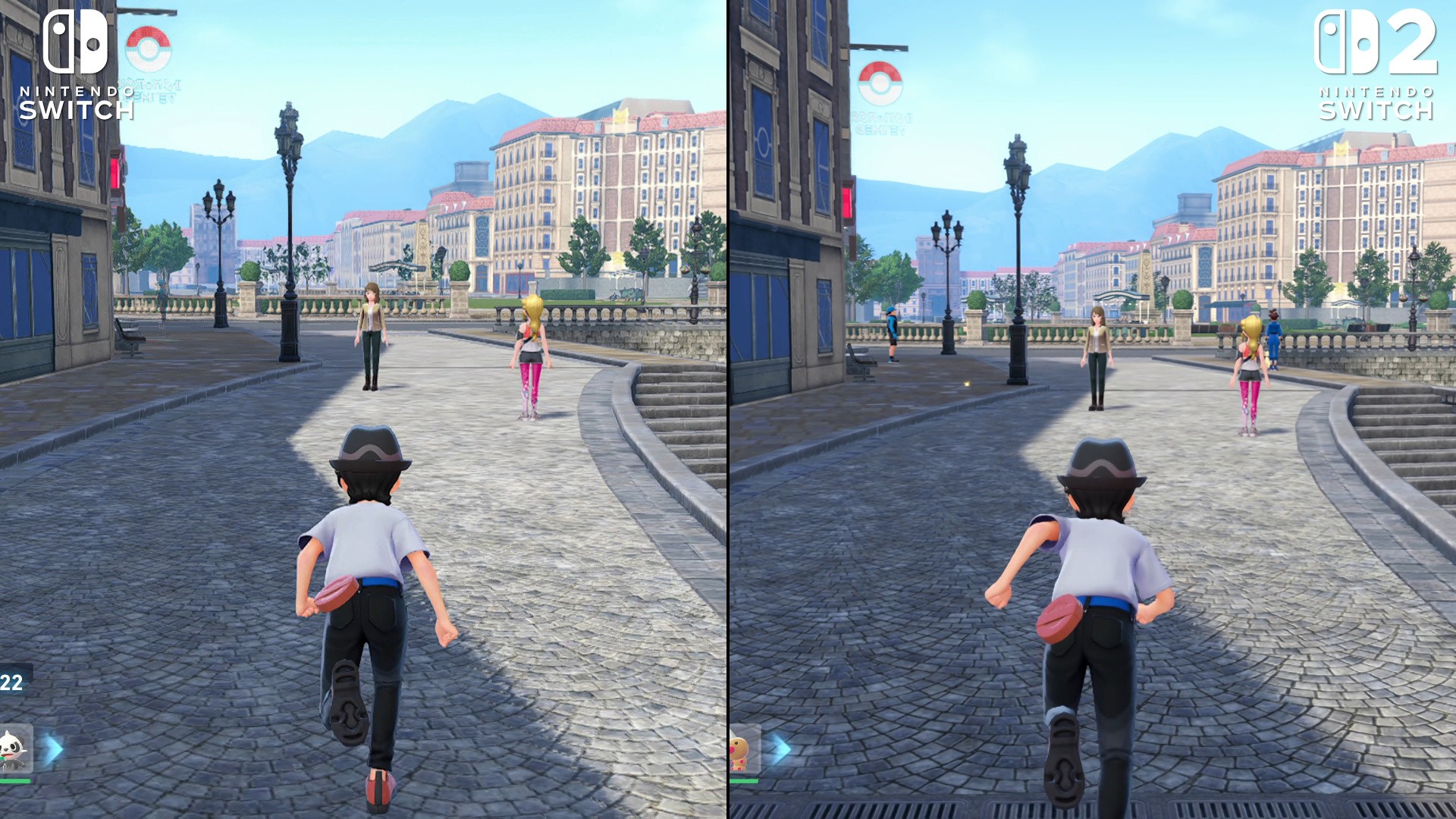
To the engine's credit, Switch 2 does at least deliver reduced LoD pop-in for other crucial geometry. Buildings, trees, street market stalls and lamp posts lining the street will render in closer on Switch 2, even if the pop-in effect for when those appear is still more abrupt and noticeable than Switch 1 stunners like Tears of the Kingdom.
Switch 2 also exclusively delivers a much-needed ambient occlusion (AO) pass on all geometry, along with higher shadow resolution across the board. However, shadows don't really look all that great in either version, and worse, the game's shadow filtering cascade toggles all too close to the camera on both systems, similar to its NPC draw distances.
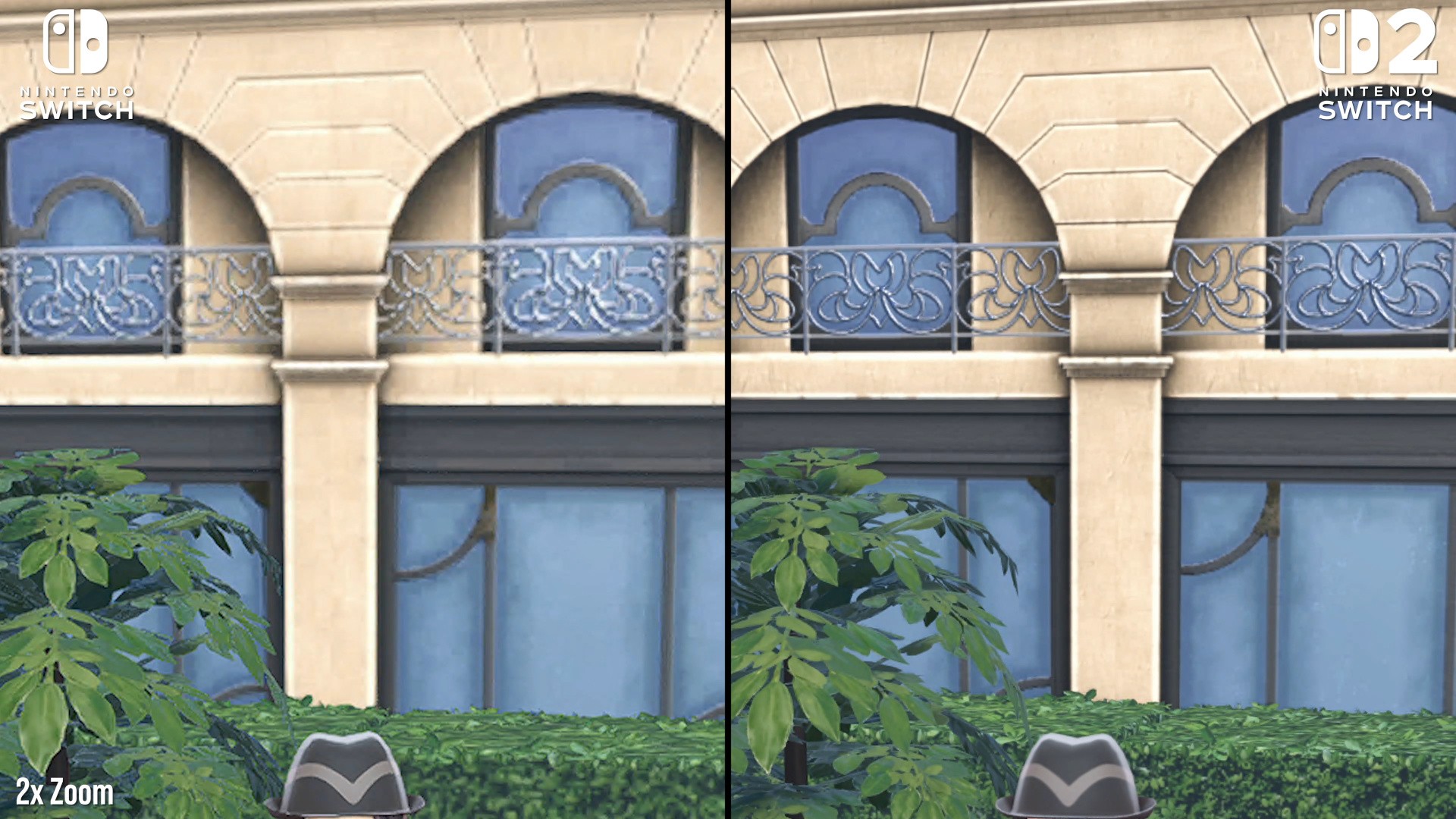
Legends Z-A suffers from an epidemic of low-resolution, copy-pasted textures strewn across building facades. Additionally, windows and guard rails are not rendered with geometric detail, but are rather presented as repeated, flat texture maps in every district, which look all the more pixelated on the memory-strained Switch 1. These textures are admittedly of a higher resolution on Switch 2, but their lack of variation and 3D depth leaves seemingly every Legends Z-A building looking sterile.
A larger install size on Switch 2, at 7.7GB compared to 4.1GB on Switch 1, is likely thanks to higher-resolution textures across the board. Yet much of this benefit is rendered moot thanks to its texture filtering setting being identical on both systems. You'll need to bring textured surfaces quite close to the camera on Switch 2 to perceive its larger-download benefits.
In better news, bodies of water support screen-space reflections (SSR) that scale decently to each console's base resolution, while interior zones are bathed in a handsome application of atmospheric fog to grant them a musty, almost antique atmosphere. And the in-engine cutscenes are nicely rendered, complete with a tasteful application of bokeh depth of field.
In terms of resolution, Legends Z-A's Switch 2 version actually renders a lower base number of pixels than Switch 1, coming in at 792p to 828p in docked mode compared to the older console's dynamic resolution count typically running near 864p. However, Switch 2 is the clear winner on this front, thanks to its clean use of Nvidia DLSS to upscale to 1440p. This delivers a far more pleasing pixel presentation than Switch 1, whose raw pixels receive no anti-aliasing.
A similar pixel uplift is seen in portable mode, with Switch 1's raw pixel count dropping to as low as 576p and looking far rougher than Switch 2 upscaling from 630p to a full 1080p. Legends Z-A, then, is one of the only Nintendo-published Switch 2 games to utilise DLSS instead of FSR 1, and we cannot help but celebrate that decision.
Sadly, the Switch 1 version's cutbacks in attributes like LoD and shadow resolution aren't enough to help it clear a steady 30fps. Our testing focused on early portions of the game, where sharp camera turns consistently dropped frame rates into the mid-to-high-20s, and we're unsure whether later battle zones and more powerful Pokémon will be even harsher to its performance cadence. Switch 2, conversely, doesn't appear to break a sweat in maintaining a flat 60fps frame rate, and it even exceeds the Switch 2 patch of Pokémon Violet/Scarlet on that front.
Game Freak deserves credit for using its Legends line as an experimental break from the series' long-held template since its Game Boy classics. In Legends Z-A, relocating to the big city is a great idea on a mechanical level, while aesthetically, we appreciate the diversity in Lumiose City's separate districts. Players get to peel at the city’s layers, with rooftop pathways, sewers and secret alleyways opening up through smart use of Pokémon abilities. There's real fun to be had while happening upon so many distinctive Lumiose landmarks. And we must admit, some of the design shifts make it easier for Switch 1 to render this game in ways that the aging hardware struggled with Legends Arceus.
But in a gaming world where Cyberpunk 2077 can run competently on a Switch 2, a release like this feels like a wake-up call. We certainly hope future Pokémon games break up with Switch 1 and start over in terms of their technical base. If the series continues to march in the direction of open, free-roaming design, it needs a more elegant solution to world- and asset-streaming, free of obvious pop-in, along with a significant raise in the quality and diversity of geometry and elements that make an open world feel alive.
If Legends Z-A ultimately serves as Pokémon's Switch 1 swan song, the best we can say about it is that it at least runs decently on Switch 2 - even if it feels silly to pay $10 extra just for that boost.

Comments 7
Got a great giggle out of the tagline. Thanks for that.
I'm closing in on the end of the game, and yeah it's an embarrassing display for a brand that is worth over a billion dollars. That said, I also think the game looks fine. I love the new character designs, and the game runs well on Switch 2, which on its own, is something I am fine with. It's just that when compared to other games from IP that are worth so much less, it's insane how low budget these Pokemon games continue to be. Even a release like Trails in the Sky 1st Chapter from Falcom (a company that doesn't make nearly as much money as The Pokemon Company) absolutely curb stomps Pokemon Z-A in its presentation.
Tears of the Kingdom, on Switch 1, you could see the whole way across the map yet Gamefreak can't handle a few NPCs in a city more than a few metres away even on Switch 2. Honestly this is just incompetent in 2025.
Would be disappointing on an indie game but Pokemon is the biggest franchise in the world, it's embarrassing.
Considering how much money, the Pokémon company makes on these games, this is just pathetic. The franchise should have gotten AAA budgets by now.
The contrast between the Cyberpunk 2077 footage, and then back to Pokémon, was just hilarious. 🤣
Insane that people still pay $70 for this...
And the cherry on top for this game was the day one dlc thing.
While the generational leap is impressive I still feel that the Pokemon Company and Game Freak should be able to do more. Say what you want about Sword and Shield, but the cities and towns in those games actually look really nice.
I think Game Freak as an independent studio might want to keep using their own in house tech, but I feel like something need to change.
Always heard a lot of complaints about this game when it came out. At the same time I was addicted. Played 100+ hours of it, couldn't put it down. Even convinced a friend of mine who was highly critical of the game to purchase it and he's having a great time.
Show Comments
Leave A Comment
Hold on there, you need to login to post a comment...