
 by
by 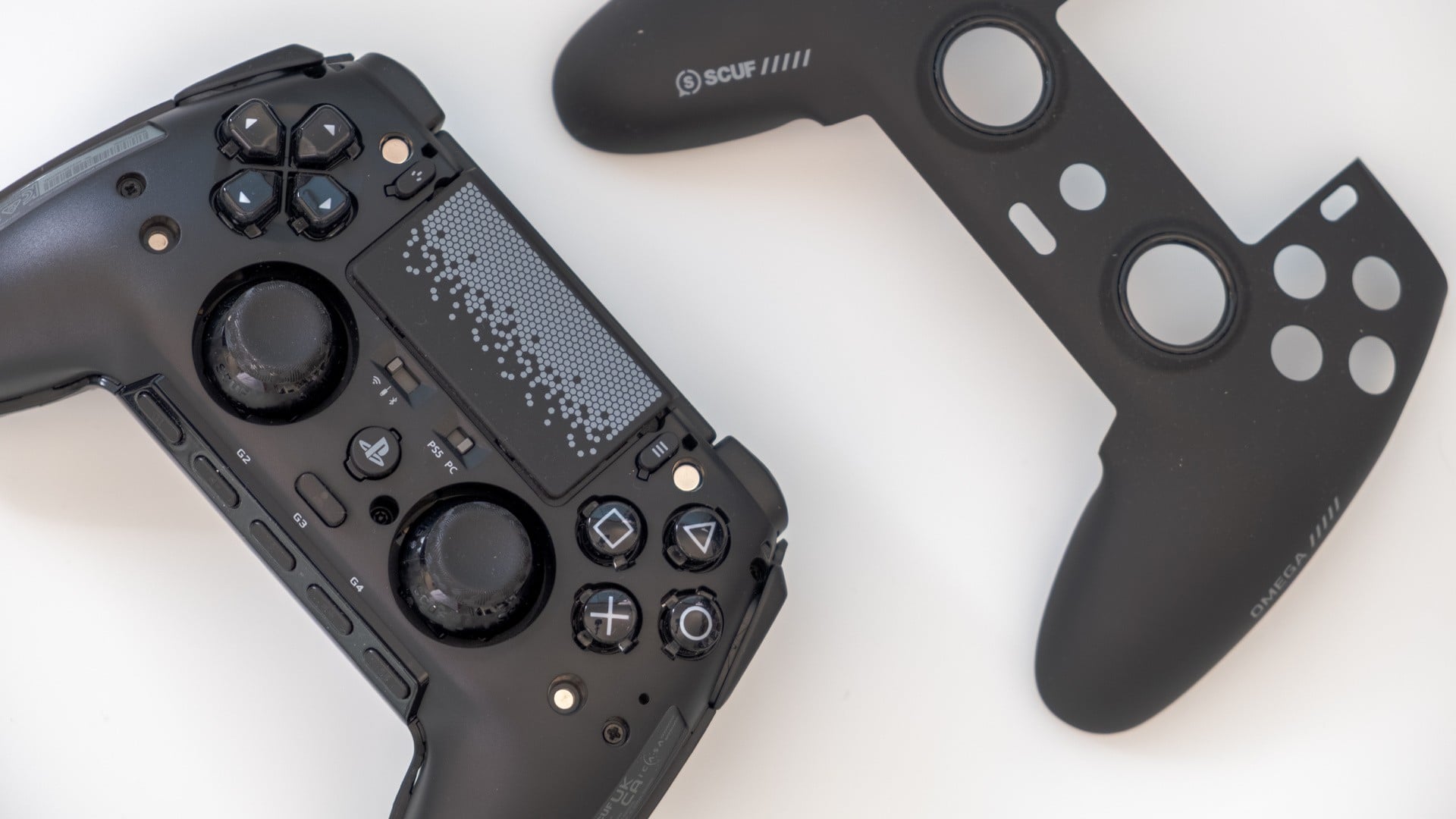
It's really hard to make a great third-party PS5 controller. Everyone, even a massive peripherals company like Corsair or Razer, needs to start out with one of Sony's official DualSense controllers, take off a bunch of stuff they don't want, add on their own gubbins, and then sell the finished product at a price that takes into account the starting controller price (£60), the Sony license and the value of the extra features. That's why the cheapest possible wireless examples that actually work in PS5 games tend to be way more expensive than a first-party controller - and why the focus shifts to adding on as many features as possible to justify that premium.
Enter the £210/$220 Scuf Omega. As the name (and the price tag) suggests, this is intended to be the ultimate PS5 controller, with a boat-load of competitive features: drift-resistant TMR sticks, 11 extra mappable inputs, hair triggers and mechanical microswitches. The Omega also supports gaming on PC, where you can ratchet up the polling rate from 250Hz to 1000Hz to increase responsiveness, and via Bluetooth on mobile devices.
Is it a great third-party PS5 controller? Yes, absolutely. Is it worth that much money? Well, you tell me. For a certain type of person that's heavily invested into the PS5 ecosystem and plays competitive games where these extra features can provide a critical advantage, it absolutely does the job. For pretty much anyone else, the standard DualSense controller is the better value option. But even for folks that don't need a controller that costs as much as three triple-A PS5 games, the Scuf Omega is still an interesting piece of equipment with some smart ideas.
Let's start with the design. What I really like about the Omega is that it doesn't feel like a controller with a billion different features - what's here is largely under the soft touch plastic surface, ready if you need it, invisible if you don't. When it comes to some controls, that is literally true - the switches to swap between wired, wireless and Bluetooth connectivity, or PS5 and PC modes, lie underneath the magnetically-attached top shell.
The extra inputs are also smartly placed to not interfere with "standard" grip styles. The five tiny buttons labelled G1 to G5, for example, are integrated atop the light bar that joins the two handles. In PS5 mode, G2 through G4 control headset volume and mic muting, with G1 and G5 reserved for extra functions, while in PC mode all five are fully remappable. These are great for triggering less common functions, like swapping between different profiles, and you can map them using the controller itself or the Scuf mobile app - which is a nice touch. The mobile app also lets you upgrade your firmware, which is a nice way to sidestep having an awkward PlayStation app.
The side buttons and rear paddles are easier to reach without relaxing your grip, so they're better used for more critical functions that you'd normally have to change your grip to trigger, like jumping, reloading and sliding. The more complex the game, the more useful these become. In Hades 2, for example, you're not really limited by the default collection of controls, but in something like Warzone having dedicated buttons for some less commonly used functions is super handy. And if you end up pressing these buttons by accident or just not using, you can replace them with blanks to prevent any controller-based mishaps.
The Scuf Omega is also the polar opposite of the Razer Wolverine V3 Pro 8K that I reviewed for Eurogamer in that it goes all-in on mechanical buttons, eschewing the softer membrane feel for a more immediate clicky feedback. This is where my personal preference lies, and these microswitches are used throughout: the d-pad, face buttons and hair triggers. The whole controller feels snappier and more responsive as a result, which is helped further by the zero-deadzone TMR sticks. Again, the controller is limited to 250Hz on PS5, so playing on PC at 1000Hz can also aid responsiveness in titles like fighting games that depend on precisely timed inputs.
The Omega is also a sharp improvement over the DualSense when it comes to battery life. The default PS5 pad can run dry after only a couple of long play sessions, while the DualSense Edge requires recharging more or less daily with regular use. The Omega isn't lasting multiple weeks or anything like that, but its 18 hour rated lifetime is still 50 percent longer than the DualSense's 12 hour maximum, and more than double that of the DualSense Edge's seven-hour lifespan.
Ultimately, the Scuf Omega is another beautifully crafted gamepad from the old masters, but it falls foul to the same high prices that preclude pretty much every custom PS5 controller from mainstream contention. Regardless, the combination of genuinely important spec upgrades with best-in-class usability make it worth considering for the lucky few with the budget for world-class machinery.
For PS6, I hope Sony opens up its third-party controller ecosystem. You can get some genuinely great options at the £100 mark on PC, where Chinese manufacturers like GameSir, 8BitDo and Gulikit are competing hard on price, incorporating new tech quickly and improving just as fast. PlayStation players deserve to benefit from these advancements too.