
 by
by Unreal Engine 5 has become a staple for modern video games, offering powerful tools and advanced rendering, though it's hard to see fast-paced racing titles as the most obvious fit for the engine's most advanced features. Star Wars: Galactic Racer aims to change this perception by pairing cutting-edge visuals with a smooth 60fps target on console hardware. There's also plenty of evidence that Fuse Games is staffed by a cadre of ex-Criterion developers, best known for their work on the Burnout series of destructive racing games.
At the core of Galactic Racer's visual presentation is ray-traced hardware Lumen global illumination, with its per-pixel diffuse GI delivering consistent lighting, realistic bounce light from environmental hazards and fine-grained occlusion. While high-speed movement and motion blur generally mask minor temporal noise or GI breakup, it's possible to notice these artefacts more clearly during quieter story moments or in photo mode.
Rather than pairing Lumen diffuse GI with ray-traced reflections, the developers opted for a screen-space reflection technique for specular lighting. This pragmatic choice works well because racing games use a forward-facing camera most of the time, allowing the engine to calculate clean reflections on puddles, ice and streams with less isruption from player camera manipulation that can unearth the usual SSR limitations.
The game also uses virtual shadow maps and even vehicle headlights are shadow-casting, which is a nice touch. Another key UE5 feature is ticked off with detailed Nanite meshes, ensuring that environment assets, foliage and player vehicles maintain high geometric fidelity. Although minor pop-in or texture blending flaws can occasionally be spotted upon close inspection, the overall visual impact remains convincing even at extreme speeds.
Beyond raw graphics, Galactic Racer captures the visual language of the science-fiction franchise, mirroring other recent outings in Star Wars Outlaws and Star Wars Jedi: Survivor, while drawing inspiration from classic arcade racers like Burnout and MotorStorm. Perhaps unsurprisingly then, the standout feature is the destruction system, which causes vehicles to fly apart upon impact in a spectacular fashion reminiscent of older genre favourites.
When examining hardware performance, the base PS5 delivers an exceptionally stable 60fps alongside crisp image quality driven by Unreal's native TSR upscaling, with a ~1296p internal resolution in its sole graphics mode. The PS5 Pro offers similar visual features but increases the rendering resolution to ~1728p for a sharper presentation in motion. Interestingly, TSR is still used here rather than PSSR, which may minimize the game's GI noise. Regardless, the image quality here is strong with an equally good 60fps lock.
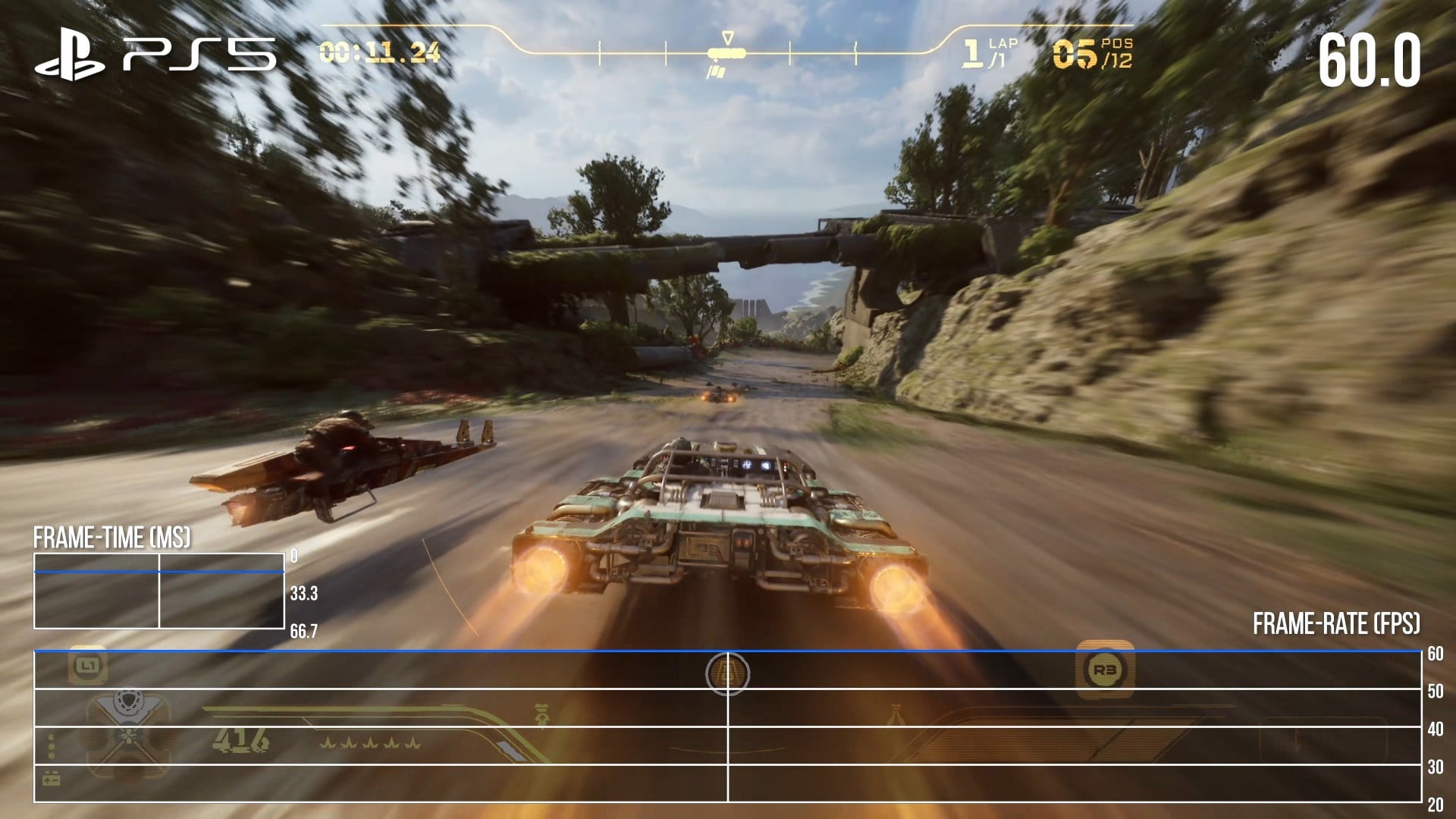
Xbox Series X matches the performance and visual parity of the standard Sony console, maintaining solid frame-rates and clean output. However, the Series S requires significant compromises, substituting ray-traced Lumen for baked lighting and lowering the internal resolution to ~864p to preserve smooth performance. The GI presentation is downgraded, with less clear directionality and coarser GI detail, though the changes can be extremely noticeable in some scenes and less so in others. Ultimately, it's a sensible cutback for Series S in service of a solid frame-rate and satisfactory image quality.
From a gameplay perspective, the title establishes itself as a proper arcade racer focused on approachable mechanics and branching track designs rather than strict simulation. It takes some time to master, but the core driving model feels rewarding and offers a refreshing change of pace for modern releases - more Dirt 5 than Forza Horizon. MotorStorm is a clear inspiration as well, as the game leans on some of that series' gameplay conventions, like cross-class racing and multi-route track designs.
Ultimately, Star Wars: Galactic Racer succeeds as both a technical showcase for Unreal Engine 5 and an entertaining arcade racing experience. It delivers robust performance and impressive visuals across all platforms, and comes highly recommended for fans of fast-paced racing action.