
 by
by 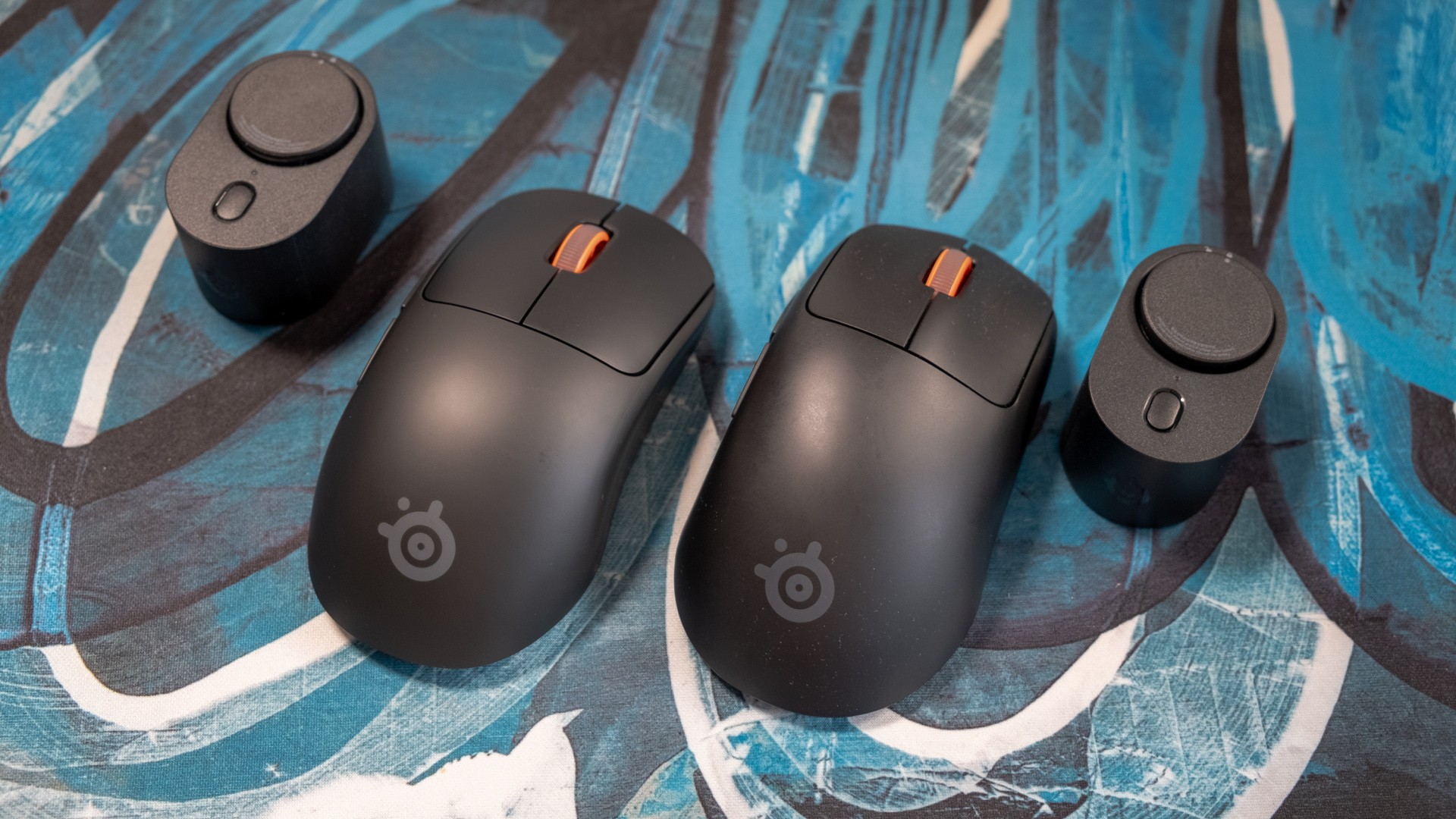
In some ways, it was inevitable: SteelSeries has finally brought its "infinite battery life" swappable battery system at the heart of its (DF-favourite) Arctis headsets to its gaming mice, thereby unlocking the responsiveness benefits of high polling rates without the annoyance of frequent recharges. Each £170/$180 mouse comes with two batteries, so one is used in the mouse while the other recharges in a dock. To make use of that extra juice, its new mice also support ultra-wideband wireless. That could be a winning formula for competitive players looking for a high performance mouse for esports, but how do the new ergonomic Rival Pro and symmetric Sensei Pro compare to other flagship models from other brands? I've recently tested the Razer Viper V4 Pro and Logitech X3 Superstrike, and the SteelSeries mice hold their own - and even carve out their own niche.
Before we get into the comparisons, it's worth covering the design and features on offer. Both shapes make for extremely lightweight (53g) designs, with high-end optical sensors, optical switches and the aforementioned support for 8K polling rates over an ultra-wideband connection. This is the first time we've seen UWB tech on a mainstream gaming mouse - last time out, we tested it in a keyboard. Ultra-wideband uses a much bigger chunk of higher frequencies versus standard 2.4GHz, so it's more resistant to interference and can send an order of magnitude more data. That has obvious advantages for a mouse designed to operate in crowded LAN halls while sending a huge amount of positional and click data.
Both models hew close to the likes of Logitech's X3 Superstrike physically, with a glossy black coating, convex separated buttons without comfort curves, a lightweight mouse wheel in fluro-orange, low profile side buttons and large skates that wrap around the central battery cavity. One oddity is that the mice have no USB ports at all - a move that SteelSeries tells me improves wireless signal strength. It's a simple, understated design that I quite like, though the coating does mean that the mice readily show fingerprints - as you can see in the gallery below.
| Specification | Sensei Pro | Sensei Pro Mini | Rival Pro | Rival Pro Mini |
| Shape | Symmetric | Symmetric | Ergonomic | Ergonomic |
| Dimensions | 125.6x66.5x38.6mm | 118x62.5x36.2mm | 125.7x68.2x42.2mm | 120.7x65.4x40.5mm |
| Weight | 53g | 49g | 54g | 50g |
| Sensor | TrueMove 42K Pro (up to 42K DPI, 800 IPS, 70G) | |||
| Wireless Connectivity | Ultra Wideband (UWB) with true 8K polling | |||
| Battery System | Dual hot-swappable batteries | |||
| Battery Life | Up to 120 hrs at 1K (across two batteries) Up to 32 hrs at 8K (across two batteries) |
|||
|
Launch Price (US/UK) |
$179.99/£169.99 | |||
| Release Date | October 13, 2026 | |||
When it comes to grip styles, the full-size mice are well suited for palm and relaxed claw grips, while the Mini versions of each style drop the weight to 49g with correspondingly smaller dimensions; players with smaller hand sizes or a preference for fingertip or aggressive claw grips are better served with the miniatures.
SteelSeries needed to make swapping batteries simple for the concept to work, and they've accomplished that. The battery just needs to be rotated a few degrees and lifted out to remove it from the mouse or the dock, which takes a matter of seconds. The mouse turns itself back on if a fresh battery is inserted soon afterwards, but needs to be manually turned on if you're lackadaisical. That on button, which also toggles DPI, is on the bottom of the mouse, and is the only additional button beyond the usual left/right, mouse wheel and forward/back side buttons. DPI settings are shown on a small LED on the left side of the mouse, and polling rate modes are shown with another coloured LED on the ovoid mouse dock.
Performance settings, key remapping and other changes are set in the SteelSeries GG software, including independent polling rates for movement and clicks, rotation adjustment, motion sync and single-digit DPI adjustment. It's a comprehensive package, and I was particularly intrigued by the inclusion of a max performance mode - which disallows the sensor from clocking down when idle - and a LAN mode, which cuts UWB transmission strength to prevent interference. (That could have helped in a recent Valorant Champions tournament, where developers Riot Games asked competitors to swap to wired mice.) The Sensei Pro and Rival Pro are also the first SteelSeries products to support the new GG web app, which includes core functionality like remapping, firmware updates and DPI setting, but misses out some of the most esoteric options.
After testing the mouse in fast-paced games like Hades 2, Wardogs, MechWarrior 5: Mercenaries and Counter-Strike 2, SteelSeries' latest holds up well against better-known competition in the form of the Logitech X3 Superstrike and Razer Viper V4 Pro. I ended up sticking with the symmetric Sensei Pro for most of my time with the mice, as I found it a bit more comfortable. The inclusion of the dual battery system means that I'm happy to keep Sensei in its highest power mode, though admittedly the X3 could be paired with a PowerPlay mousepad to achieve a similar level of battery nonchalance.
So configured, the Sensei Pro feels superbly responsive, especially when paired with a high refresh rate screen, and the combination of the classic shape, 50:50 front/rear balance and grippy coating make it easy to pick up and reposition the mouse as needed. I surprised myself with a few long-range assault rifle headshots in War Dogs, for instance, and also performed well in my usual Counter-Strike 2 deathmatch warmups. The clicks here aren't as pleasantly damped and immediate as they are with the X3 Superstrike, which I really get on with in its most aggressive setting, but the optical switches feel fast enough and produce consistent tactile feedback.
After relatively underwhelming SteelSeries mouse releases in the form of the 2020 Aerox (ventilated, weight-saving) and 2021 Prime series (solid, weight-saving, optical switches), the Rival Pro and Sensei Pro represent a proper generational leap that puts the company back on the map. The swappable battery system, ultra-wideband wireless, lighter designs, higher-grade sensors and web app make these mice extremely easy to recommend - despite their high launch prices.
In my own internal ranking, I'd put the Rival Pro and Sensei Pro right alongside the Logitech X3 Superstrike as the best FPS mice available, with the Razer Viper V4 Pro one rung below and Mchose's excellent value K7 V2 Ultra+ two rungs down. These are all excellent mice, but SteelSeries has by far the best charging implementation here, a move that permanently unlocks the high-end features that most players will eventually turn off in other wireless mice to save on battery life. If you like the shape and don't need or want Logitech's radically different click experience, these SteelSeries icons reborn should be your first port of call.
SteelSeries provided travel and accommodation to speak to the Rival and Sensei Pro's designers in Copenhagen, as well as units for this review.