
 by
by 
Before the end of 2025, we spoke at length with Ubisoft engineers responsible for porting Assassin's Creed Shadows to Switch 2. As the team members were generous with their answers, we're circling back to present some of the porting team's quotes and findings - along with their advice to other game studios working on their own ambitious Switch 2 ports.
Many of our conversation points with Ubisoft were borne from our prior coverage of the Switch 2 port: its lack of ray-traced global illumination (RTGI), its apparently smooth variable refresh rate (VRR) in portable mode, its frame-pacing issues in docked mode, its handling of screen-space ambient occlusion (SSAO) and its use of the Switch 2-compatible Nvidia DLSS technology.
We start by confirming something we learned about Ubisoft's Anvil Engine, which powers AC Shadows across PC and consoles. The engineering team members we spoke to referred to an Anvil element dubbed the "Platform Manager" as a key facet of scaling the game's performance from the highest-end PCs to the lowest-end consoles like Xbox Series X and Switch 2.
"The Platform Manager, our scalability system, is something that we were pretty happy about with all the efforts we did on AC Shadows previously [on other platforms]," Lead Rendering Programmer Sebastian Daigneault says. "We leveraged this Platform Manager to be able to define properly the scalability settings for docked mode and handheld mode. We have a ton of settings that we adjust - multipliers and things like that - between docked and undocked to keep the same experience that we had on the HD platforms. Everything is tied to dynamism, which is a super-big pillar of AC Shadows. So we tried to choose the proper recipe to make sure that we could still have the good experience tied to our strong tech pillars."
Like the Xbox Series S version, Switch 2 does not support RTGI in standard gameplay. When pressed about this, Ubisoft referenced the one exception - a hideout zone - where Series S enables RTGI, going so far as to suggest Series S could have enabled RTGI more frequently. "It was perfectly running in the world," says Rendering Technical Architect Nicolas Lopez. "It was a bit raging, to be honest, but we were very short on memory." Lopez then points to "shipping" the game as a reason to remove RTGI from the Series S version - instead of trying to balance constant memory shortages that might make the game crash or otherwise not run well.
That issue was even stricter on Switch 2: "The memory is very constrained, and then finding space for it is really hard," Lopez says. Complicating matters on Switch 2 is the "cut-in-half" nature of portable mode, plus Ubisoft's need to "make more aggressive use of the Async Compute Queue" in order to solve for "challenges with shader execution cost" on Switch 2. Lopez says Switch 2's ACQ is "very crowded, almost full," compared to less aggressive use on other consoles.
"It would be very difficult to make space on the GPU for the ray-tracing passes, but it's definitely something we're going to try in the future," Lopez adds. He hints to additional Switch 2 issues with ACQ: "Static compute work doesn't scale with resolution," thus taking away possible Switch 2 gains on this front when running at low base resolutions, and "the handling of group shared memory on the compute shaders is very tricky on this platform." The latter issue "requires some heavy micromanagement" to "spread wider on the ACQ."
Thankfully, AC Shadows has a pre-calculated, probe-based GI solution, which the Ubisoft developers have exhibited in a debug view in provided footage. Falling back to this system, as developed for the Series S version, gave the developers an easy optimisation win. Yet the probe-based GI on other platforms is supplemented by a ground-truth ambient occlusion (GTAO) variant of SSAO, which proved too expensive for Switch 2. Lopez confirms that a "cheaper SSAO that dates back from Far Cry 4," known as screen-space bent cone occlusion (SSBC), takes its place on Switch 2 - and can also be toggled on Steam Deck.
Screen-space reflections (SRR) are removed entirely, a concession to free up GPU time on Nintendo’s T239 hardware. In docked mode, Ubisoft suggests this cut frees up roughly 1ms of frame-time, a figure that doubles to about 2ms in portable mode. Efforts to add SSR are ongoing, and the Ubisoft team suggests the feature could potentially be added for docked mode, though portable mode is less certain. In the meantime, the game employs local cube maps, but not dynamic ones, as an optimisation measure - so you'll see proper sky colours in puddles and reflections but not accurate geometry.
The subtlest Switch 2 cutbacks involve AC Shadows' simulation elements. Clouds run more efficiently because, according to Senior Engine Lead Bruno Champoux, Ubisoft "increased the distance between each [cloud] simulation point." Similar tweaks are found in cloth and rope assets, with the "bones" that make up their simulation being reduced, while other cloth assets are wholly disabled.
Tree branches can no longer rotate under heavy winds, and vertex shaders used to animate trees are simplified. The density of scattered objects in the wind has been reduced. And animations in general are still driven by the same Atmos system that fuels the other console platforms - with constraints that limit onscreen articulation. Champoux confirms that the "hard-coded AVX2 intrinsics" that fueled simulation algorithms for the other platforms' Intel and AMD CPUs had to be ported to NEON, an ARM platform, as well.
"For the trees, on the game's more high-end versions, in the vertex shaders, we traverse a hierarchy of branches, and each branch is linked by a spring - to which we apply a force to animate the branch and the hierarchy with the wind," Lopez says. "This [enables] secondary movements. The trade-off is that the trees' vertex shaders are very costly. This was not necessarily a problem on PS5 or Xbox, because the vertex shaders didn't take so much time, because we were bound by alpha test. But on a lower-end platform, it was more challenging, and we had to cut some things."
Shrinking the game's install size to 61GB was as simple as removing the largest assets from the default installation package that Switch would never access - namely, 4K-minded textures and "level-of-detail (LOD) zero" models. Ubisoft didn't learn until late in development that the game's install size would fit on a physical cartridge, but the team still believes that local installation on either built-in storage or a microSD card is essential: "the speed of the cartridge is not able to feed the game," Champoux says.
One major engine element that reached Switch 2 unscathed is its micropolygon geometry. The Ubisoft team weighed having to take drastic measures: "Should we bake the meshes into standard LODs to have a better balance in terms of size and GPU performance when they're rendering the mesh?" Daigneault said. His team found the existing micropolygon solution worked - and to test this hypothesis more clearly, the entire city of Kyoto was deleted "to see if micropoly was really killing the GPU or not," Lopez adds.
AC Shadows diverges from the other console ports' choice of anti-aliasing and upsampling, which employ TAAU or the PS5 Pro-exclusive PSSR. The Switch 2 port employs Nvidia's DLSS - and our own tests suggest this is probably a higher-quality DLSS variant. Compared to the PC version, running with DLSS 3.7, very similar kinds of stylisation are evident in freshly disoccluded areas of the image, suggesting a similar technique.
Daigneault admits that AC Shadows' Switch 2 development began with tests of Anvil's built-in TAAU system, as it required less GPU processes to run compared to DLSS. "But we saw that DLSS was giving very good results [upscaling] from lower resolutions to 1080p," he says. Portable mode resolves a 720p image using DLSS, which is then upscaled using a low-cost filter to 1080p on the portable screen. AC Shadows' dynamic resolution system maxes out at 600p base pixels, with lows closer to 400p, according to the developers. Docked mode, meanwhile, uses a 1080p DLSS output with a maximum internal resolution of 900p.
Unfortunately, AC: Shadows on Switch 2 continues to suffer from poor frame-pacing while docked. Ubisoft's devs believe the issue comes down to operating at too tight a frame-time margin on the Switch 2, as over-budget frames are more common on the hybrid system. "We are just on the edge of the razor," Lopez says, even though frame-time judder occurs even in seemingly lighter rendering moments. In any case, the developers suggest they "continue to put efforts into optimisation."
Handheld mode largely sidesteps this concern. Here, the developers use VRR with low frame-rate compensation to achieve a more stable frame-rate, even though their 30fps frame-rate target is beneath the 40Hz VRR minimum the Switch 2 screen appears to have. "We insert an extra frame," Lopez says. "We are representing the same frame in the middle of the next frame to fake 60Hz, so that VRR can trigger and then smooth the final result." Daigneault says that this strategy came from collaborating with the Star Wars Outlaws Switch 2 porting team. "We are seeing with Nintendo also how we can improve such things in the future," he adds.
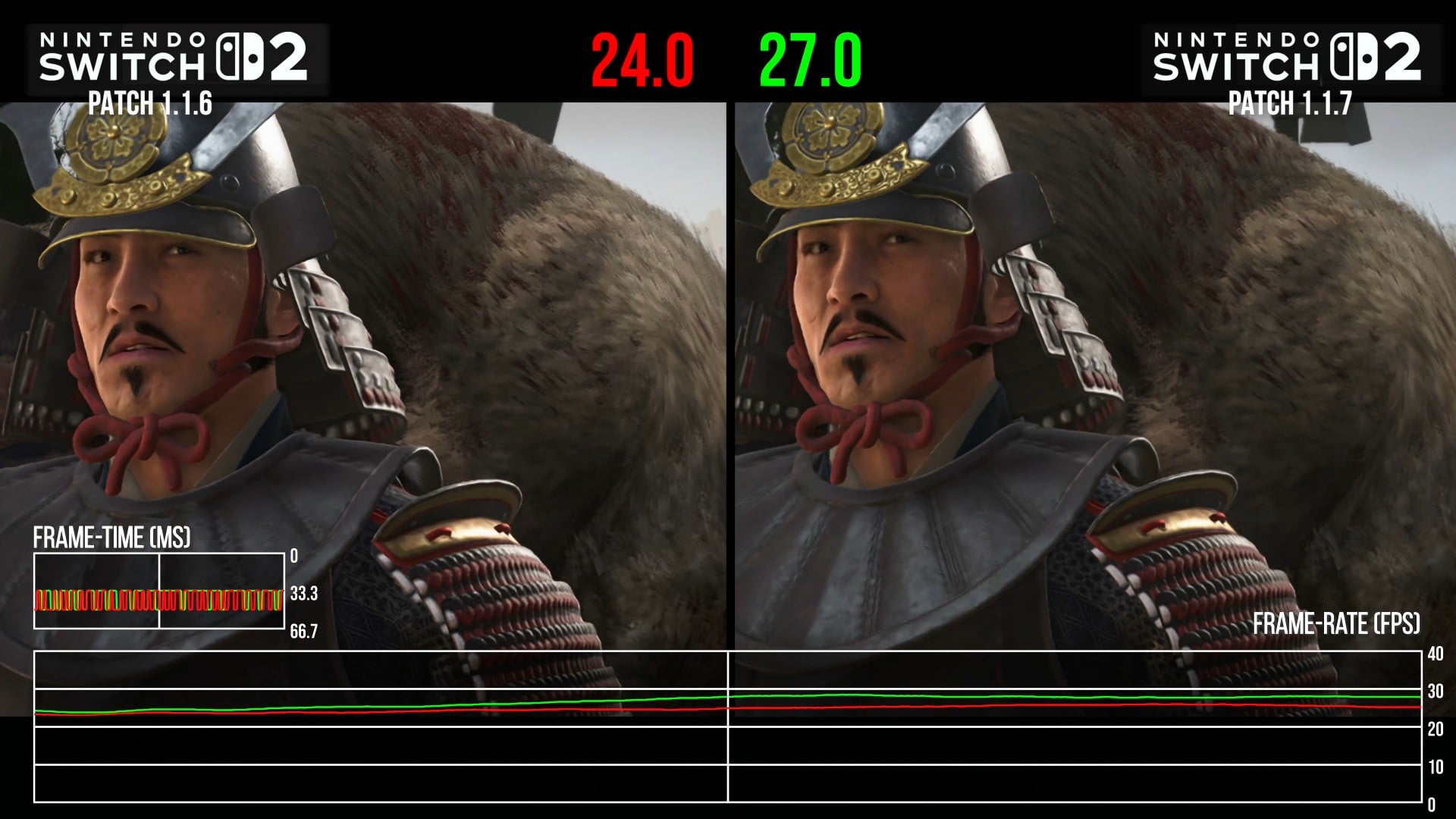
In the weeks since our chat with Ubisoft, patch 1.1.7 went live to address some issues with frequent game crashes, and our brief testing confirms fewer crashes along with firmer adherence to a 30fps frame-rate compared to the game's launch code. But poor frame-pacing remains an issue while playing the game in docked mode, leaving it far easier to recommend AC Shadows on Switch 2 as a portable adventuring experience.
Ubisoft's general advice to game makers with Switch 2 port aspirations is simple: start early. "It cannot be an afterthought - like, you do all the other platforms and then, oh, let's port to Switch 2," Daigneault says. He mentions his team's experience with porting Immortals: Fenyx Rising to Switch 1, adding, "we could already set a plan and leverage that experience for the [AC Shadows] Switch 2 port. All the investments we had in scalability really paid off. If your engine doesn't have a strong scalability system, that's going to be hard on [a low-spec] platform."
"Nintendo really improved their SDK, tool chain, and everything versus Switch 1," Lopez says. "It was really a pleasure to work with the hardware and the SDK. Honestly, I was surprised. Some people called it an impossible port, and it can sound a bit impossible at the beginning. But the key is to understand the specificities of the GPU architecture. Like sometimes we faced problems that we didn't know how to solve because we're so used to working on the RDNA architecture with PS5 and Xbox. To solve this, we had to dig into how the shader compiler worked and how shaders are processed by the [Switch 2] GPU to understand why sometimes they were so slow and how we could make them faster just by tweaking a few things. It's the kind of things that don't really exist on other platforms. You really have to understand this."


Comments 4
Very interesting interview! I hope they improve their scalability systems for future games, though, because while AC Shadows is very much the same game on Switch 2 with cutbacks, the actual cutbacks are really felt in some areas - water and lighting in particular. Maybe they could learn from or even leverage Star Wars Outlaws engine for Switch 2 versions.
Interesting read! I’m currently playing on Switch 2 and it’s still AC Shadows but it’s very rough in some places. In handheld mode, the default HDR presentation also looks really off with a significantly raised black level floor. Disabling HDR for the internal screen in the Switch 2‘s system settings improves the contrast significantly.
I tried the game on SteamDeck at launch but returned it because I found it very unstable in larger cities. Their VRR implementation on Switch 2 definitely helps with that. However, I‘m not sure if their use of DLSS is the best idea. I remember the TAAU looking pretty sharp on SteamDeck and with the extra frametime they might have been able to include SSR at least.
Reading that VRR helps a lot undocked reopens that same wound - I'm really hoping for a software or dock-based solution to VRR when docked. I will very much not be pleased to own a bum Switch 2 if the only solution is a console revision.
" AC Shadows diverges from the other console ports' choice of anti-aliasing and upsampling, which employ TAAU or the PS5 Pro-exclusive PSSR. The Switch 2 port employs Nvidia's DLSS - and our own tests suggest this is probably a higher-quality DLSS variant. " Is this guy really saying that there's one aspect of the 5 time less powerful switch 2 better than the ps5 pro ? Ps4 pro is more powerful than switch 2. There's not a single aspect of the switch 2 that can top the ps5. Resolution, rt, fps and all the numerous details. Sad like hell we can't reach these guys who waiting these things
Show Comments
Leave A Comment
Hold on there, you need to login to post a comment...