
 by
by 
Yesterday, Digital Foundry's High on Life 2 video review went live on YouTube and it's interesting to see how the established shortcomings of Unreal Engine 5 are dominating reaction to the review, as opposed to our commentary on the game itself - where we found the game to be a substantial improvement over its predecessor, rich in creativity and innovative ideas.
Let's get to the bottom of the criticism. High on Life 2 has one graphics mode only, targeting 60 frames per second while rolling out all of Unreal Engine 5's core visuals features: Nanite micro-geometry, Lumen global illumination and virtual shadow maps. The more any given developer sinks into the quality of the pixels on-screen, the fewer of those pixels can be natively rendered and that's where upscaling comes in to "make up the difference".
PlayStation 5 renders internally at circa 720p, while Xbox Series X comes in with a relatively modest boost to around 792p. PS5 Pro disappoints: while there are options for the UE5 standard TSR upscaler and Sony's own PSSR, neither of them feel like much of an upgrade over the standard consoles, with similar resolution to PS5 and Series X, albeit with slightly smoother performance. Xbox Series S? Resolution is slightly lower but more to the point, Lumen GI is stripped out while shadow quality and texture quality are reduced. The game loses much of its visual identity.
While High on Life 2 targets 60 frames per second, none of the consoles successfully achieve it on a consistent basis - and while a VRR display helps, what may well be CPU limits see frame-times move outside of the variable refresh rate window, so the game still stutters.
What we're looking at here is a developer looking to deliver all things to all people: the visual finery of Unreal Engine 5, paired with the 60fps gaming that users crave. However, certainly with the existing builds of UE5 used for the current crop of titles, something has to give - there's no such thing as a free lunch in rendering. Going into the generation, Epic's own demos for UE5 saw circa 1080p internal resolutions upscaling to 4K with a 30fps target.
At this point, the trades with UE5 are a given - but we still had a lot of fun with the game. It's a rare shooter where its influences are obvious but still feels fresh. You can sense the echoes of Sunset Overdrive, the modern Doom games, Halo and even BioShock Infinite. The combat is free-flowing, the traversal is wild but elegant. The headline addition is the skateboard - basically a first-person "sprint" mechanic tied to pressing down the left stick, with slick environment interaction that works without distracting from the shooting.
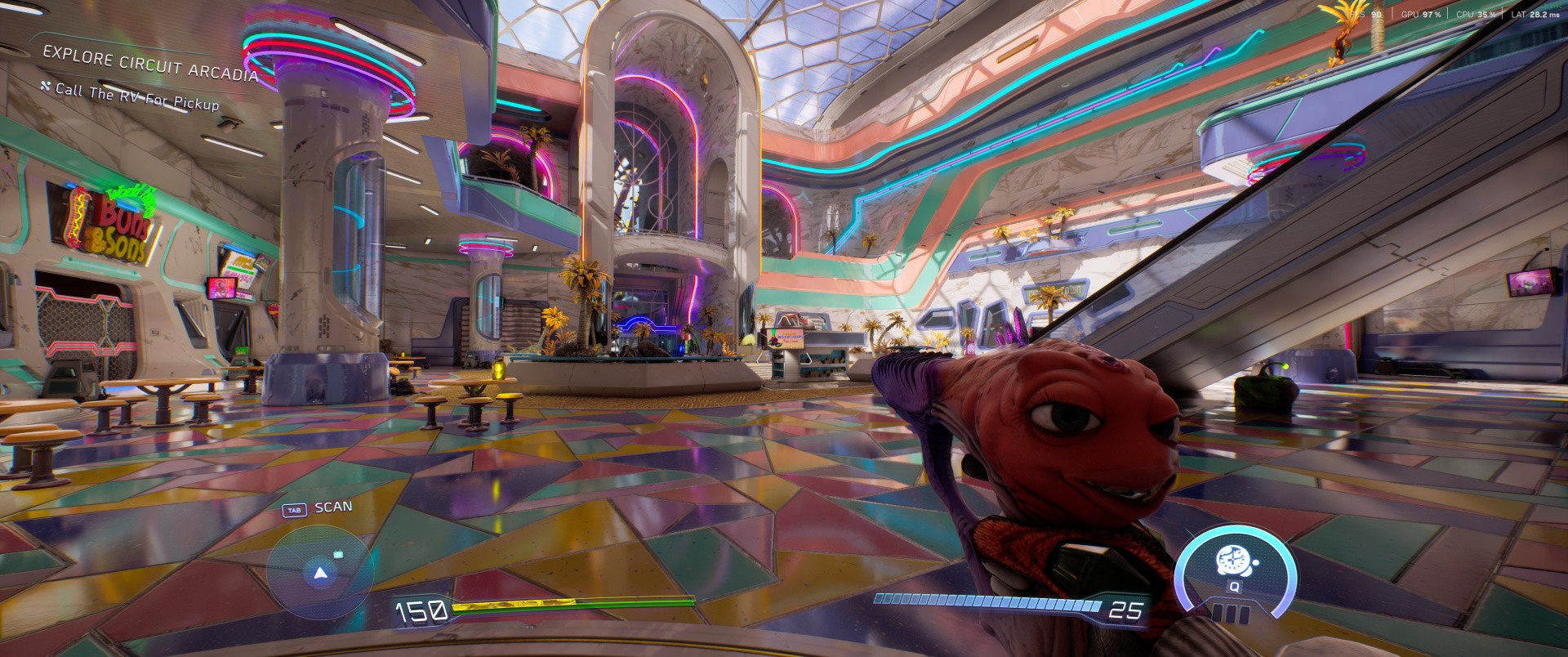
All of this is wrapped in a stylised, CG-like presentation that is a massive improvement over its predecessor. characters and props look almost perfectly rounded, polygon edges are basically gone and Lumen’s global illumination helps integrate characters and environments into a cohesive aesthetic.
And image quality and performance controversies apart, it's a good-looking game - albeit with some issues. The developers lean heavily into very clean, mirror-like reflective surfaces while using software Lumen, which exposes its limitations. The SDF-based Lumen scene is largely static and low detail, producing “blobby” reflected approximations rather than the crisp, fully geometric reflections you might expect. It's a far cry from the reflections seen in, say, Ratchet and Clank: Rift Apart or Insomniac's Spider-Man games. Reflections look messy, while the PC version has no hardware Lumen option to improve the situation.
The extensive use of screen-space contact shadows is another curious decision. While these can look good on fine detail, High on Life 2 pushes them onto larger elements like trees, bridges and even characters. When a character or object leaves the camera’s view, its shadow should remain, but disappears instead. The artefact is obvious, compromising an otherwise strong lighting setup.
But it's the image quality and performance issues that are dominating the discussion - and you have to wonder whether one graphics mode alone was the best option. It keeps things simpler for the user, but you can't help but wonder whether a 40fps balanced mode for those with 120Hz screens could have delivered a consistent experience - eliminating CPU bottlenecks and perhaps even increasing the dynamic resolution window. A 30fps quality mode is another option, but the stats from Sony in its PS5 Pro reveal suggest that 75 percent of users go for 60fps performance modes instead - and it's perhaps not the best way to experience a shooting game.
PC allows users to power past the issues but while John had only minor issues with a high-end rig, subsequent testing with a Ryzen 5 3600 paired with an RTX 4060 was a pretty miserable experience. Even on medium settings with DLSS performance mode at 1440p, bad stutter and depressed frame-rates suggested that this game may not be friendly to 8GB GPUs.
Moving up from a 4060 8GB to a 4060 Ti 16GB improved matters significantly, allowing us to return to high settings without as much stutter - only now the background streaming systems can hit the limits of the Ryzen 5 3600 causing frame-rate drops into the 40s at points. And even then, GPU limits at 1440p DLSS performance mode see us in the 50s in heavier scenes - and all of this testing is just from the intro areas.
Put simply, this is a heavy game that's going to require a decent PC to run well - but when you deploy massive horsepower on the PC side, the results are simply beautiful. On the flip side, however, broadly console-equivalent hardware doesn't deliver console-equivalent performance based on my testing. In that respect at least, the consoles - bar Series S - are delivering more, but not enough to solve the perennial challenge of running challenging UE5 fare at high frame-rates with good image quality with all the engine's bells and whistles. That'll likely require a more modern iteration of the engine (High on Life 2 seems to use UE5 5.5.4.0) and perhaps better budgeting to the limitations of the consoles.
Comments 13
I watched John and Oliver’s video yesterday and thought: it runs better on console than a lot of the other UE5 titles, it seems.
Haven’t played HOL2 yet, but it does seem to me that UE5 has been sort of disappointing this console gen. Not saying I haven’t enjoyed games with UE5, but it seems like other game engines manage better than UE does at this point. I think about Decima with Sony, seems like it’s a solid engine.
High on life, low on frames.
720p. That was the target for X360 games, and yet here we are, current gen, 720p. Add to that lots of ugly screen space artefacts, horrible blurry, unstable image quality, an inability to lock to 60fps despite the decades old resolution target, and ugly splotchy lumen reflections and lighting. And this is a brand-new game, with all of those issues.
The game itself is okay enough I guess, a reasonable shooter with pretty vague combat, fun traversal, and a truly horrible soundtrack. I do quite like the wacky character design, but I'd prefer to see it on a more competent game engine.
I've tried it on PC too where it looks better, but those stutters, those relentless, merciless, never ending Unreal Engine stutters. I couldn't take it much more than an hour or so before it drove me mad. And the god awful "soundtrack". Seriously, what were they thinking with that? Was it made by AI? By someone on acid? Or maybe just a random note generator. It's just dire.
It's not totally without merit, but it's nearly ruined by Unreal Engine.
@SodaPop8456
UE5 has been a bit of a failure in general performance terms, whilst I agree there is a lot Epic could do (and seem to have done in 5.7) most of the issues fall on the shoulders of developers. There are great UE5 games with no performance issues, the devs put in the work, others did the bare minimum and that is why they have problems. The main one seems to be incomplete shader passes which is something a dev can solve, Valve have solved it in the Deck for verified games and Intel are doing it with their shader butler program, but devs should be doing this by default.
Ah well, UE5 just doing it's thing I guess. Ubisoft selling the rights to use their amazing Snowdrop engine to interested parties could help both them and the industry at large.
@MattGPT I greatly dislike that much overused trope that devs are lazy. No they are not. The UE5 games which run acceptably are the ones which don't use the features UE5 was sold on, lumen and nanite. And they use smaller maps and so get around traversal stutter.
When devs do use the features the engine is supposed to be able to do, then things run badly. This is on Epic, they produce a product which simply isn't good enough.
I think they should have disabled screen space shadows, used shadow maps over VSM and cube maps over lumen reflections for glossy materials and this might have let them claw back to a higher resolution. The higher options would have been fine for high end PCs. Also, why is hardware lumen very rarely an option on PC, even on these newer unreal engine builds.
@LawrenceMurray
In essence software Lumen will run on everything, but hardware Lumen only runs well on console if the whole game is well optimised or on a high end PC, there is a reason even Fortnite uses software Lumen on console, the additional CPU and GPU overhead is not worth the improvement in lighting. Less of an issue at 30/40fps but at 60 it is too big a hit to performance.
In theory the dev can just tick the box and let the engine take care of it, but it usually requires quite a bit of work as it traces against actual geometry rather than the SDF that software Lumen uses, that means that geometry culling is more important, light leaks need to be checked for and it can absolutely tank performance in what seems like random locations even if it seems to work fine in other places.
I have been playing around with a few very simple projects before I move onto a more complicated one I have in mind on software Lumen performance is just a certain level, turn on hardware and without other optimisations it can destroy performance. Looking at the level design and clutter in HoL2 there is no way that will play nice with hardware Lumen without them putting in a huge amount of additional work, which probably is not worth it from a financial standpoint.
If they wanted to improve things on high end PCs they could just push out the distance further, for software Lumen, at the cost of a bigger hit to CPU.
@ramu-chan
You can claim you dislike a trope of laziness, but that is a straw man, I did not say that devs were lazy, I pointed out that most if not all of the issues are solvable with additional work. I suspect that the vast majority of devs themselves would rather put the extra work in to make a game performant, but they are likely constrained by publishers and accountants, as long as a game is "good enough" then most publishers will want it shipped, they worry far less about polish than the development team would.
UE5 is a tool, turn everything on and do not optimise and it will run like garbage, but so will nearly every engine. Power budgets have to be managed, things need to be optimised and tailored to specific levels of available hardware power.
A low level of traversal stutter is pretty much inevitable in large maps on UE5 unless they are simple, but with careful optimisation they can be reduced to one or two frames on high end kit, and a handful on mid range PCs and console, whilst also only happing periodically, in parts of a game where they do not cause issues. That is however very different to shader compilation stutter which is something that devs can entirely solve themselves with proper shader collection passes and pre-compilation burns. Other issues with UE5 are somewhere in the middle, the feature might work if you turn several on, but turning everything on without optimisation will bring even powerful systems to their knees, or turning some of them on but with something with very poor optimisation will do the same.
Clair Obscure runs great, with few issues, on average hardware, Black Myth Wukong runs poorly on almost anything, some of that relates to design, but a huge amount is related to optimisation, BMW is vastly better now than it was at launch.
"But a clever, fun game shouldn't be overlooked."
This is what I think whenever the gang says the PS3/360 had the worst games of any generation because framerates weren't locked!
Honestly that's the core. I love you all because you do these hardcore technical reviews. At first I thought it was weird that you didn't do normal reviews but then I understood it: you're tech guys and you do technical reviews. You've made a living focusing on the parts of games that usually get ignored by mainstream reviews. You're hardcore, all about the tech. You'll review a game and never really describe the gameplay or talk about if you enjoyed playing it or not. You do tech reviews. You're all about the tech.
Because of that, it's super weird for you to come out with a "But a clever, fun game shouldn't be overlooked" style review. You're the guys who overlook an entire generation because framerates weren't locked. It's off brand.
"Ryzen 5 3600 paired with an RTX 4060 was a pretty miserable experience"
Please check experience on minimum settings:
Processor: Intel Core i7-8700K / AMD Ryzen 5 1600X
Memory: 8 GB RAM
Graphics: NVIDIA GeForce GTX 1060 6 GB / AMD Radeon RX 5600 XT 6 GB / Intel Arc A380 6 GB.
720p on existing consoles is for me personally unacceptable. They do not have good enough upscaling to get away with Xbox 360 era resolutions. Simply put they cannot run all these features with good enough image quality and framerate. Recent Nvidia hardware comes through with the save on PC. It only really highlights how unrealistic UE5 was for console hardware targets. An engine with demands at least three years ahead of where it should have been for mainstream GPU performance. I don't know what they were thinking at Epic, I really don't.
@PGR And yet when you look at Ubi's Anvil engine, it has a superior feature set to UE5, and yet has far better performance and far, far better image quality.
AC Shadows has virtual geometry, hardware RT GI and reflections (which is light years ahead of UE'5 splotchy software Lumen mess), and it can happily run at around 1440p on PS5 at 40fps. Or at 60fps if you sacrifice hardware RT GI. And no stutters at all. Plus huge draw distances, great physics sims and so on.
There's no world in which a UE5 game is getting anywhere near that on a PS5. Anvil and Snowdrop show what is possible on current gen hardware. UE5 is poorly optimised bloatware.
Show Comments
Leave A Comment
Hold on there, you need to login to post a comment...