
 by
by With 2025 in the rearview mirror, I wanted to reflect on the year gone by talking about my top five games of the last 12 months - and it ended up being a bit of a Nintendo Switch 2 Edition of its own. Basically, everything Nintendo shipped this year was a winner, barring perhaps the tiring Drag X Drive and the troubled Pokémon Legends Z-A. This breakneck pace will inevitably slow as we reach 2026 and 2027, but Nintendo eased the typical post-launch software drought better than any other platform holder in recent history.
I’m also quite happy with the Switch 2 hardware. Pre-launch extrapolations of hardware capability seem to be broadly correct, but the modernity of the tech allows it to achieve great things. In particular, I’m fond of the use of tiny DLSS options that deliver okay image quality but with excellent performance. The hardware’s ray tracing acceleration also seems capable enough to tackle demanding current gen games like Star Wars Outlaws.
And the experience of using Switch 2 has been really pleasant. There’s something so freeing about the Switch concept - the idea of a hybrid console that accommodates every play scenario - and Switch 2 takes it to a new level of capability. Plus, it’s usually a lot smoother than PC handhelds that might fulfill a similar role, which have clunkier software, zero exclusive games, thick and heavy shells and power-hungry architectures. Wherever you are, whatever you’re doing, the Switch 2 is a reliable companion - and you certainly can't go wrong with any of the games listed on this page.
5. Metroid Prime 4: Beyond
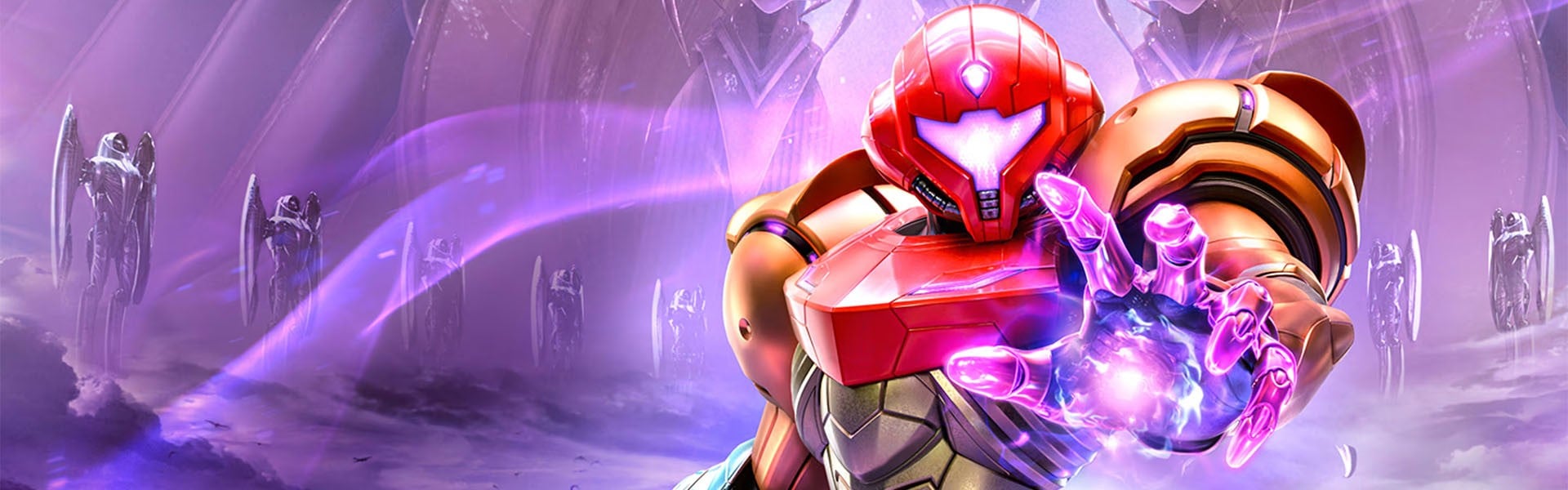
The long-dormant Metroid Prime series seemed to be dead after 2007, with the release of Metroid Prime 3 Corruption. Metroid Prime 4 revives the series after that 18 year interval, but bereft of modern gameplay systems fans may have been expecting. It’s basically a retread of the Corruption model, with its more guided exploration and greater focus on precise weapon targeting.
This is a very binary Metroidvania. Hidden areas are typically unlocked with a deployment of just one key power-up, rarely presenting any ambiguity or complexity. Fans who were hoping for a series revitalisation in line with recent Zelda titles and their open world, physics-based complexities are out of luck.
But I don’t think that’s necessarily a bad thing. There aren’t many games like Metroid Prime, and the intervening years between Primes 3 and 4 have made the core gameplay feel more novel. It’s also a good time for gamers who want a gentler experience, with some of the hard edges of the first two games sanded off.
The NPC comms suggestions are perhaps the most controversial part of this game, but I didn’t find them particularly offensive. The most you’ll typically hear is a prod pointing you towards the right general area, without a clear directive on how to complete a puzzle or anything like that. It eases frustrations without trivialising exploration.
Plus, the game’s visuals are often breathtaking. Prime 4 has some of the most captivating lighting I’ve seen in any game, period. Baking out lightmaps at this level of fidelity is probably quite time-consuming from an artist workflow perspective, but the outcome is some of the best lighting around on either Switch console. Artwork looks fantastic too, with striking visual designs. If the game didn’t have such a pleasing visual character, I think it would be a lot less appealing.
Retro’s RUDE engine produces phenomenal results - and that extends to the original Switch hardware as well, where Prime 4 is chunkier and softer but otherwise proves a match for its more powerful sibling. This is definitely a game that was built around the Switch 1 and all of its limitations, but Switch 2 gives the artwork far greater detail and clarity with its effectively quadrupled pixel counts.
4. Kirby Air Riders
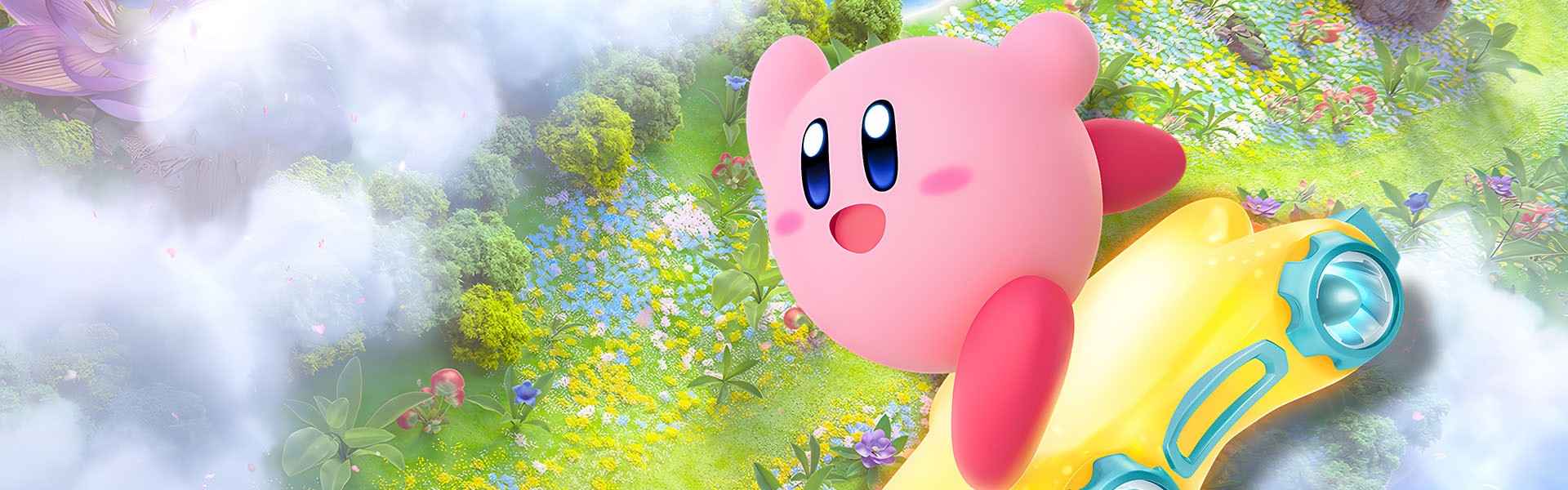
Kirby Air Riders is a weird game. It’s a third-person racing game but it’s also a top-down racing game, a party game, a minigame collection and a roguelite adventure, all jammed into one experience. Nearly all in-game actions are mapped to just two inputs - the left analogue stick and one digital button - and it’s a sequel to a poorly received 22-year-old GameCube title, which shares its basic gameplay.
But the beauty is really in the execution. Cameras are perfectly calibrated, particles look explosive, and stages look beautiful. There’s a wonderful range of driving characteristics between the various vehicles and riders, as basic driving mechanics shift wildly between the various options. As a racing game, there’s a lot to like here, with remarkable depth despite its two-input design.
Plus, there’s a City Trial mode - a competitive party game where players race to assemble the most powerful kart - and a randomised Road Trip mode, which combines every minigame and race type into one two-hour story that takes you through a series of on-rails environments. The same core mechanics can be viewed through so many different lenses.
I do have a few caveats to offer about the game’s progression structure, which basically takes the form of five checklists, with 150 items in each. Often, I’d complete a checklist item to my satisfaction - like leading a certain number of laps, or completing a race in first place - only to be stymied by some unspecified additional parameter that isn’t listed in-game and fail to complete it. It’s fine to have achievement-oriented progression, but poking around guessing at what these checklists mean isn’t especially entertaining.
It’s also an easy game - to its detriment. Single-player racing is breezy, and I even completed the stricter items - like beating level eight racers - on the first attempt. Online play presents a true challenge, but single-player races breeze by. The core racing is a blast though, and Air Riders is absolutely loaded with content and gameplay types. I expect I’ll be coming back to this one a lot over the coming years, as this is a uniquely polished, wild racing experience.
3. Fast Fusion
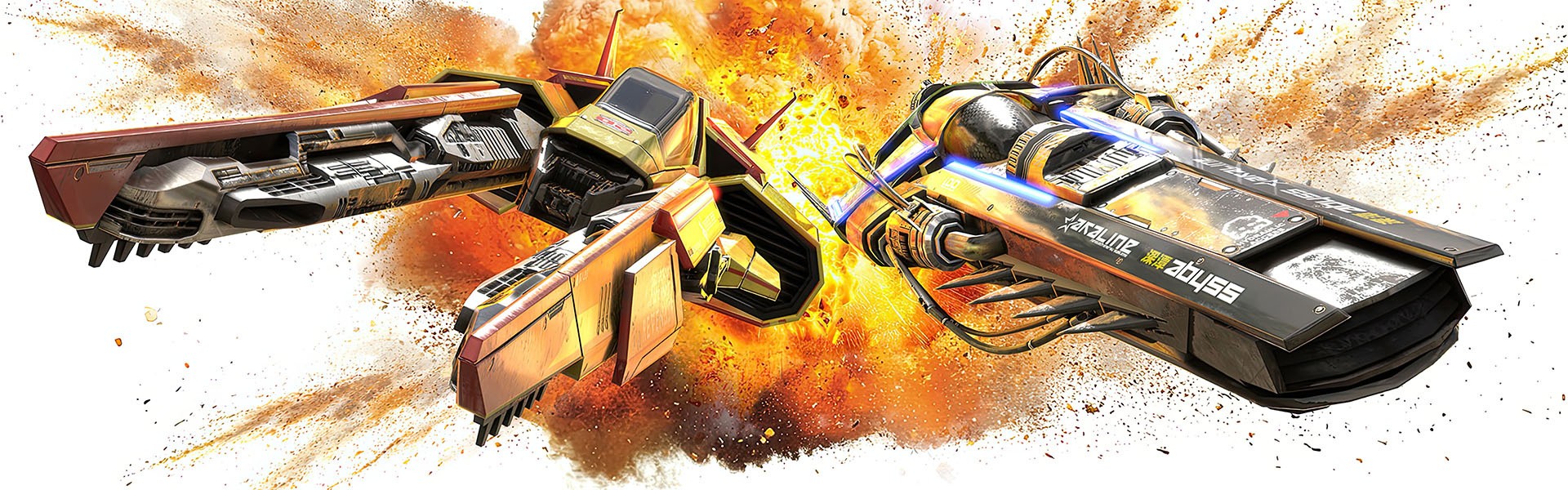
Fast Fusion is everything I could have wanted from a Fast racing sequel. It’s an outstanding looking game, for starters. The lighting is rich and detailed, materials look true-to-life, environmental assets are great, and the game proceeds at a locked 60fps. There are few racing games produced at this level of fidelity, even on platforms with more hardware grunt.
A direct comparison to Fast RMX in the game’s returning tracks reveals huge leaps since the last series entry, with a generational improvement in visual complexity. Shin’en always produces outstanding technical work on Nintendo platforms, but this game is a true standout. The game’s HDR produces a pleasing result as well - at least on a good television or monitor - with searing sunlight and fluorescent vehicle light strips.
I also greatly appreciate the various gameplay tweaks that have gone into this game. I enjoyed Fast RMX, but the game was a little too punishing for my tastes, and I found it difficult to progress more than about halfway through the game’s difficulty ladder. Fast Fusion, in contrast, is a slower game, where obstacles don’t require superhuman reactions to avoid. The subsonic difficulty is a good warm-up, but supersonic and hypersonic feel appropriately paced.
One key camera tweak also makes the game much fairer relative to Fast RMX. In Shin’en’s last Fast racing title, engaging boost dramatically widened the field of view and shifted the camera position down, to enhance its perception of speed. Unfortunately, this made it harder to see the track ahead and to avoid on-track obstacles and barriers. This encouraged more strategic boost deployment and track memorization, but I found it frustrating at times.
In Fast Fusion, your field of view is widened somewhat while boosting, but you can still easily follow the track ahead. This one small change makes Fusion a lot more approachable, especially in the higher speed categories where boosting used to blind the player for long stretches of track. Fusion is, at its core, a really capable racing effort as well. The basic racing mechanics feel polished, enemy AI offers enough challenge without feeling exploitative, and track designs are inventive and thrilling.
It’s an especially remarkable game because, according to its credits, Fast Fusion was seemingly developed by a core team of four people, plus two individuals who are only credited with music contributions and one voice actor. Manfred Linzner in particular seems to have driven much of the project, credited with game design, track design, game programming, engine programming, executive production, additional music and sound effects.
Fast Fusion is a fully featured racing game that stands among the best arcade racers produced in recent years, and it was developed with an extremely lean, incredibly efficient production relative to other games in the genre. Perhaps as a result, it’s offered for a mere $15 USD on the eShop, which is a total steal. It’s easy to sink dozens of happy hours into this game.
2. Donkey Kong Bananza
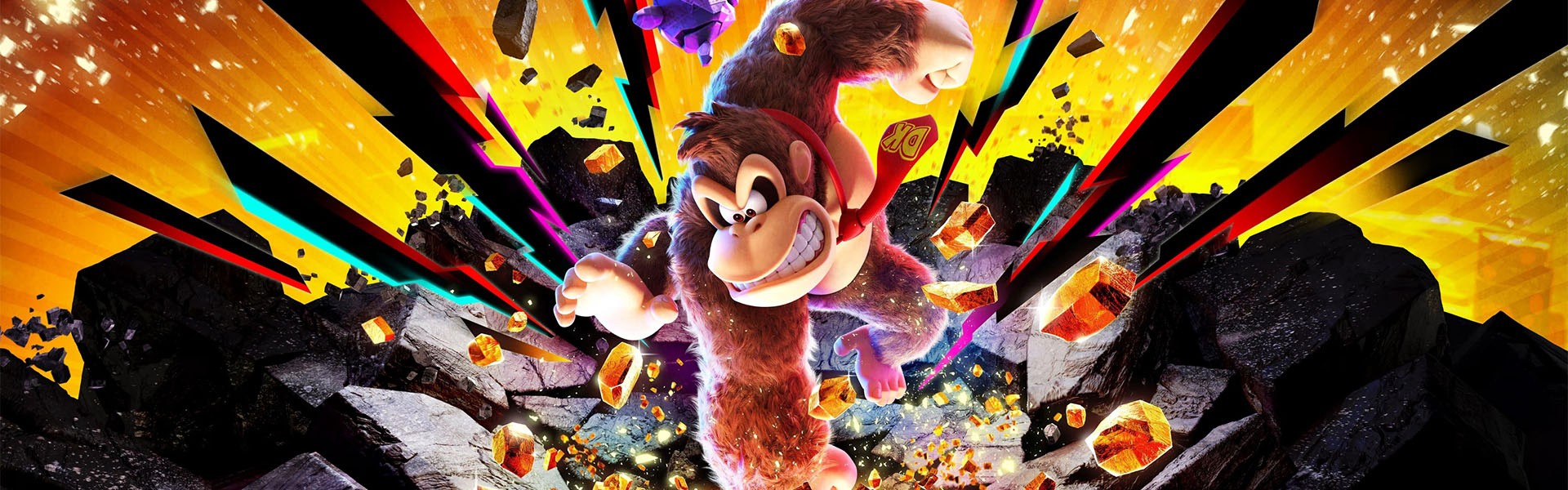
I didn’t expect too much out of Donkey Kong Bananza. Pre-release, I struggled to make heads or tails of the game. It was a platformer, but it integrated advanced movement mechanics and destructible environments in a way that seemed fundamentally opposed to creating challenge. I didn’t quite grasp how this game could be a worthy successor to Super Mario Odyssey, or how it would be received as the Switch 2’s second major exclusive.
Those concerns melted away as soon as I started playing. The environmental destruction is tremendous fun as Donkey Kong blasts through stone, dirt and gold, which gives the game addictive feedback. However, that freedom is bounded by concrete level design that imposes sensible constraints, which gates player movement through specialty terrain types. As you go deeper through the game’s inter-planetary layers, the levels become more sharply defined and the ground is harder to mould, transforming the game into a more directed platformer.
Nintendo has created a mechanically interesting, polished platforming game around Bananza’s core mechanics, which include upwards, horizontal and downwards punches, mapped intuitively to X, Y and B, plus a jump, a roll, the ability to pick up and fling terrain chunks and the ability to use the terrain like a surfboard. Plus, the player gains the ability to use five Bananza Transformations, which impart special abilities that allow DK to tackle certain types of environmental challenges.
It’s a very different kind of game from Nintendo EPD Production Group 8’s last game, Super Mario Odyssey, which had a three-button core move set. Bananza is more complex and demands a wider range of inputs, which is unusual for a Nintendo platformer. Somehow, Nintendo EPD has managed to smooth out any frustrations with the game’s more three-dimensional approach to platforming, though subterranean traversal can sometimes feel slightly awkward.
I also enjoyed the more propulsive progression in Bananza, which departs from the collectathon gameplay in Odyssey for something that is usually somewhat more linear. There’s plenty of opportunity to collect Banandium Gems in the post-game, but the core gameplay structure isn’t built around reaching some arbitrary number of collectables to continue.
Bananza is the kind of conceptually challenging major release that Nintendo seems to excel in these days. Few production houses would let a AAA studio toil away for eight years breaking ground on a new, untested platforming concept. There’s some of that Tears of the Kingdom spirit here - of designing gameplay around game-breaking abilities - which I imagine accounts for a large chunk of that protracted development time.
My only real worry about the game concerns its post-game content, which seems to encourage repetitive gold grinding a little too much. Perhaps a different Banandium Gem progression system would have been wise. Even so, Donkey Kong Bananza is one of my favourite 3D platformers in recent years, and it’s a pretty stunning design accomplishment. But another Nintendo first-party effort took my top spot this year.
1. Mario Kart World
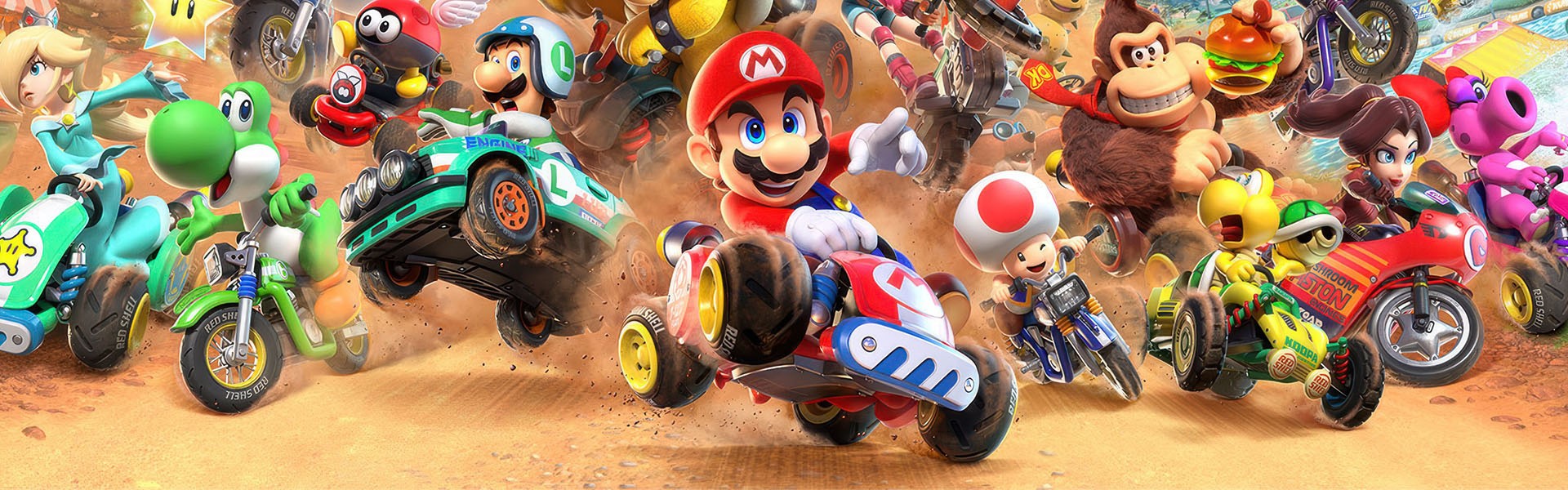
Arcade racing games are a dying breed. The last triple-A arcade racers - GRID Legends and Forza Horizon 5 - were released four years ago. Dirt 5 was the most recent big-budget arcade racer with properly arcadey handling characteristics in my opinion, and that came out at the beginning of the current console generation in late 2020. That made Mario Kart World an extra-special release for me - obviously, it’s a new game in a highly acclaimed series. But it’s also another big title in my favourite gaming genre, which has seemingly ground to a halt in recent years.
Mario Kart World really delivers on that big-budget racing promise, with Nintendo’s characteristic visual and mechanical polish applied to a vast open world. The artwork and design here is consistently high quality, the gameplay is tightly tuned and animations look superb. It’s on another level relative to just about any other racing game I’ve ever played. There are racing games with a large open world, satisfying gameplay and great art - but none that combine those elements quite as effectively as Mario Kart World.
It almost goes without saying that the raw moment-to-moment gameplay feel is excellent. This is classic Mario Kart, though the game is tuned a little differently relative to Mario Kart 8, with a different handling of water sections, weaker items, automatic item trailing, a doubled player count, and looser vehicle cornering. After a few races, it feels like second nature, and I just couldn’t stop playing event after event.
Each of the game’s 30 courses has been lavished with attention and care, and most are instantly recognizable at a glance. There’s really not a bad track in the bunch, and a few - like the new Bowser’s Castle, Great ? Block Ruins, Starview Peak, and Rainbow Road - feel truly exceptional. Each of the returning tracks has been carefully redesigned to work best within Mario Kart World’s driving mechanics, and to satisfy artistically as well.
That game features new abilities - wall-riding, rail-grinding, and jumping - that enable all kinds of intricate routes. World’s skips are complex and reward practice, and some of the techniques used to score global records are mind-boggling. It’s best to practice these maneuvers in the open world, where rewinds can help you set up the perfect approach and failures are less punishing.
World packs a cup mode - which connects 4 discrete tracks with lengths of traversable road - and a Knockout Tour mode, which is essentially a one-lap race that takes place exclusively on that interstitial track. I’m kind of split here: the revised structure has produced dramatically more track content than any prior Mario Kart title, but the interstitial track segments tend to be more sedate, with long straightaways and few turns.
But this is an area where Nintendo may be evolving somewhat, because some of the intermission tracks have recently been revised to feature more turns, jumps and aerial features. It’s hard to say whether this indicates an overall change in direction, if it’s a one-off or if it’s the kind of change that will only be implemented for water sections as they are more easily modified. But hopefully Nintendo trends in the direction of improving these interstitial segments - or at least allowing us to play the discrete tracks more often.
Open-world exploration is a delight. I’ve greatly enjoyed progressing through the game’s P-Switch challenges, collecting Peach Medallions, and activating Question Mark Blocks. At launch though, Mario Kart World didn’t indicate their locations at all on the map, making progression needlessly difficult. As of recent updates, you can at least see the position of completed P-Switches and Peach Medallions on the map, which makes this challenge much more manageable.
I do wish the game took more advantage of the content it has. There’s no traditional cup mode, and the game’s versus race, battle and time trial modes don’t have the same star-based progression as the other modes. The game’s open world content is limited to those P-switches and collectables, which feels pretty limited relative to a series like Forza Horizon. I feel like Fast Fusion makes the most of the content that it does have, while Mario Kart World is a bit more conservative. It’s not helpful that Nintendo reduced the difficulty of CPU racers in a July update, making it substantially easier for new players to beat the game’s single player races in 150cc.
But again, this is a bit of a point-in-time evaluation for a game that will probably change considerably over the coming years - especially given Nintendo’s track record with Mario Kart 8 and its massive trove of post-launch content. I’d love to see expanded open world challenges, alongside new tracks and potentially an accompanying landmass.
So Mario Kart World is a great game, and it has the potential to become a near-perfect racing title with future expansions and updates. In any case, it’s still the best racing game of the past few years in my view, and therefore easily scores first position in my game of the year ranking for 2025.


Comments 5
Great year for Nintendo launches.
This echoes of lot of my thoughts on the Switch 2. I'm looking forward to games that were made with the Switch 2 in mind from the start but Nintendo has had a great launch year.
Metroid is certainly a divisive one, Edge Magazine gave it just 4/10.
@ramu-chan It is divisive, but if you like it it's fantastic. I thought it was 80% brilliant, but 20% let it down.
Yet the online discourse makes it sound like a terrible game and GROSSLY over exaggerates things like the team chatter - which hardly happens - or green crystal collection - which as long as you don't leave it all to the end isn't really a chore.
Most of the game is just classic Metroid Prime - oodles of atmosphere, clever design and plenty of fun. But I can see why some won't like it as much.
This is why I love individual lists, far more interesting than a homogenised list. We've got Metacritic, Steam reviews and The Game Awards for that. It's also far more likely to shine a light on games that might have been overlooked.
Show Comments
Leave A Comment
Hold on there, you need to login to post a comment...