
 by
by AMD's rollout of FSR Redstone, its latest generation of ray tracing and image reconstruction techniques, is apparently still ongoing and incomplete. We know its Radiance Caching feature is slated to launch in 2022's Warhammer 40,000: Darktide at some point in the future, while Redstone's Ray Regeneration system is only live in one game as of press time - and in limited fashion.
That leaves FSR Machine Learning Frame Generation (MLFG), an upgrade to FSR 3.1's existing FG system, as the most widely available FSR Redstone feature thus far. By turning the feature on in AMD's system-wide Catalyst interface, PCs with RDNA 4 GPUs can force MLFG on much the same way they could with FSR 4 Super Resolution during its launch.
In the software we've tested thus far, we've confirmed the same mix of good and bad news seen in other Redstone tests - particularly those from Hardware Unboxed. As our similar findings revolve around equal parts image quality and frame-pacing cadence, we've applied our own tests to reach firm conclusions that we hope AMD will act upon in the future.
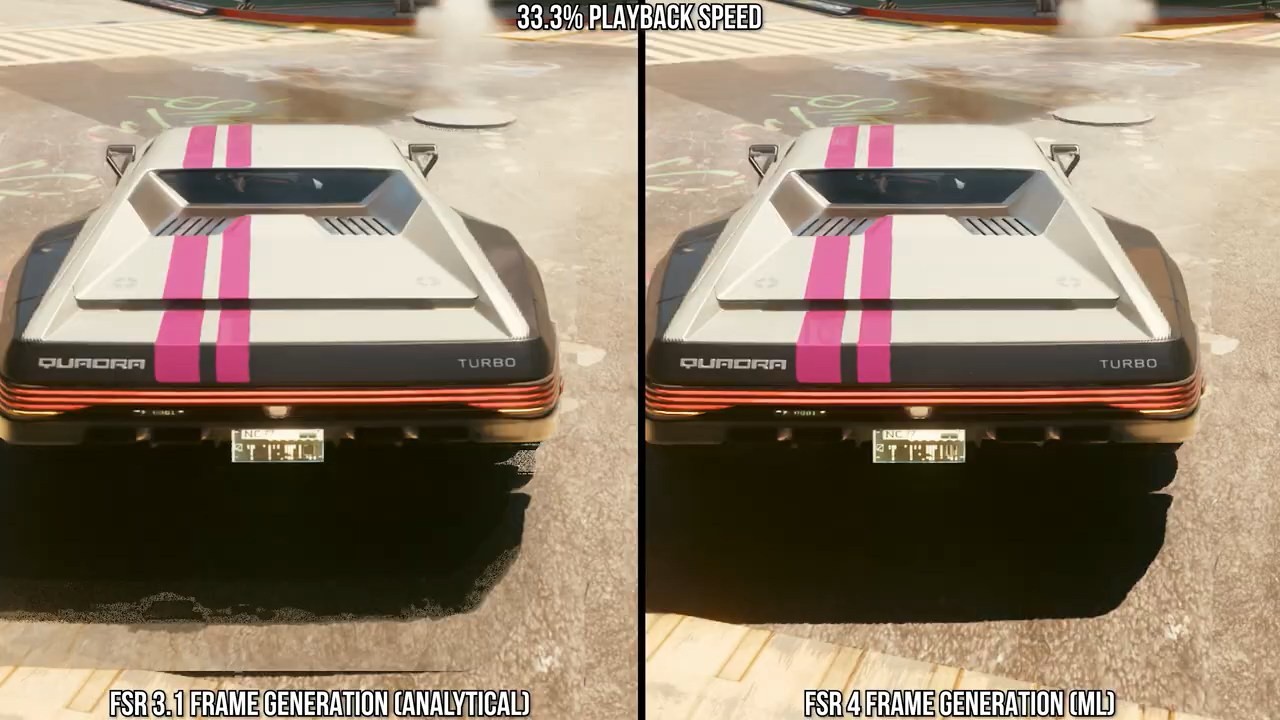
In promising news for Team Red, MLFG significantly jumps on an image quality basis compared to FSR 3.1 FG, and its increased precision is most evident when tracking objects that lack motion vector data. Shadows behind cars in Cyberpunk 2077 no longer suffer from lag or warped-perspective artefacts in FSR MLFG, in part because MLFG now finally combines optical flow data with nearby objects that do have motion vector data to leverage - ie, shadows and their shadow-casting geometry.
The same intelligent engineering has been applied to fast-moving particles like the ones seen in God of War Ragnarok, which no longer have ghosting effects and exhibit clear frame-by-frame movement, better fitting what your eye may expect from real-life flickers of a flame. These two clearly visible improvements to generated frame image quality better resemble both Nvidia's DLSS and Intel's XeFG models.
While we welcome that clear upgrade from AMD's prior frame-gen methodology, we're sad to report that one of the worst issues with FSR 3.1 FG persists in this month's MLFG update: spiky frame-times.
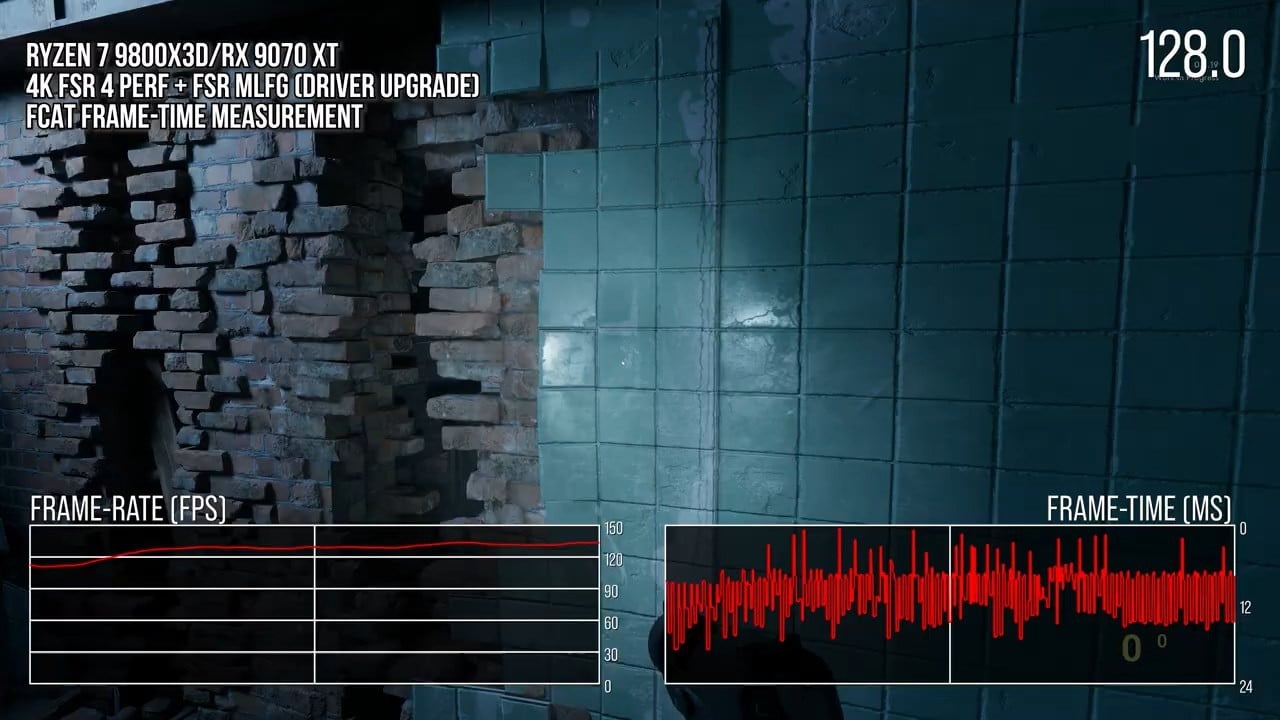
We tested Industria 2, an Unreal Engine 5 first-person horror game that's compatible with FSR MLFG, by finding a relatively empty and boring room and then turning the viewpoint at a relatively slow speed, all while rendering the game at an unlocked frame-rate on a variable refresh rate (VRR) panel. Looking only at the frame-rate chart, a seemingly steady 120fps count suggests that FSR MLFG clears this simple rendering scenario handily. But our frame-time chart shows counts that range from 4-16ms - along with a jumpy line where these between-frame values constantly fluctuate. On our screen, this has the appearance of lurching, where each frame persists for varying and inconsistent lengths.
Worse than that is a 0-1ms length for some of this test's measured frame-times, which are classified as "runt" frames. These blip onto and off the screen in a way that is impossible for even highest-end 700Hz panels to properly render, and thus they have the appearance of a "torn" frame - the kind of visual artefact that VRR displays are ironically supposed to solve for.
And we know this shouldn't happen, as we measure far smoother frame-time readings in the same test with vanilla, non-FG rendering and with DLSS 4 RG applied. We measure similarly jumpy frame-time charts in God Of War Ragnarok with FSR 4 MLFG enabled - they're smooth when the camera is still, but once the camera begins to slowly turn, frame-pacing becomes nearly as problematic as Industria 2, complete with its own runt frames.
Other tested games with FSR 4 MLFG enabled, including Cyberpunk 2077 and Black Myth Wukong, benefit from smoother frame-pacing. In most gameplay for each of these, slight frame-time variance is largely imperceptible much of the time, with noticeable "ping-ponging" exceptions emerging on occasion.
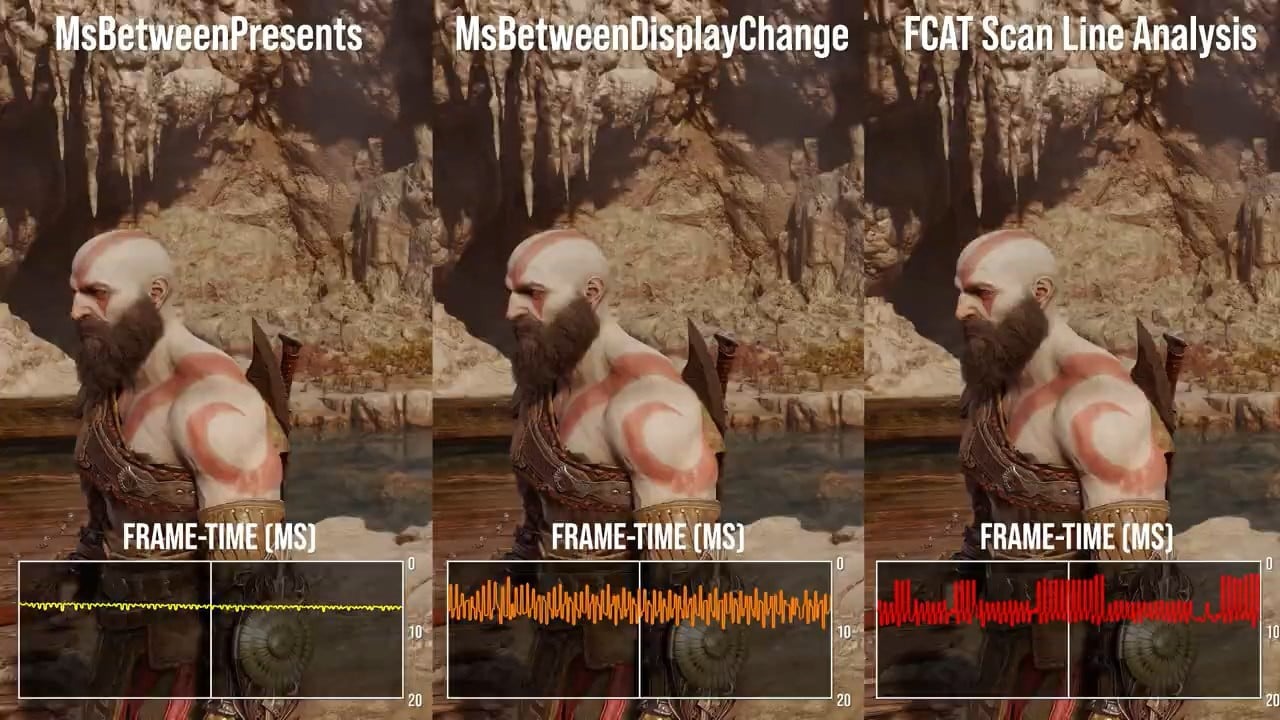
In the top-of-article video, Digital Foundry lifts the veil on our testing methodology to confirm how we're measuring frame-time spikes that other testing methodologies might miss. For PC game testing, DF employs a Frame Capture Analysis Tool (FCAT), which requires connecting a gaming PC to a separate, capture-specific PC, then analysing the resulting frame-by-frame output - as opposed to internal-capture tools which may not accurately reflect the final framebuffer as delivered to your PC screen of choice.
FCAT includes a handy-if-flashing colour-strip visualisation that assigns a different flash of colour to each newly generated frame, and we include a brief visual sample so you can see it in action. Thus, please tread carefully in the above video shortly after the 11-minute mark - and the video includes a clear warning about this, as well.
We're delighted that AMD has so thoroughly improved the visual make-up of its FSR-branded FG system. Thus, we'd like to remain optimistic about MLFG eventually receiving a patch to resolve frame-time jumpiness, but its persistence over two years since our initial FSR 3.0 findings makes us wonder if AMD has a working solution in mind. Frame generation, after all, is meant to increase apparent smoothness of games in motion, but ping-ponging frame-times break this illusion altogether.
In the meantime, users can admittedly "fix" this FSR 4 MLFG defect in at least some games by fixing their GPU's output to a specific frame-rate cap and enabling v-sync. But this isn't how we recommend playing PC games, and it won't help for any MLFG scenario where frame-rates can't hit the specified cap. We hope AMD comes up with a smoothness solution that requires far less of a hoop-jump than similar FG offerings from Nvidia and Intel GPUs.


Comments 2
On a sidenote, I could be mistaken but Intel seems a bit quiet on their upscale/FG progress? I have an MSi Claw 8 with an ARC 140V GPU and the games that natively support XeSS like AC Mirage and Hogwarts look and run absolutely amazing. That said, there aren't that many B570 and B580 offerings at retailers. 🤔
Any thoughts of interviewing the dev for lossless scaling? Their adaptive frame generation tech has superb frame pacing. How one guy does what AMD couldn't catch through QA is quite impressive
Show Comments
Leave A Comment
Hold on there, you need to login to post a comment...