
 by
by We'd seen rumblings about the October security and feature update patch that Windows 11 automatically downloaded and installed for users. Among other reported issues, it for some reason disabled USB keyboard and mouse connections when entering the Windows Recovery Environment (surely you've kept some old PS/2 devices handy, right?). But that pales compared to the absolutely bizarre testing results we recently confirmed regarding PC gaming performance.
As it turns out, the October patch, identified by its KB5066835 patch number, left a number of users scratching their heads in regards to performance in Assassin's Creed Shadows. At the time, the wild frontier of Steam comments about uninstalling monthly Windows updates, complete with all of their built-in security updates, may not have seemed like a sound path to better PC performance.
It wasn't until Nvidia directly addressed KB5066835 with a recent GPU driver hotfix that we finally raised our eyebrows and took a look. Nvidia blames this October patch for 24H2 and 25H2 versions of Windows 11 in its notes to users, saying that it may lead to "lower performance" in "some games."
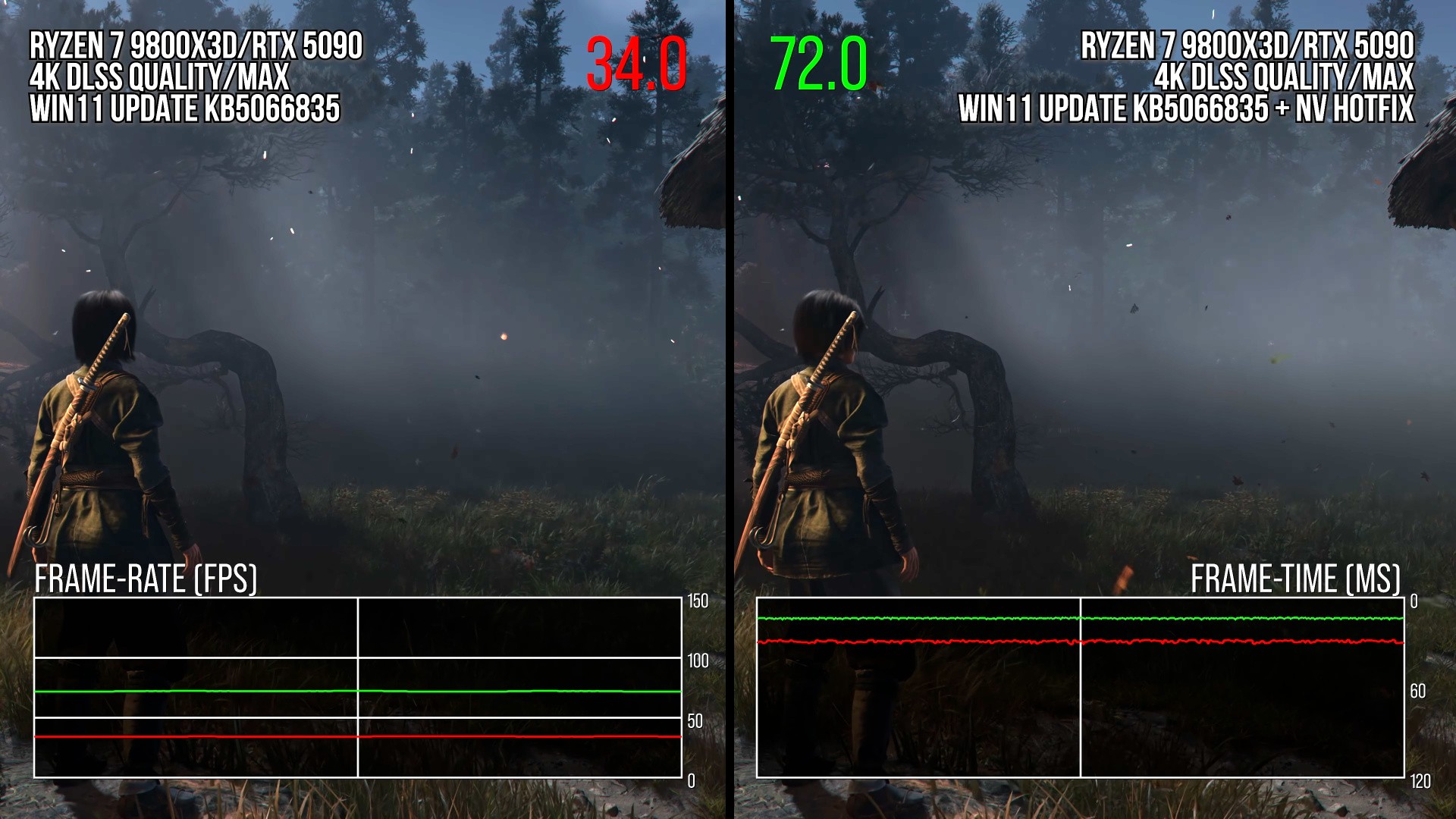
Having seen complaints in the wild, we booted AC Shadows on one of our normally patched Windows 11 PCs and immediately saw remarkably low frame-rates on a Ryzen 7 9800X3D PC with an Nvidia RTX 5090 GPU. We recorded footage on the affected PC, installed this week's Nvidia hotfix, then recorded again in the same regions of the game, spaced out by using save points from our original review of its PC performance.
The KB5066835 Windows Update, left untreated, sliced AC Shadows frame-rates from 33 percent to over 50 percent.
Determining exactly which other games have been affected is not easy or obvious, mostly because Nvidia has opted not to broadcast its own findings for us to test and confirm. We haven't found much information about other games whose performance was directly affected by KB5066835, with an exception of Counter-Strike 2 suffering more dips and stutters in frame-rate before having the hotfix appiled.
But this scenario certainly has us scratching our heads as far as what kind of testing regimen and communication with GPU makers take place on at Microsoft these days. Did Microsoft's October update expose a huge flaw in GPU drivers that OEMs needed to fix? If so, why was Microsoft unable to steward that information more responsibly to companies like AMD and Nvidia with weeks of woeful performance existing in the wild?
Or, in the opposite scenario, why is Microsoft breaking performance levels in a manner that GPU manufacturers have to correct on Microsoft's behalf after the fact?
Either way, this is only the latest Windows gaming headache the Digital Foundry team has faced in a year full of them. As such, we're beginning to turn our minds around on the matter. Putting our heads together to come up with a non-Windows solution - for ourselves and for our PC gaming readers - isn't necessarily an easy thing in terms of drivers and overall game compatibility, and it may take time and effort to come up with something satisfying. But that effort still might be a little less crazy than repeatedly suffering the slings and arrows of outrageous Windows installation misfortune. Stay tuned.


Comments 17
We already know Windows sucks a lot of performance out of hardware, but seeing a Windows patch affect it to this degree is bonkers.
But I also have to wonder how widespread the issue is. Logically if it was affecting most games to this extent there would be a larger outcry, right? So it's likely it's still either a relatively small number of games, or the performance dip is much smaller generally.
Either way not a great situation, and hopefully more press like this will get the issue resolved faster.
Maybe Microsoft was being honest when they said that their code is being written by AI, approx 30%.
Alex alluded to this in DF Direct, but I would absolutely welcome a video (or series of videos) on transitioning from Win11 to Linux, with a special focus on users with NVIDIA GPUs. I'm vaguely aware of the 'Nvidia tax' on Linux and would be willing to accept the performance penalty on DX12 games.. but what's turned me off about making the switch is the unclear support for other features I care about, like HDR, VRR, and DLSS.
I loaded up AC Shadows a few weeks ago and noticed that the performance was surprisingly bad but at the time I just put it down to it being the result of a bad patch or something. Good to know that this is fixed but it does annoy me just how many things Microsoft break with Windows updates.
I had an issue with Star Wars Outlaws crashing to the desktop with no error or event log entry when I updated to Windows 11 24H2 last year and it took almost six months for that issue to be fully fixed at which point I had lost interest in playing the game.
@ddmagnas Echoing this! Would love to see it!
I want an official Steam OS for PC.
Compatible with everything you need.
Then I can finally leave Windows behind, for good.
I have a wild idea, what if DF would repackage a bazzite distribution to make it great, DF Approved. It would be called something like DFighterOS and would come preloaded with Alex optimised settings and have Rich voice saying 'Bespoke' every time there's a warning dialog box. There could be some tasteful ads removable for supporters.
WHO IS WITH ME?
This is one of the reasons I like consoles. When its time to play I prefer just to hit play and enjoy, not have to deal with random stuff line this searching the internet for clues why my game is no longer running propper. (Not anti pc, just a preference).
@MichaelBach 'tis what I miss the most about console gaming for sure. But I'm a sucker for getting the best experience possible, so the god(s) say I must deal with this Microsoft BS :[
I don't know who makes, maintains or updates Linux but this is the time to really reach out and make it as accessible as possible for noobs like myself! The more people on board the better. Won't be upgrading pc until win 10 runs out of security updates next October but I'll sure be watching a lot of Linux tutorials in the mean time!
@samtallic @ddmagnas i have been using nvidia and wayland on linux with kde plasma for years now and would love some professional writing about these things for my own reasons, too! but as for my personal experience, some quick answers for you two:
HDR - pain in the rear but kind of possible. questionable quality at high resolution or framerates unless you use displayport because the hdmi consortium are jerks. seems to be relatively rapid development on this, though.
VRR - support exists, though you're usually better off leaving it off
DLSS - works great, used to be kind of a pain but Just Works nowadays. it's gotten me a lot out of a sub-1k black friday laptop i got last year with a 4000 series nvidia card, and it's the only way to get good performance out of my 3080 ti destop playing one of my all time favorites, strangers of paradise final fantasy origins, because square enix cannot code (the windows version isn't any better)
@Nebatunia there's a lot involved with everyone that makes a linux distro you download, install, and use, and it's nearly all volunteers and various company employees contributing to open source projects, it's not just one company like Microsoft. grab a spare nvme or ssd and give it a try sometime, I'd recommend Bazzite for you as it's very easy and oriented around gaming, as since valve's steamOS is open source, Bazzite is further modifying steamOS to be more compatible with all gaming PCs and not just valve hardware
@anna_ ah thanks that's good to know! Is there a reason valve hasn't just released their version for everyone to just install?
Ya know, my wife suddenly developed an inability to play house flipper 2 a month or so ago. I wonder if this issue caused that problem for her. The game would get stuck in an infinite loading screen when she would go between locations.
@Nebatunia they have! it's why we have Bazzite in the first place. valve focuses on their own hardware compatibility, which makes sense as they wisely made the choice to use amd video chips in their products. it's a lot of extra work to include nvidia alone, and some extra settings and support to include support for a wider range of pc hardware in general as the steam deck/machine can be and is slimmed down a bit by not needing that.
@anna_ wouldn't it be in valves interest to do one that supports Nvidia as well? I remember that one of the main reasons that valve started down the road of Linux was that Microsoft was going down the path of pay walling gaming on windows around 2012/2013? So if that happens again it's best to get as many windows users over to Linux asap?
I have severe performance drops in Gears 4 with the Xbox Ally X. I used to have pretty solid 60fps at high settings on the handlheld launch day and now after all those updates, even on medium settings, performance hovers around 40-55.
Show Comments
Leave A Comment
Hold on there, you need to login to post a comment...