
 by
by 
Last week, Linux launched on PlayStation 5, bringing with it the wealth of opportunities afforded by an open operating system running on a closed platform. Put together by well known security researcher Andy Nguyen - aka TheFlow - PS5 Linux works via an existing exploit for launch PlayStation 5 consoles running on system software releases up to version 4.5. Prepare the appropriate Linux image, launch the PS5 exploit, then use a computer to send across the correct payload and the PlayStation 5 slips into rest mode. On waking, Linux boots from an attached USB or SSD and you're good to go.
A few steps further and Linux can be moved to an SSD that sits in the PlayStation 5's m.2 bay, vastly accelerating storage speeds vs the USB alternative - though a USB stick is still required to boot the OS. Beyond that, you have full access to the Linux desktop, specifically running Ubuntu 26.04 LTS. Around 15GB of useable memory is available, with the user able to access all eight cores and 16 threads of the Zen 2 processor cluster. The full 36 compute unit GPU is also available. From boot, CPU clocks run at 3.2GHz with the GPU at 2.0GHz. Running an optional tool engages PS5's boost mode with CPU frequencies at 3.5GHz, with the GPU hitting system spec 2.23GHz. The tool also allows you to increase cooling to compensate.
It's worth pointing out that while those two paragraphs make the process of running Linux on PS5 sound quite simple, it's far more complex if you're not au fait with Linux generally - and I count myself amongst that crowd. It should also go without saying that actually finding a PlayStation 5 on a low enough firmware is challenging too. Firmware 4.5 launched in December 2021 and TheFlow has no plans to bring PS5 Linux support to any other system software updates. I paid £520 for an untouched firmware 2.0 unit from eBay, which is far below the usual asking price. My unit currently sits on firmware 4.03 - which is when Sony introduced support for the m.2 expansion port.
At the time of testing, I did encounter another issue that TheFlow is currently looking to address. I could only run the PS5 with 1080p output resolution. Anything higher caused black screens.
First order of business - some basic benchmarks. I ran Geekbench 6 to get some idea of system performance, first with boost mode disabled and then with full CPU and GPU clocks. The boosted multi-core score of 7566 is comparable with the similarly Zen 2-equipped Ryzen 5 3600 (fewer cores, high clocks), while the single-core of 1127 ranks with something like a Core i7 7700. Compare and contrast with a more modern mainstream processor: the Ryzen 5 7500F delivers a 2888/12869 result with 6000MT/s DDR5.
I figured the best way to put the GPU through its paces was to take a look at PC games where we have a positive lock on PS5-equivalent settings, downloaded via Steam. I also had to limit like-for-like tests to games that ran at native 1080p owing to the display output limitation. So yes, in effect, we're treating PS5 as a 1080p Steam Machine of sorts, using the Proton compatibility layer to run Windows titles under Linux.
I started with Black Myth Wukong, where the PS5's performance mode runs with the equivalent of PC's high settings, albeit with lower quality textures. This typically uses frame generation to turn 30fps into 60fps, except for the prologue which runs unlocked with no frame-gen, making it a good comparison point.
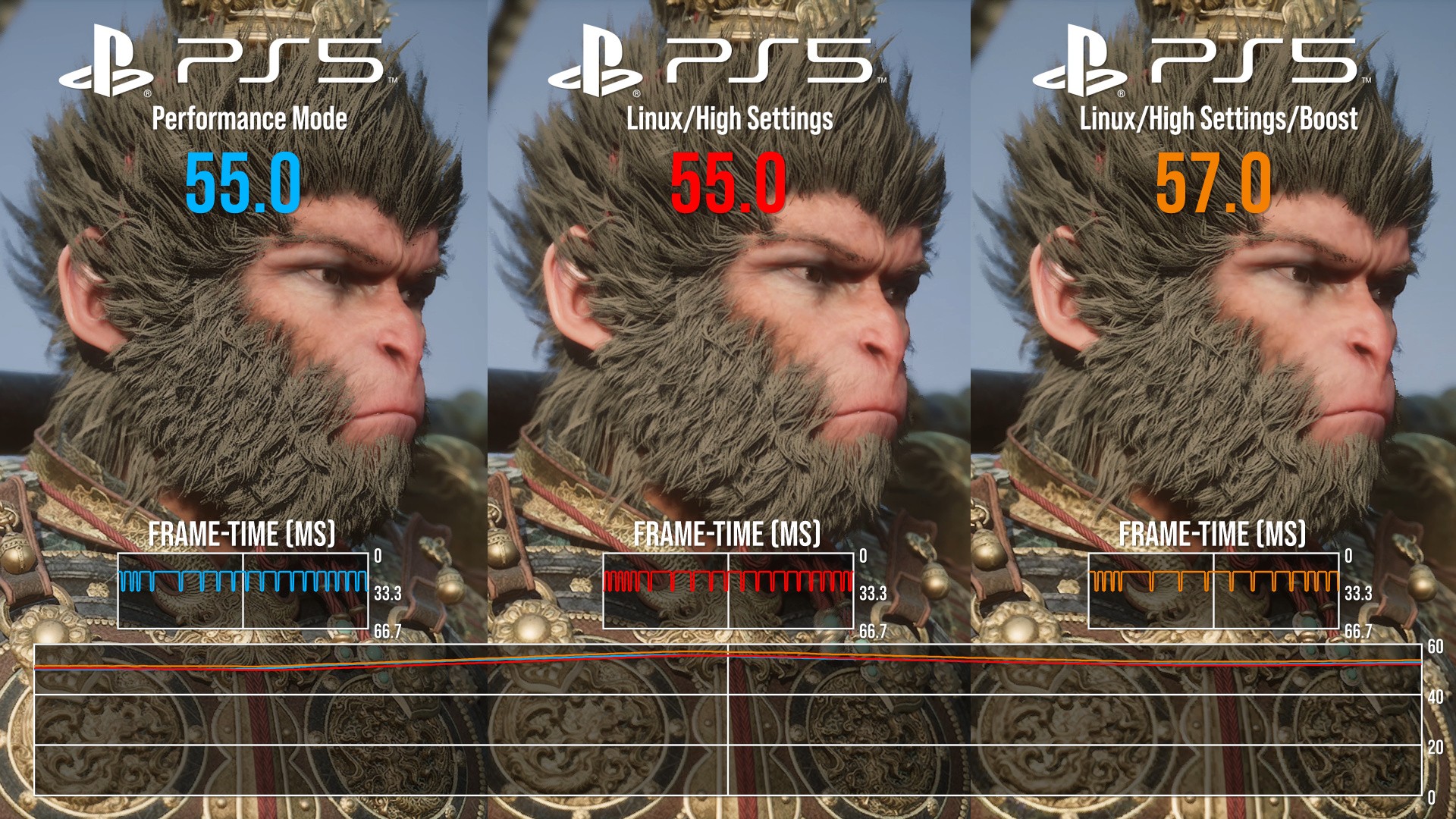
While in-the-moment results may vary slightly, running without boost clocks active saw Linux deliver 99.9 percent of the performance of the PlayStation 5. Turning on boost mode saw a small gain - an extra three percent of frames delivered. There's a curious quirk here, however. Turning on high quality textures under Linux could see frame-rate drop by up to 5fps in more detail rich scenes. As I discovered, memory management seems to be a bit of a weakness - perhaps down to less efficient use of unified memory compared to a standard PS5 running under its own OS.
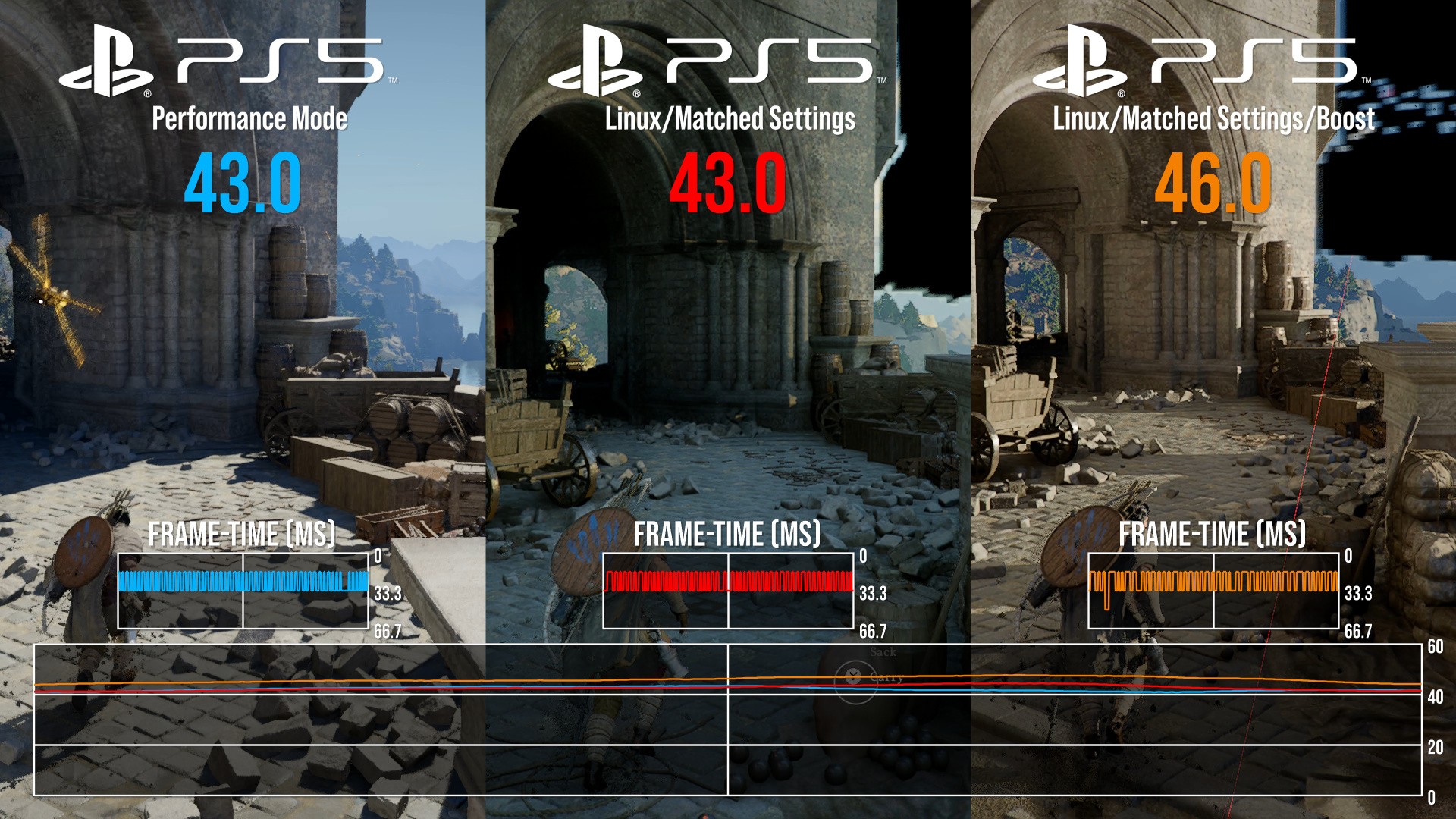
Next up, Crimson Desert where I wanted to test the now infamous Bug Hill for CPU-limited performance. I used the PS5's performance mode, which runs at native 1080p and where we have developer-supplied settings equivalents. This is where I encountered my first problem: the sky doesn't render properly (maybe some kind of ray tracing issue?). This puts any kind of GPU testing out of contention, but results when CPU limited may still be valid. [Update: the sky artefacts are a known issue that can be resolved by adding RADV_DEBUG=nohiz %command% into the command line in game properties on Steam]
Either way, the non-boosted PS5 delivered 98.9 percent of standard PS5 performance, with a 3.8 percent improvement with boost mode active. It really does seem as if PS5 Linux is offering pretty much the same level of GPU and CPU performance as the standard PS5 in selected titles - though I did actually expect more from this game. Remember, we're getting the full eight CPU cores and 16 threads with Linux - developers get 6.5 cores on PS5 games, the rest reserved for the system.
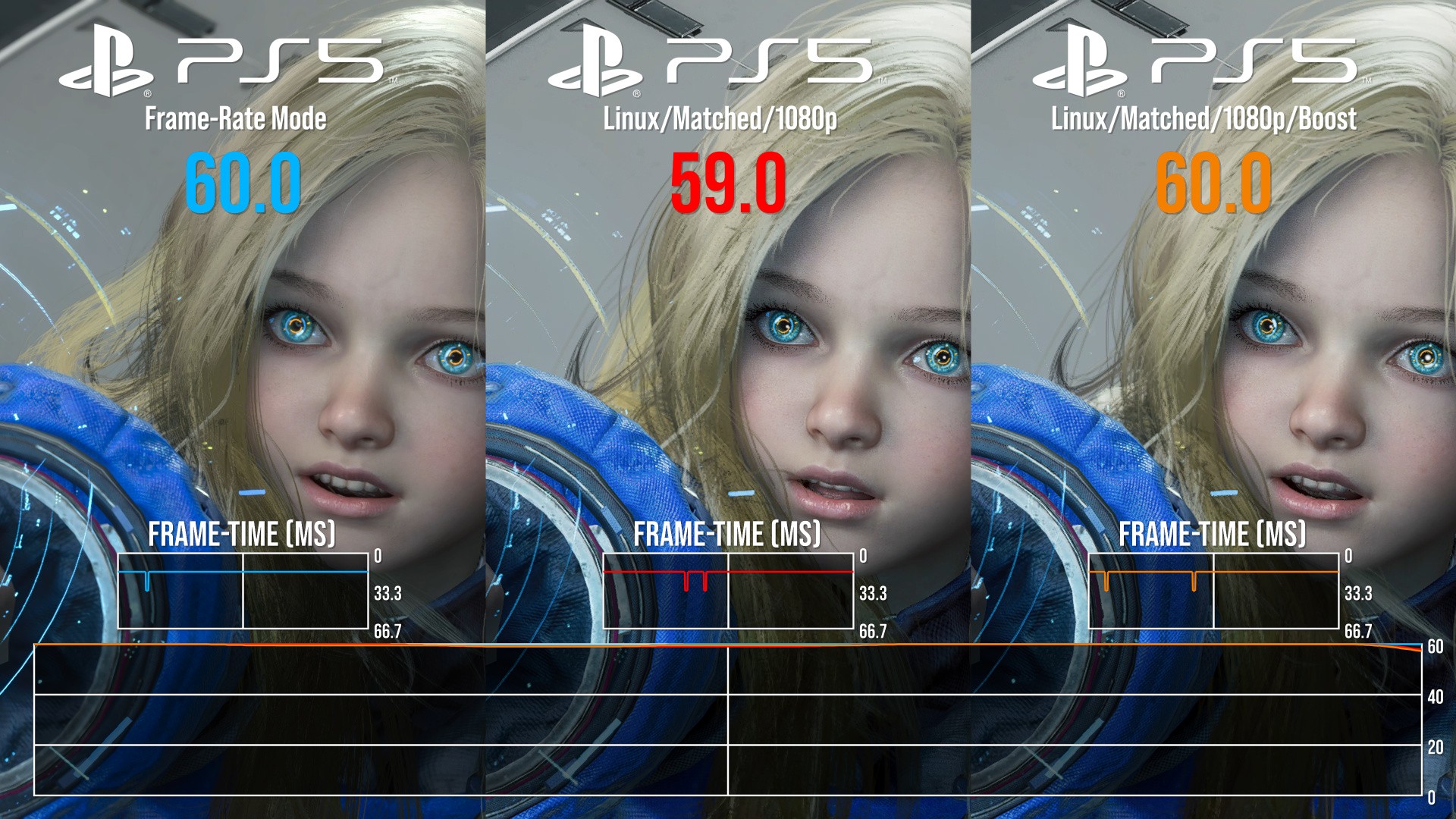
Finally, running out of native 1080p PS5 games to compare, I bent the rules slightly. Pragmata runs at native 1080p on PS5 in both its oddly-named resolution mode and its frame-rate mode. It uses a basic FSR 1 spatial upscaler to hit 4K, which would have a minimal impact on performance. I wanted to try ray tracing comparisons, but unfortunately, Linux wouldn't play ball - the RT option is greyed out. That left me with the frame-rate mode, which rarely budges from 60fps on PS5. The curious thing is that to begin with at least, Pragmata on PS5 Linux runs almost as well - with just a few odd dropped frames. Moving into the second level, however, performance was less stable and on PS5-equivalent settings, there were some jarring stutters.
I think a primary issue for running games on PS5 under Linux concerns memory. On standard PS5 games development, game creators have full control over the unified RAM. On PS5 Linux, a dynamic allocation for graphics is used that seems to top out at around 5.5GB. I noticed that reducing Pragmata texture quality from high to lowest definitely helped to create a smoother experience but it still wasn't ideal. Similarly, I found Ubisoft Massive's Avatar: Frontiers of Pandora to have severe stuttering and even crashing issues, seemingly running out of RAM. Owners of 16GB handhelds will be aware of how Avatar has RAM problems and it's a variant of the same issue here.
Nevertheless, across the games tested it was interesting to see how these multi-platform games can deliver - at best - very similar performance to the PlayStation 5 even though games developed for a dedicated OS are being swapped out with PC versions running through the Proton compatibility layer. It's just the memory side of things that causes issues. For the record though, I wouldn't expect to see that kind of parity for games developed primarily for PS5 that were subsequently ported. Sony's first party efforts, for example, typically seem to require an extra level of GPU performance to provide PS5 equivalence.
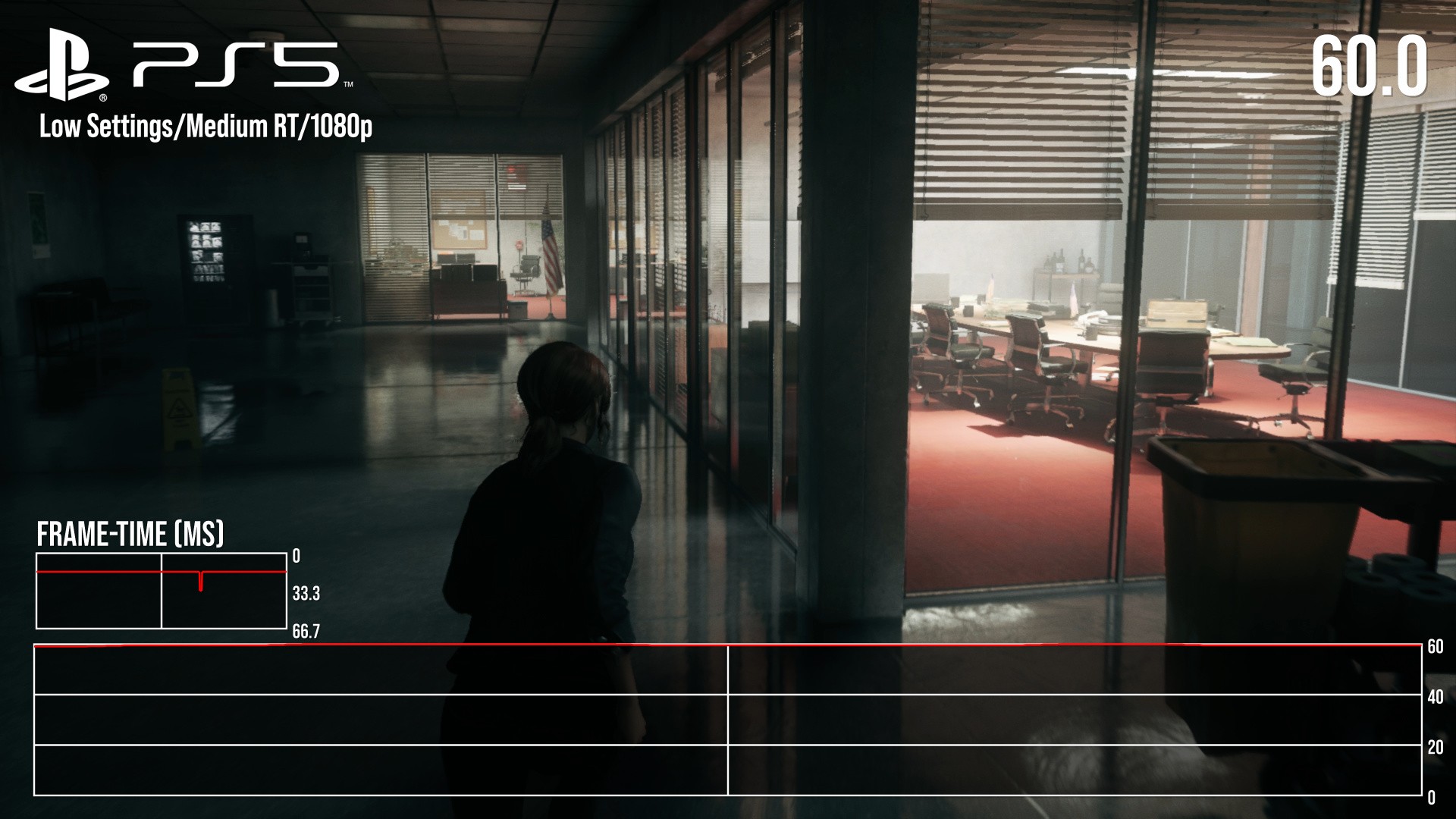
I also did some quick testing with ray tracing, using Control Ultimate Edition. The PS5 version runs at native 1440p with a 30fps quality mode using RT reflections and a 60fps performance mode that disables RT. I always thought that Remedy missed a trick by not providing a 1080p60 RT mode - the maths suggests it's possible.
Under Linux, Control ran at 1080p mostly at 50-60fps on the closest I could get to console-equivalent settings. Parity isn't possible as some PS5 raster settings are lower than PC's low, while RT reflections are checkerboarded for improved performance - an optimisation PC never received. With that in mind, I do think Remedy may have been able to offer a decent 1080p60 RT experience.
Control also offered an interesting option: super-sampling. The limitations of PS5 Linux display output could be circumvented by running internally at 1440p or even 2160p, with a downscale down to the 1080p output. As Control runs at 1440p on PS5 in its quality mode, I gave the super-sampled 1440p a couple of quick tests. On the first, I found performance generally above 30fps, but there was some occasional stutter - and again, based on what I know of the PC version, I think it is down to graphics memory limitations. When I tried again, I actually got a hard crash soon into my session.
Of course, the nature of the set-up here is quite exclusionary - I'd venture to suggest that there are not that many PlayStation 5 consoles around still on firmware 4.5 (and there's no way to downgrade), but nevertheless, PS5 Linux is a remarkable achievement and a fascinating way to put the hardware through its paces in a way that simply isn't possible with a standard retail console. However, the memory limitations in gaming here highlight the advantages of a fixed platform with a dedicated development environment. PCs with 8GB GPUs and 16GB of system memory often have issues with a lack of graphics memory when compared to the PS5 versions operating not only with 16GB total but with an actual 12.5GB of useable memory for developers.
Regardless of the limitations, it's been fascinating to get full access to PlayStation 5 hardware, complete with a vast array of content to test via Linux - and there's still more that I'd love to take a look at. I notice that people have Bloodborne running via ShadPS4 and Motorstorm Pacific Rift via RPCS3 emulation. Then there's the wealth of modding opportunities available, not to mention the idea of running path tracing on the PS5 GPU. I'm not expecting crazily good results, particularly from PT, but the freedom to run that software and anything else on the Sony console is compelling.