
 by
by In our 2025 bingo card, we admittedly did not predict this one: high marks across the board for Kirby Air Riders as one of the most technically sound and visually compelling Switch 2 games in the new console's first year.
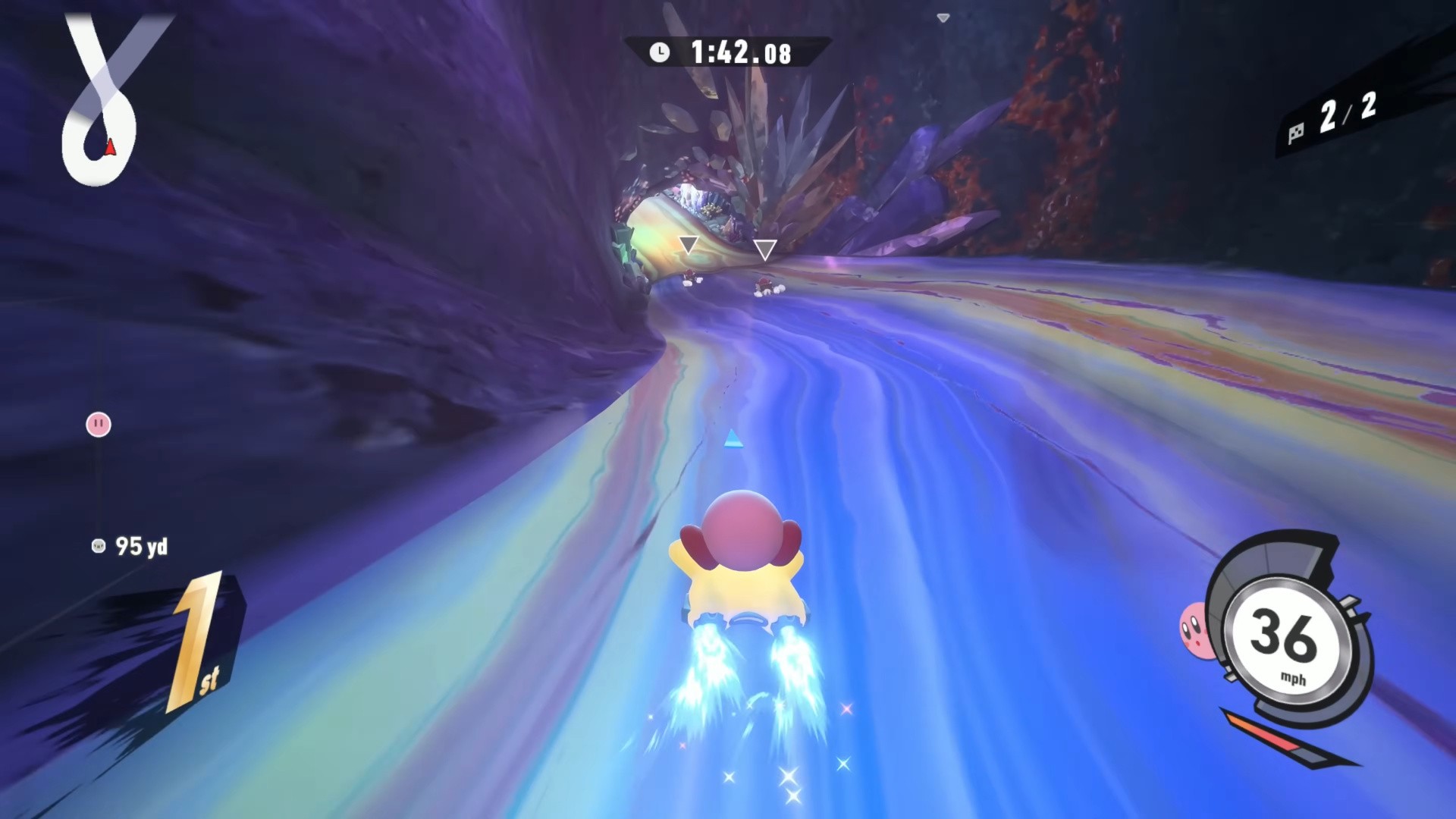
That statement, about a cartoony racing sequel to a coolly received 2003 GameCube game, admittedly lands inside the vacuum of the Tegra T239's limitations as a "current-gen" chipset. Meaning, KAR's achievements fit within an admittedly modest technical makeup. Even so, the combined development teams of Sora, Ltd. and Bandai Namco have delivered a remarkable racing-combat-collection mash-up on a visual level that in some ways looks more striking than June's ambitious Mario Kart World.
Kirby Air Riders is the first publicly documented game to use Bandai Namco's SOL-AVES engine, a proprietary software framework that has been in development since 2019. Job listings tell much of the story here, as SOL-AVES engineers were expected to have skills in advanced technologies like physically based rendering (PBR) and real-time ray tracing - key prerequisites for any forward-looking tech base.
PBR as implemented in a Switch 2 game is a true KAR highlight. Light-bounce properties vary based on the game's materials and surfaces, ranging from sunny foliage to lava-tinged copper piping. Materials show a wide range of lighting responses in one particularly impressive, steampunk-inspired racetrack, as specular highlights blur and sharpen against metal and stone.
Based on license notes in the credits and our own impressions, we wonder if these benefit from a clever application of Nvidia's RTXGI system - a probe-based ray tracing-driven lighting system for computing diffuse indirect lighting.
The game’s Switch 2 license information reveals a credit for Nvidia’s RTXGI, a probe-based ray tracing-driven lighting system for computing diffuse indirect lighting. This system may indeed drive key elements of the game’s lighting, but Switch 2 performance implications suggest it may have been used to precalculate static probes instead of operating fully in real-time. Complicating matters further is the game’s extensive use of lightmaps, which suggest RTXGI could be a complementary technology, rather than a driving force behind environmental lighting.
Yet this approach suits KAR's higher speeds and fixed lighting conditions (ie, no rotating time-of-day system). And due to the limited resources available on Switch 2, this possible version of RTXGI avoids the noisiness inherent in combining a real-time model and a necessary temporal uplift via something like DLSS - which would lead to a messier image all around, if not a necessary downgrade to a 30fps refresh.
Similarly, the game relies on specially crafted cube maps for reflections, instead of a more processor-intensive screen-space reflection (SSR) solution. We've seen the latter approach in Switch 2's Fast Fusion, which employs noisy but perspective-correct SSR. Thanks to KAR's high speeds and generally fixed camera angles, KAR gets away with less accurate cube maps and enjoys higher mid-race reflection fidelity as a result. These also contrast with Mario Kart World's dynamically updating cube map techniques, which are more perspective-correct but refresh unevenly and carry larger frame-time burdens.
The handsome handling of indirect lighting continues when examining the game's star character himself. Kirby's spheroid shape employs something that approaches subsurface scattering, in terms of light transferring and moving around his entire body. This looks particularly striking in the steampunk environs of Steamgust Forge, where the light transfer on Kirby's body can shift from the cold green tint of a pipe-filled room to the body-encompassing glow of nearby lava floes moments later.
Even the game's smaller touches stand out. Its motion blur system is quite tasteful, in terms of limiting its impact on the lower one-third of the screen: quick turns and frenetic combat receive a per-object blur in the player's nearer field of view (FOV), while the top of the screen offers more clarity for upcoming items, enemies and roadway. And even in that nearer FOV, particle effects aren't just bombastic - they focus player attention in intelligent ways.

Camera tracking feels particularly impactful. The field-of-view expands and particle effects explode whenever players successfully pull off a drift-powered speed burst, while the camera is tuned to gently follow players through turns no matter how aggressively or smoothly they may press the joystick. This KAR-specific camera tuning pairs well with its unique one-button control scheme, in terms of emphasising successful use of its brake-drift-accelerate gimmick.
So while KAR is indeed as colourful and vibrant as Kirby series fans might expect, it's ultimately drawing upon clever interpretation of pre-baked lighting tricks to look more next-gen than many of Nintendo's first-party offerings in recent years. And that may boil down to Bandai Namco's new custom-built SOL-AVES engine, which the company has been developing since 2019.
Its aesthetic and rendering makeup feel like another real major step for Nintendo since the baseline that was established in the Wii U era, with games like Tears of the Kingdom pushing some otherwise limited rendering defaults to their limits. Between this and the voxel-filled Donkey Kong Bananza, we're happy to see Nintendo beginning to step up with first-party games this year. (With, er, at least one Pokemon exception.)
All of this visual makeup has clearly been tuned with performance as a priority. In the game's default 3D racing modes, docked play renders at roughly 1080p at all times, while portable mode mostly averages at 900p, with dynamic resolution occasionally pushing that resolution down to 720p or in lighter scenes and menus up to 1080p. Switch 2's "DLSS Lite" mode has been skipped in favor of what appears to be SMAA, which works to this game's visual benefit in order to lock to a 60fps target. We do see pixel counts as high as 1440p while docked in the game's simplest top-down racing mode, as well.
Docked play barely misses the 60fps beat in the default "Air Riders" mode, with only an occasional lost frame here or there. The more intensive City Trial mode, which squishes together racing, combat, item collection and other mini-games, pushes Switch 2 a bit harder, getting closer to the 50fps mark in intensive sequences and even applying animation decimation - as in, making distant characters animate more slowly to shave precious CPU cycles.

Meanwhile, KAR supports split-screen play in all modes, even when Switch 2 is undocked. Notably, in split-screen gaming, KAR opts not to cap frame-rates, compared to the 30fps cap in Mario Kart World's split-screen modes. And the game can't quite hit its 60fps target when playing this way, landing between 40-50fps pretty regularly.
If you're playing solo, we honestly recommend KAR in portable mode as far as its performance-to-resolution profile is concerned, since it nears 1080p resolution quite often and sustains either a locked 60fps or a high-enough frame-rate inside the portable screen's variable refresh rate (VRR) window. Its regularly circa-1080p resolution may have been a necessary sacrifice for 60fps in docked mode, but SMAA can only do so much to clean up a lower base pixel resolution.
In terms of launch week complaints, KAR's washed-out HDR implementation is our biggest, as the vibrant and handsomely lit racetracks would have benefited from a full luminance window. We can also confirm that the "throwback" racetracks lifted from 2003's Kirby Air Ride on GameCube look quite dated compared to the newer tracks; they're a welcome addition on a content level and enjoy healthy texture updates, but their mildly updated geometry and diffuse materials compare somewhat poorly to the modern-day contents in the rest of the package.
Otherwise, we're having a blast with KAR - and, honestly, struggling to parse all of its content. The City Trial mode has a charming, WarioWare-like quality, in terms of constantly surprising players with emerging mini-games while players rush through a five-minute frenzy of upgrading their vehicles and preparing for a final challenge. We're still having a good time while we figure out its intricacies in both solo and online play.
The campaign mode does a great job doling out small tastes of the game's varied racetracks, vehicles and objectives, and its wacky plot resembles Smash Bros Brawl's Subspace Emissary - in all of the best ways, we reckon. As a word of warning, this "Road Trip" mode has a number of stops-and-starts to load new challenges, and those can add up when playing via a slower physical cart or microSD Express storage than via Switch 2's internal storage.

Comments 5
Sakurai's team always punches above its graphical weight with great art style and clever tricks; still waiting on that Kid Icarus Uprising sequel/remake. 1080p is pretty underwhelming for Switch 2 but the game looks good, but I'm looking forward to true Switch 2 games since all these so far seem like upgraded Switch 1 games.
still no review of Garfield kart 2: all you can drift
Again, the EU price is listed in British pounds in the Game Profile. That's incorrect.
Thinking about it, not many games have a redemption story like Kirby Air Ride. To go from being commonly called a straight up bad game to now what is considered an established classic with a well received sequel. I always have loved it but only understood why people hated it when I attempted to play split screen with my girlfriend...I've rarely seen so much anger over a game control scheme in my life! And she hated City Trial mode the most lmao
@Granadico I would give my left kidney for a Kid Icarus: Uprising remake.
Show Comments
Leave A Comment
Hold on there, you need to login to post a comment...