
 by
by 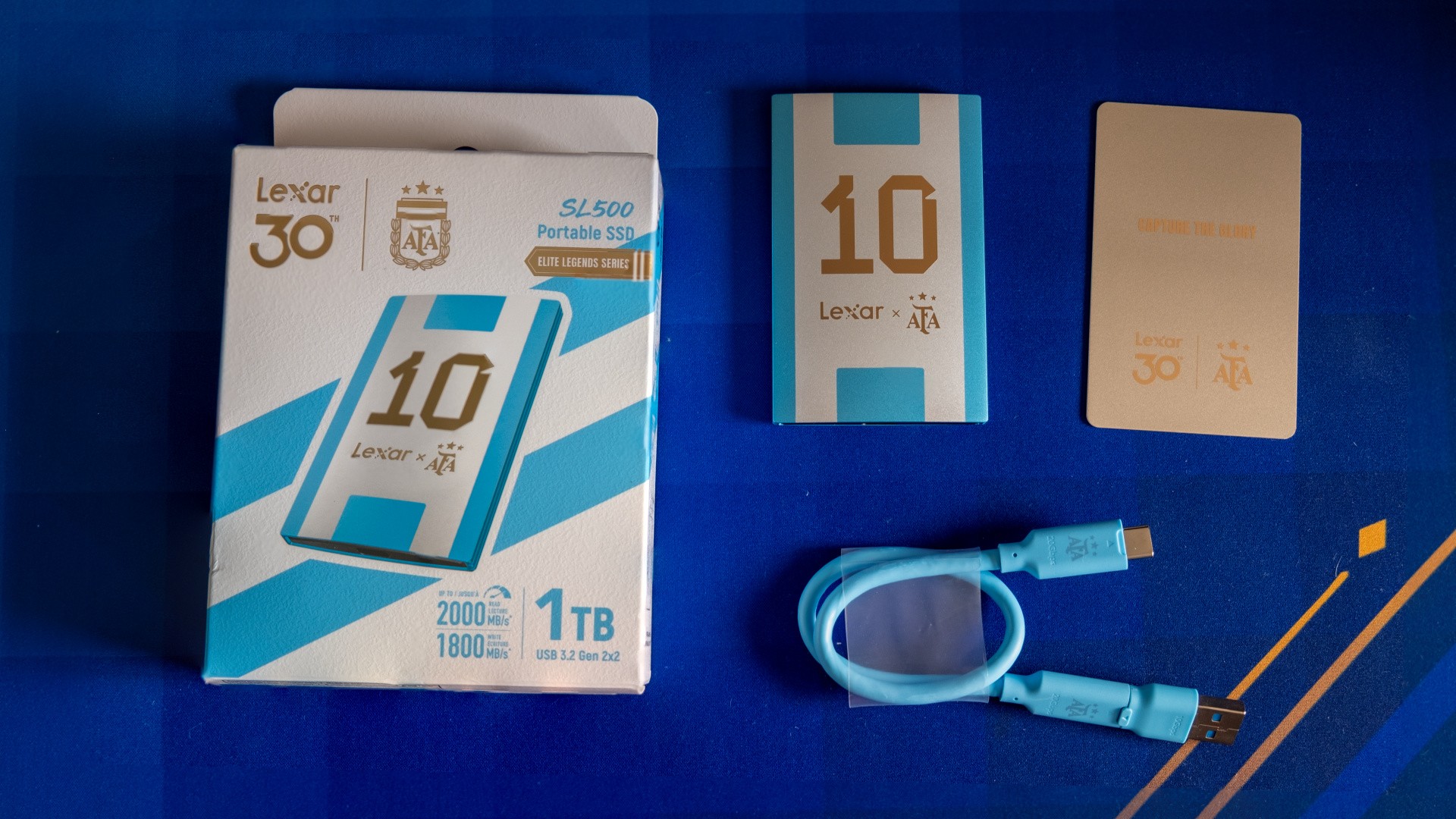
Portable SSDs aren't the curiosity they once were; it's pretty much accepted that you can now get a palm-sized box, plug it in via USB, and get capacities and transfer speeds roughly analogous to internal alternatives. Crucial's X-series drives and Samsung's T-series drives are both ones I've recommended in the past, thanks to their robust designs and reasonable value-for-money, but I've not had a look at Lexar's offerings before now.
The drive we're testing today, the SL500, has been hit by the huge increase in flash memory prices that have disrupted the price of the Steam Machine and caused successive increases in the prices of PC components and games consoles, so it's not surprising that it's extremely expensive (£186) judged by 2025 pricing.
However, that uptick in core material costs means that adding on extra niceties is easier to justify, as they end up being a much smaller percentage of the overall price. Enter the SL500 Elite Legends edition, with includes a high-end metal chassis, colour-matched accessories and Argentinian Football Association branding.
I'm not a huge football fan, but the blue, silver and gold colourway is attractive enough, and the extremely slim (4.8mm) aluminium design feels suitably dense and expensive. The armour provides resistance to temperatures between -40°C and 85°C, and the non-branded SL500 is expected to resist drops up to 2m with IP54 water/dust resistance - weirdly, the SL500 AFA Edition makes no such claims.
Testing the drive first on an M1 MacBook Pro, sequential speeds topped out at around 1000MB/s, but testing on a Thunderbolt 3 port on my desktop PC revealed the expected speeds - 2.1GB/s reads and 1.5GB/s writes. For context, higher-end PCIe 3.0 drives top out around 3500MB/s and SATA drives are limited to 550MB/s, so this is much closer to an NVMe drive.
Random speeds are also reasonable, at around 56K IOPS reads and 57K IOPS writes with access times on the order of ~500ns as tested in CrystalDiskMark. Again, for context an internal PCIe drive would be able to achieve around 200K IOPS reads/writes with around ~80ns access times, so latency is the primary penalty you're paying for the USB 3.2 2x2 20Gbps link here.
Transferring Hades 2's 10.97GB Steam installation to the drive took 55 seconds; repeating the test with a weightier game - the 69.94GB Counter-Strike 2 - took one minute and 45 seconds. Transferring the files outside of Steam made the process even faster. That makes the SL500 a great choice for your secondary Steam installation directory, even if you want to go through the trouble of moving directories to a faster SSD when you start to play them regularly.
Overall, is it a great time to buy SSDs? Not really. Will things get worse? Most likely. Is this still an interesting option? Sure, £186 for a 1TB drive that can hit 2000MB/s is right in line with other options from SanDisk, Crucial and Samsung - so the Lexar SL500 is well worth considering if you like the look and form factor.