
 by
by Nearly three years after launching on Xbox consoles and PC, Starfield has made planetfall on PS5 and PS5 Pro. It's an auspicious time to deliver a NASA-coded space game to a new audience, with the real-life Artemis 2 mission still ongoing, but the mission outlook isn't as rosy as it ought to be.
While the game remains as fun and atmospheric as ever, the PlayStation 5 code unfortunately suffers from a litany of performance and stability woes, while the PS5 Pro version encounters novel PSSR problems and a confusingly large number of modes and settings. Still, it is possible to get a good experience with the right choices, and it's fascinating to see how the PS5 release compares to the Series X version - and how PS5 Pro approaches PC in terms of fidelity.
With seven mode/setting permutations on PS5 and a stunning 24 on PS5 Pro, we didn't have time to exhaustively test every mode available. Instead, we focused our efforts on the best standard options, and we'll cover those first before looking at more exotic alternatives later.
On PlayStation 5, just as on Xbox Series X, the default option for many players will be the 60fps performance mode. Internally, performance mode runs at around 1080p, with some evidence of variable rate shading (VRS) techniques to shore up performance by reducing the shading complexity of elements away from the focal point. The Xbox Series X ran at around 900p at launch, but has adopted a similar 1080p outlook with heavier VRS usage to match the PS5 version. Interior areas run at a steady 60fps, but larger cities like New Atlantis and Akila City can dip as low as the 30s. Performance here is around 5fps faster on Series X.
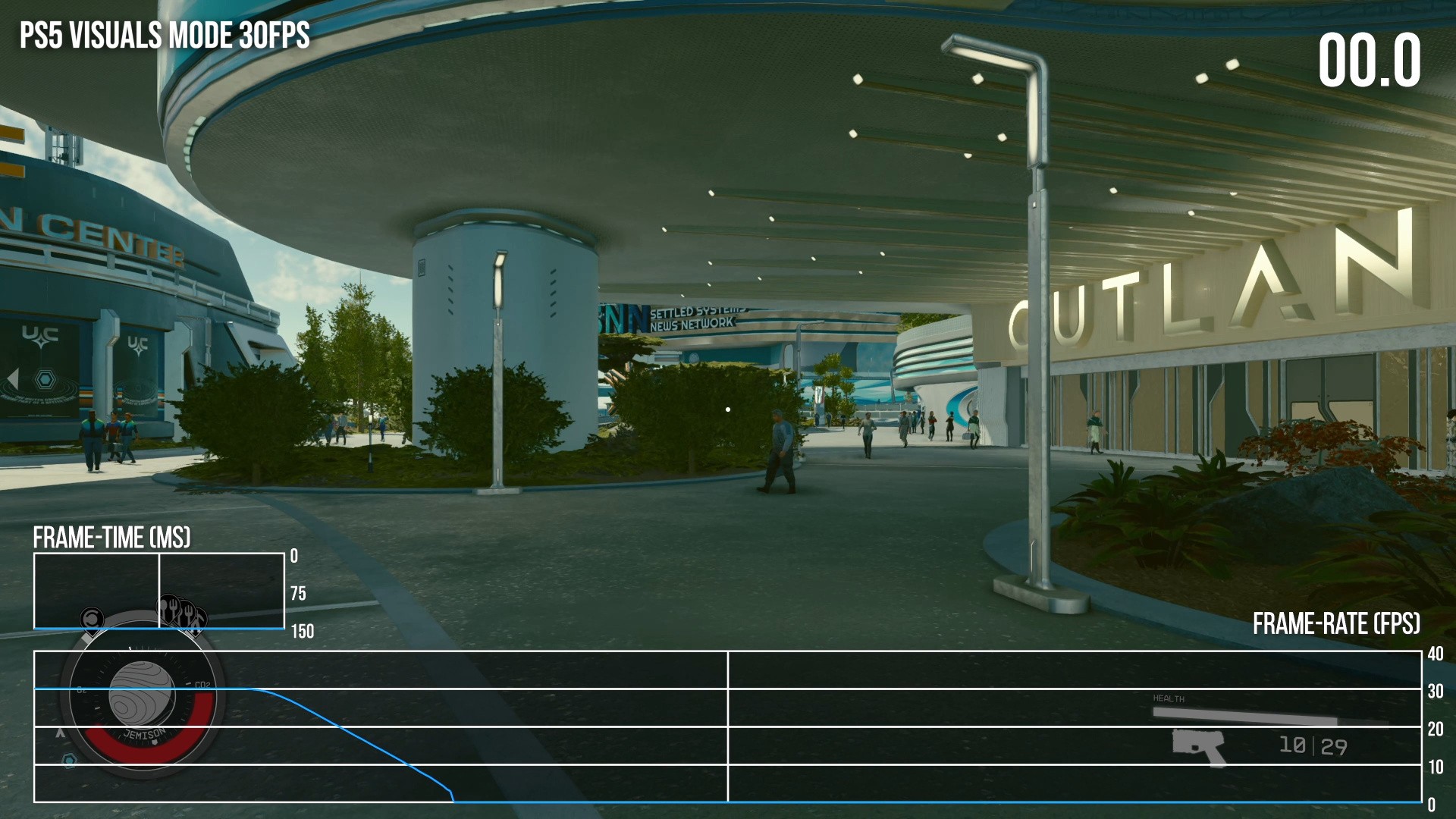
The 30fps quality mode on PS5 provides better visuals, including longer draw distances, improved shadow resolution and more detailed terrain. It also benefits from a higher internal resolution of around 1440p, while sticking to its 30fps target even in dense urban areas. That's an improvement versus the launch Xbox Series X version, and also better than the historical releases of Skyrim, Fallout 4 and Oblivion.
Moving onto the PS5 Pro, owners of the premium Sony console benefit from higher graphical settings in the 60fps performance mode, though surprisingly internal resolutions dip from 1080p to around 900p. This does seem to help performance, with the PS5 Pro sometimes holding around a 10fps advantage over Series X.
Image quality is also hampered by the use of first-gen PSSR, which leads to obvious artefacts like flickering, breakup and noise in motion. It's possible to force second-gen PSSR as a system-level toggle, which is sharper and cleaner overall. However, PSSR 2 also introduces its own new artefacts, with chunks and instability visible in foliage and other areas treated with ambient occlusion. Still, it's probably worth enabling, though our footage used the default PSSR for consistency's sake.
Unfortunately, both PS5 and PS5 Pro crashed somewhat regularly during testing, a phenomenon that didn't affect the Xbox Series release on launch. When crashing, the game locks up and becomes unresponsive, requiring a forced restart at the system level. We observed this behaviour across multiple modes and configurations, so there's no obvious suggestion on how to avoid these issues. The Xbox Series X version of the game also seems to have regressed technically, with no crashes to speak of but new stutters in the opening sequence and other demanding scenes.
As well as the headline 30fps and 60fps modes, there are five additional mode/setting configurations to choose from on base PS5, and 22 more permutations (!) on PS5 Pro.
Focusing on PS5 Pro, there are multiple graphics quality tiers and frame-rate targets (30, 40, 60 and unlocked), plus system-level toggles exist for VRR and upscaling. The Pro-exclusive "enhanced" mode pushes up internal resolution to 1800p, while also enabling higher quality cube maps, shadows, foliage and draw distances, all at a stable 30fps. You can also choose to run the enhanced mode with a 40fps target on a 120Hz display, though performance dips closer to 30fps in cities.
While the Enhanced mode is a welcome addition, many of the available mode and setting combos don't make sense - for example, there's no reason to run a low-visuals performance mode at 30fps when higher-fidelity modes run identically. Similarly, it's possible to enable unlocked frame-rates without a VRR display, which can result in poor frame delivery. Some toggles, like v-sync, appear not to function at all in the current build.
Altogether, the configuration options don't appear to have been carefully designed, and pruning options that don't make sense could be a net benefit. After all, while enthusiasts can look up the best combinations online or experiment themselves, less technical players could easily end up selecting a combination of options that needlessly degrade the experience. Our view is that curated modes for each frame-rate target would serve the majority of players better.
Finally, the game's HDR implementation is also subpar, with reports suggesting that Starfield essentially delivers SDR in an HDR container. That makes it impossible to see a proper high dynamic range image, which is a real missed opportunity given the beautiful science fiction vistas and NASA-inspired machinery crafted by Bethesda's artists.
While Starfield remains a fascinating role-playing game that's well worth playing, its technical implementation on PS5 and PS5 Pro has plenty of issues that need addressing. Preventing crashes obviously comes at the start of that list, but the broken v-sync toggle, settings changes not persisting, PSSR artefacts and overall performance deserve attention too. Ultimately, these issues cloud what could have been a definitive late-generation update, and the current version feels like a side-grade - or even a regression - versus the game's initial console outing.
One purely positive reading is that Starfield now feels like a game that is ready for new console hardware. The confluence of different modes, frame-rate targets and upscaler options means that the existing code could run on more powerful machines like PlayStation 6 without the need for a bespoke upgrade. Similarly, a port to the mooted PS6 handheld or even Switch 2 could also be viable, though CPU limitations in NPC-dense areas would still be challenging to overcome on a portable machine.
Whether these future projects come to pass or not, it's still good to see one of the biggest Microsoft releases now available to a new audience on PlayStation. Now, Starfield just needs further polish to reach its Kármán-line-high potential.