
 by
by 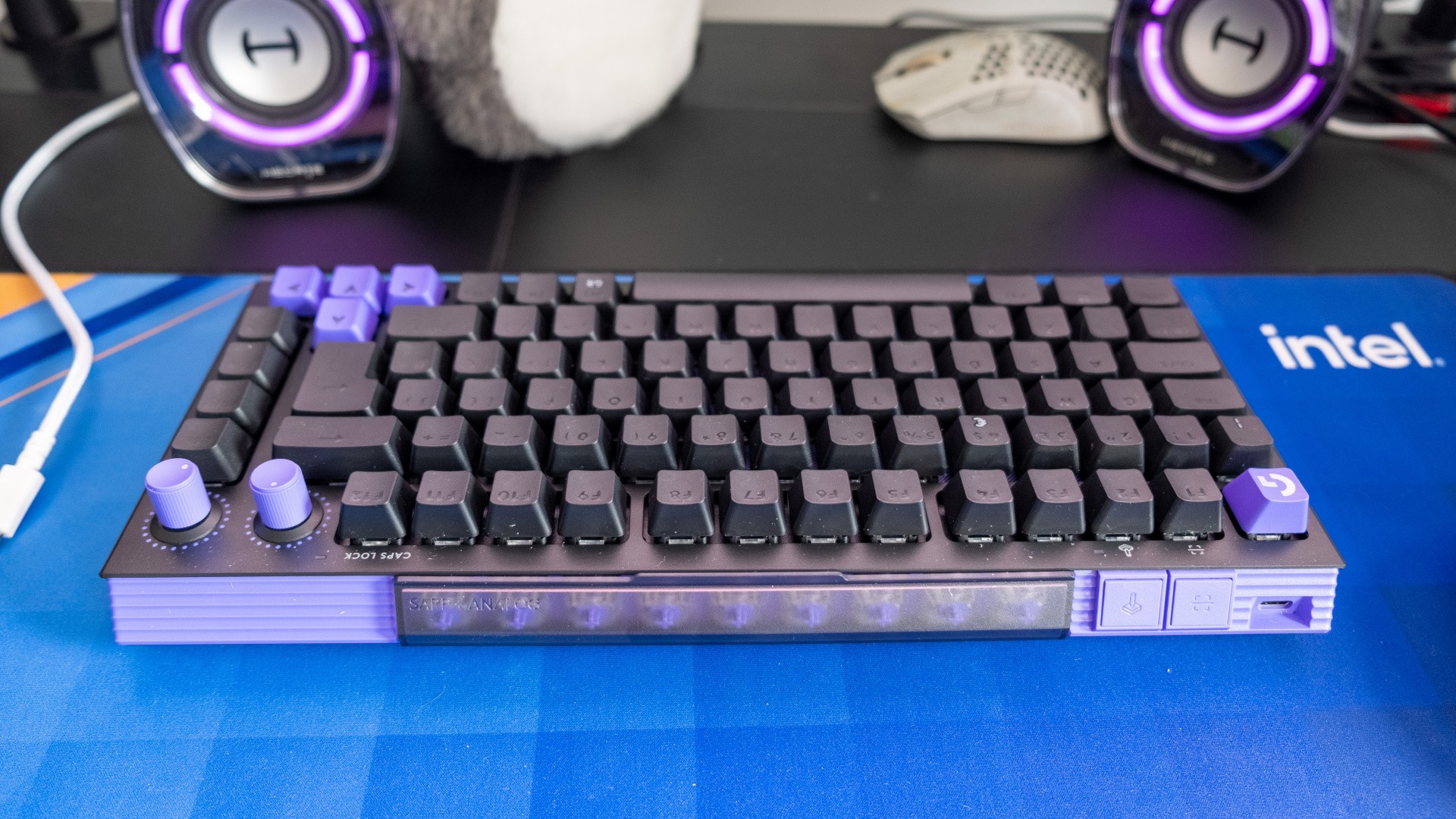
The Logitech G512 X is a fascinating keyboard that offers both mechanical and TMR analogue switches in a single chassis, available in 75 percent and 98 percent sizes and beautifully presented in black/lilac or white/mint colourways. The £170 G512 X 75 I tested does everything it says on the tin, yet I just don't get the core concept: why would you pay so much for 39 hot-swappable keys when you could instead just get a TMR or fully mechanical keyboard for much less?
Let's back up. What even is the difference between TMR and mechanical switches in the first place? Both are mechanical in the sense that they are built around an intricate physical switch under each key, offering benefits over non-mechanical keyboards in terms of tactile feedback, longevity and customisability. The difference is that a standard mechanical switch actuates at a set point through metal contacts, while a TMR switch uses tunnelling magnetoresistance sensors to detect movement from the top of the switch's travel to the bottom. That provides an analogue input, unlocking some extra functionality useful for fast-paced FPS gameplay, while also boasting faster detection and an even longer lifespan.
With that in mind, re-enter the G512 X. The idea here is that you get mechanical switches pre-installed into the keyboard, but you also get nine linear TMR switches housed behind translucent plastic at the top part of the keyboard. These switches can be swapped in, replacing the mechanical switches you started with, but only in 39 of the possible 75 sockets. And, as you only have nine of them, unless you buy more from Logitech, you only have enough to change, for example, WASD, 1234 and the space bar. That gives you access to some useful features in G Hub, but the rest of the keys remain mechanical, so they'll feel slightly different.
If you're confused, congratulations, so am I! I can respect the engineering effort that goes into creating a keyboard with sockets that simultaneously support two completely different types of switches, but if you're going to go to all that trouble, why not make it properly expensive and give that feature to every switch on the board? And provide more than nine switches so you can actually change over every key you're likely to touch while playing an FPS game, for example?
Beyond the weirdness, the G512 X is a very pleasant keyboard to use. The mechanical switches provide great tactile feedback (linear switches are also available if you prefer), the sound of the keyboard is fairly deep, and the 75 percent layout here includes a print screen key, the arrow keys and two dials for key brightness and volume in the top right corner, which is a nice result from a keyboard that takes up minimal desk space.
You also get game mode and switch scan buttons tucked away on the back side of the board, right next to the USB-C port, allowing the keyboard to a) disable keys that would accidentally bring you out of an important game and b) recalibrate the keyboard after inserting a new switch. Elsewhere on the underside of the keyboard, there's a small row of o-rings that can be inserted to provide more tactile feedback for keys set to two functions. The little rubberised feet that prop up the keyboard can even be pulled free to reveal integrated keycap and key switch pullers - incredible.
Aesthetically, the keyboard's black and lilac colouring is pleasant, reminding me of the similar tones used in the Logitech G325 headset we just reviewed, with nice bold key legends and prominent RGB lighting along the front edge that bleeds into the (not included, £35) palm rest. The build quality here isn't superb, with plenty of flex evident under torsion, but for a plastic body it's reasonable enough. (Again, just pretend the keyboard doesn't cost £170 at this point).
In-game, the G512 X performs just fine, as you'd expect from a keyboard that supports an overkill 8000Hz polling rate, adjustable actuation points, competition-focused features like rapid trigger and SOCD. Of course, all but the 8000Hz polling rate aren't available with the default mechanical switches, so you'd be much better off with the (now cheaper!) G Pro X TKL Rapid, which comes with a full complement of Hall Effect analogue mechanical switches.
What keyboard size do you prefer? (51 votes)
- 100%/98% (full-size)
- 80% (TKL, no num pad)
- 75% (more compact layout)
- 65% (no Function row, but with arrow keys)
- 60% (no Function row, usually without arrow keys)
Ultimately, I just don't understand why Logitech chose to make this keyboard. There are some cool ideas here paired with solid hardware, but for a £170 keyboard the main feature is too compromised to actually recommend to most people. I'd much rather have seen a Logitech keyboard that really goes all-in with TMR switches, or one that at least extends the TMR/mechanical swap idea to the whole board, even if it cost more - because then at least it would do something unique and well in the keyboard market. And the G512 could have retained its fun looks and mechanical switches at a lower price, which is something I could have fully gotten behind. Unfortunately though, that's not what we got.
Hopefully, Logitech keep pushing with TMR switches and this dual-swap concept, as I think it does have potential. Until then, though, I think the esports-focus analogue inputs are better handled by simpler, all-HE or all-TMR keyboards. As well as the older G Pro X TKL Rapid, which is now available at £110, you could get similar FPS features from the third-gen SteelSeries Apex Pro series, the many HE keyboards available from Keychron these days or the Wooting 60HE V2 and larger Wooting 80HE. If you want a TMR board specifically, then the Cherry Xtrfy MX 8.2 Pro is a good shout, as is the Gamakay TK75 TMR.
What do you make of the G512 X? Are TMR switches on your priority list for your next keyboard purchase? Let me know in the comments below.