
 by
by 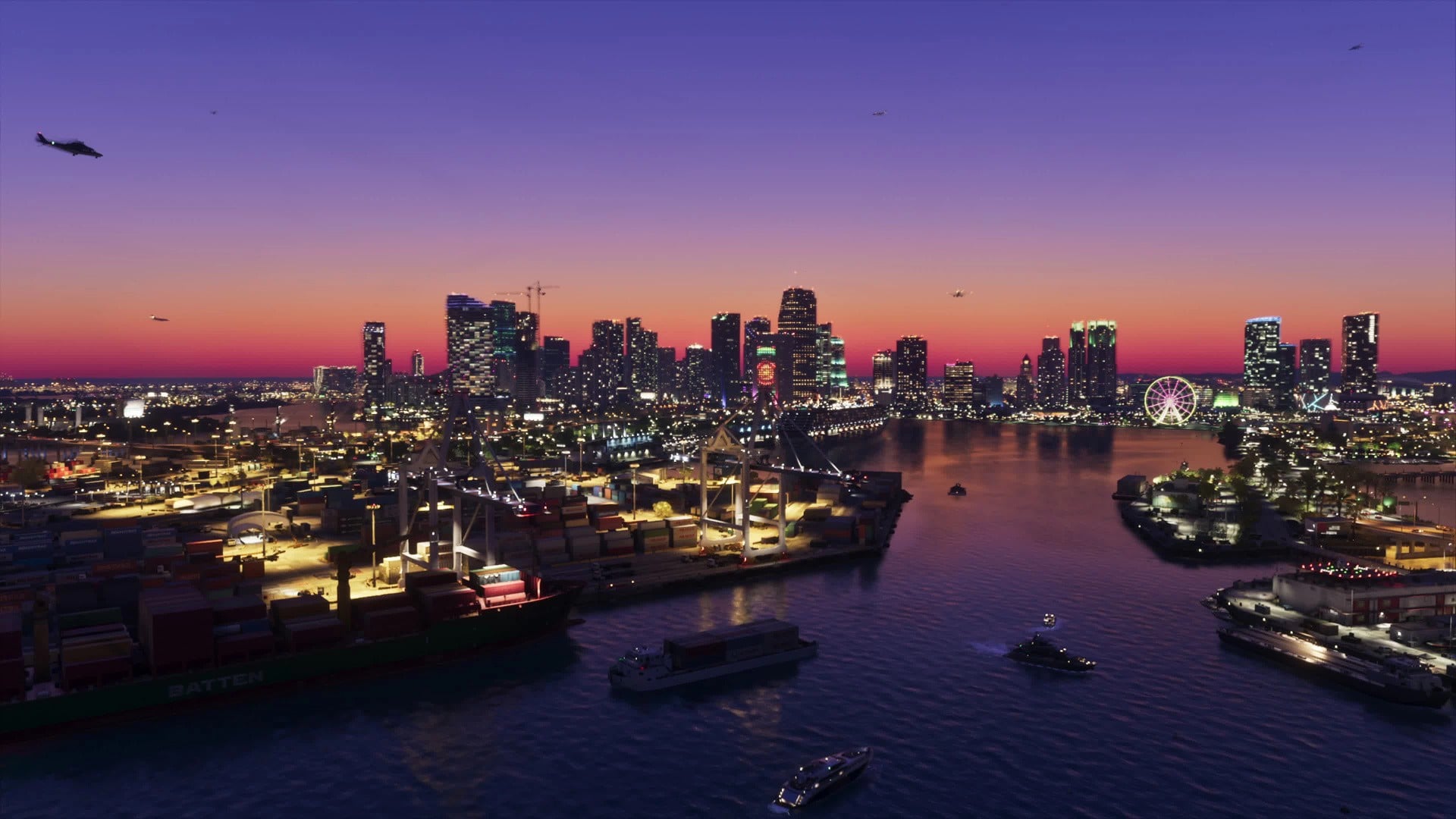
A new Grand Theft Auto 6 trailer has been revealed, showing the game's snazzy cover art and 80s inflected music to underscore its pre-order date. Alongside that though, Rockstar's website also updated with a new video clip of Vice City, embedded in the page itself as you scroll up and down. It features a sweeping view of Vice City's skyline at night, with a wide bay at its centre. The frame is characteristically crammed with detail, with everything from tennis courts in the foreground to the distant skyscrapers.
One curious omission caught the eagle-eyed GTA fans' attention, however: a Ferris wheel. At the far side of the bay, this amusement bizarrely casts no reflection in the water. Zero. Nothing. Nada. So what gives? Why is that Ferris wheel not reflected at all, when everything else is? And is it a bug?
It's crucial that we get to the bottom of this so let's run through the facts. We already know from analysing GTA 6's first two (much lengthier!) trailers that ray traced reflections are included in the game. This remains the case: based on this new shot, it's clear the game uses a hybrid approach to reflections - ray tracing and screen space reflections.
Are you pre-ordering GTA 6? (2,383 votes)
- Yes, as soon as pre-orders go live
- Maybe, it depends on reviews
- No, I'm not getting the game at launch
First of all, ray tracing is indeed used to draw reflections across Vice City's central bay. One sign is that the game mirrors the geometric mesh of nearby buildings in this case, but without shadows or ambient occlusion factored in too. Ray tracing can be configured in multiple ways to save on GPU performance - and the RAGE engine will have its own unique setup that we can't speak to. However, it's clear that the ray traced reflection on the water here is not accurate to the lighting or shading of the scenery above.
The result: the reflected image is visibly brighter than the source object. Likewise - and more pertinently - to save on GPU costs, ray tracing can also be set up to discriminate between objects - and even exclude them from the ray tracing pass altogether based on the game's Bounding Volume Hierarchy (BVH). This alone would explain the missing Ferris wheel reflection. It's an object in similar range as the surrounding buildings, and yet one that's seemingly not flagged to reflect using the ray tracing approach.
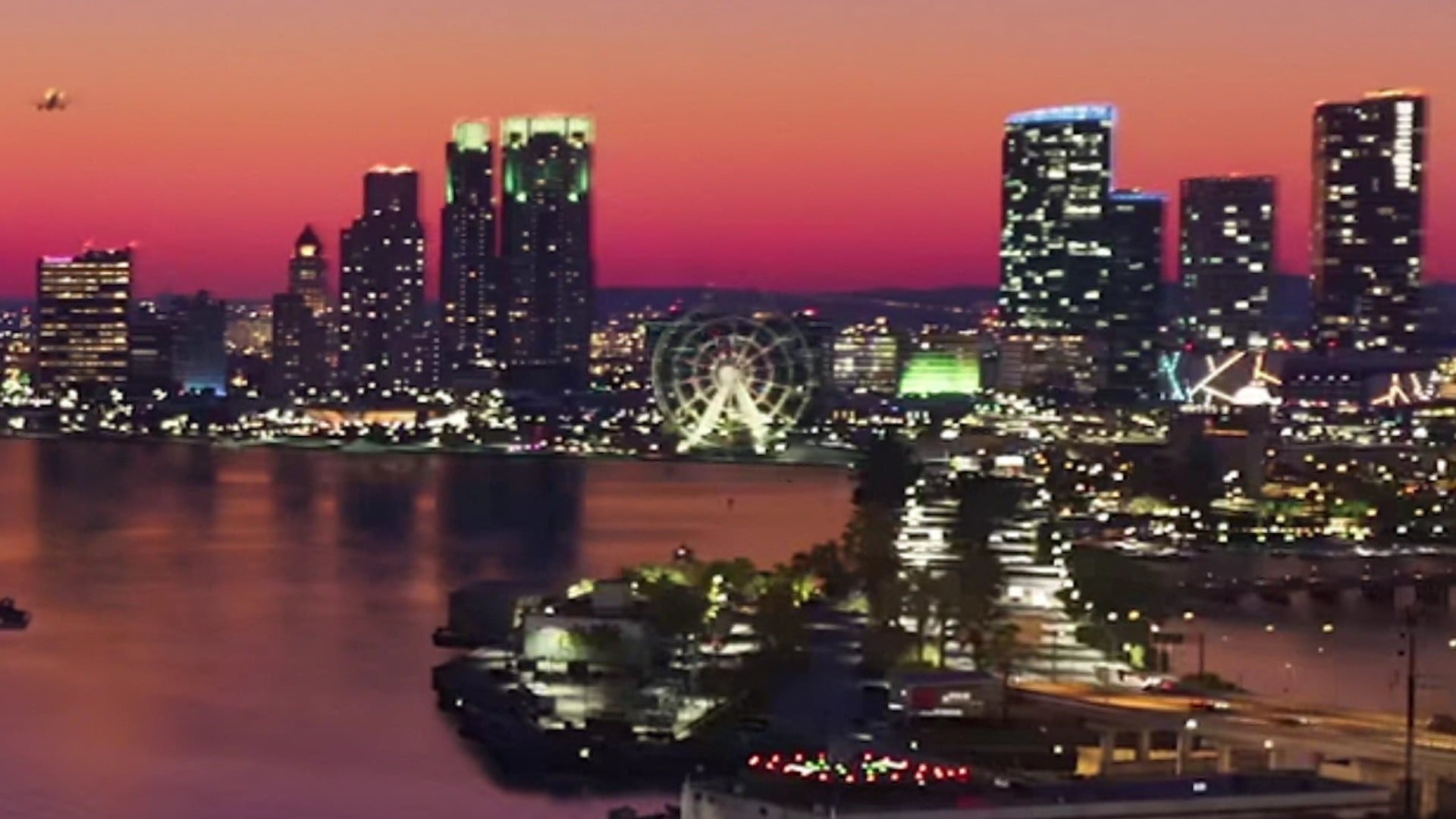
It's likely a ray tracing related quirk that, perhaps, will be tweaked in the final game. The upsides of RT reflections are also apparent in this footage though. The good news is that there are no occlusion artefacts on the water, as we might see with a pure screen space reflection (SSR) approach. As a result, sky-scrapers do not impact the reflection as they encroach on the sides of the frame. Likewise, flying helicopters do not affect the mirror image, even when they obscure the source object (ie a building) - something that would cause SSR issues. The reflection stays stable throughout. That being said, SSR is still used here in a limited capacity, as a fallback method, which is evidenced in a subtle cut-off at the screen's edges. Where ray tracing isn't applied, SSR fills in certain blanks in the water body, though clearly this does not extend to geometry like the Ferris wheel either.
In short, neither ray tracing or SSR are configured to reflect that Ferris wheel. Variables like camera distance are a factor - especially for ray tracing - and this is something we have no control over in this brief 10 second clip. To get a full grasp on how this works we'll have to wait until the final game, but for now, hopefully this offers some explanation.