
 by
by Valve's foray into virtual reality hardware formally continues with the oft-rumoured, finally-revealed Steam Frame VR system. We've gone hands-on, head-on, and eyes-on with Valve's first new headset in over six years, and while our testing has been brief, we're already convinced that this is the most compelling VR competitor we've yet seen to Meta Quest 3.
Yes, Valve's code-named "Deckard" is quite real, and Valve staffers have told us it's the product of years of iteration, moving past the learnings from their 2019 Valve Index system and beyond. Like Quest 3, it relies on an inside-out tracking system and operates by default as an "untethered," locally processed VR system - meaning, no cables connecting to a PC or console.
We don't yet know Steam Frame's price, and it's currently a fair question whether it will approach or exceed the Meta-bankrolled price of $499 for the base Quest 3. Still, Steam Frame has a few immediately captivating features that Quest 3 doesn't, particularly for the millions of PC gamers who've already invested in Steam's massive ecosystem of 2D content. Valve wants those users to bring those experiences - yes, even 2D ones - into their new VR headset, either streamed from their PCs or, for less demanding games, running natively on the headset.
Reading between the spec-sheet lines gets to the heart of what makes Steam Frame so fascinating. In order to run your favourite Steam games natively, Frame leans on a brand-new translation layer that ports native PC code to the ARM64 platform. This development is, in a word, megatonne - a hardware-compatibility game-changer that surpasses the scenario of porting Windows code to Linux via SteamOS's WINE translation layer.
We didn't test Steam Frame for long enough to confidently determine how well its Snapdragon 8 Gen 3 chipset runs a wide variety of Steam software; that will have to wait for a future in-office testing period. The same goes for much of what we went hands-on with. We had limited time and minimal software to test, both for native VR and 2D games, and some of our impressions are anecdotal without immediately having rival headsets to compare at Valve's home offices.
Still, there's lots to get into ahead of Frame's eventual, unconfirmed launch date, currently in a "Q1 2026" window, and, in our opinion, lots to be excited about.
Fit and finish
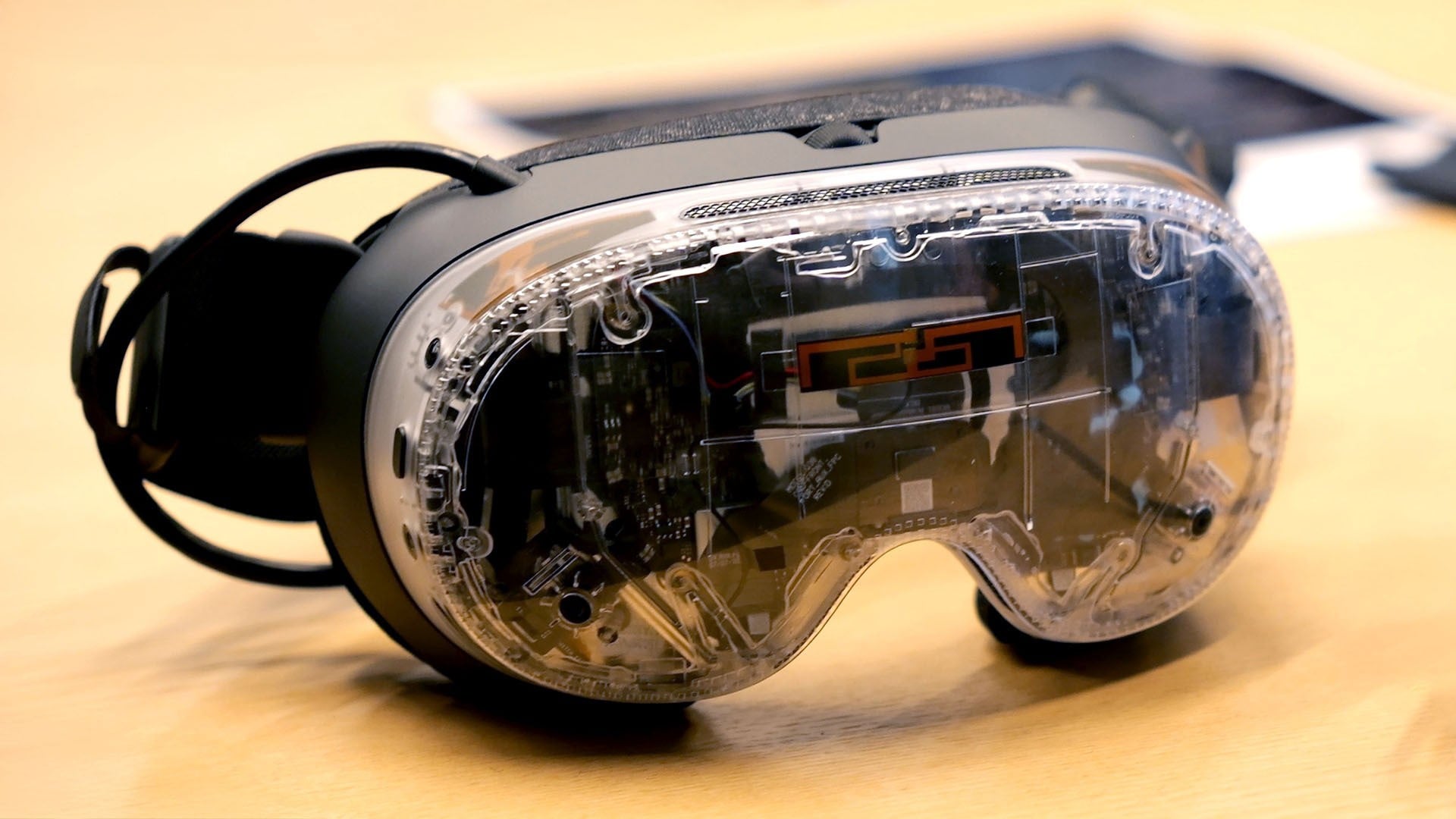
We start with the device erring on the side of thinness and minimalism, which we felt was more apparent while wearing the device than merely glancing at it on a table. When Quest 3 debuted with a pancake lens assembly in 2023, we were already impressed by its resulting reduction in headset depth. What more could be done to reduce a VR headset's size?
The biggest answer is an interesting one we're surprised no other untethered VR headset has tried before: moving the battery from the front-of-face headset to the headstrap. It's an evolution of popular Quest 3 headstraps that include a secondary external battery as a counterweight. Valve goes one better by putting Steam Frame's 21.6 Wh battery in the back-of-head portion of the default strap, not the headset itself, to more evenly distribute weight.
Frame offloads additional weight by building its speakers into its default horizontal strap. (An optional vertical strap can be attached to further dial in users' preferred Frame fit.) Vibrations can create issues with built-in VR tracking systems, so Valve engineers placed two drivers per side of the headset that face in opposite directions, in order to offset potential vibrations inside a sensitive location like a headset strap.
The entire headset portion of Frame, then, weighs in at an astonishingly slim 185g - though Valve cheats a bit by not including the weight of the cloth facial mask in this count. Add that mask plus the battery-fitted, cloth-backed headstrap, and Valve estimates 440g of weight in all, which still comes in below the 515g eight of Quest 3 with its default strap.
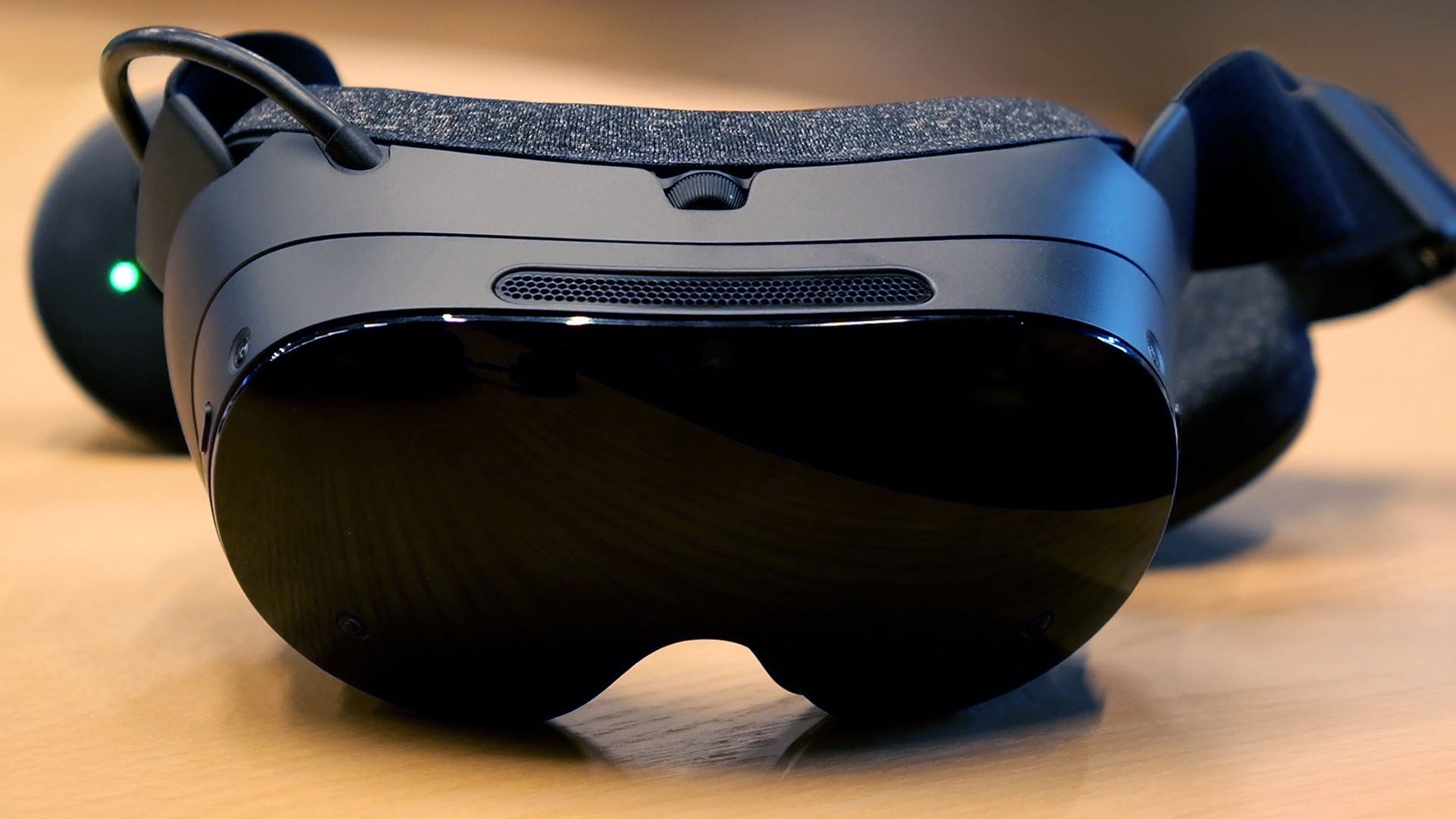
Without exact measurements from Valve, we can only suggest from eyeballing Frame that it has indeed further reduced the headset's depth beyond what Meta accomplished from Quest 2 to Quest 3. Its center-of-mass seemed to land comfortably in our brief session.
Without a variety of head sizes or pairs of glasses to test with at the event, we can only suggest that space for glasses inside of Frame feels a bit limited in its default configuration. We would like to see swappable face masks that make more room or prescription lenses replacements, both of which have been made for other popular VR headsets. As of press time, Valve hasn't confirmed whether we can expect either or both.
The company has confirmed the entire strap is swappable by way of the one exposed cable visible on its top, leaving the door open for first- or third-party headstraps with different battery or audio configurations. (No new straps necessarily coming from Valve, to be clear, as the company "has nothing to announce at this time" on that front.)
Lenses, panels, and foveated streaming
Steam Frame includes two fast-switching LCD panels that render 2160x2160 pixels per eye, which is almost identical to Quest 3's 2064x2208 per-eye resolution (and outright doubles Valve Index's pixel count). Each runs at frame rates ranging from 72Hz to 120Hz, with an additional 144Hz "experimental" option selectable through menus.
From our limited in-person testing at Valve's Bellevue headquarters, we found the combination of lenses and panels resembles the Meta Quest 3 experience. We noticed minimal ghosting, lack of image warping (an inherent perk for pancake lenses) and an easily dialed-in "sweet spot" of seeing a clear, wide field of pixels wherever we were looking. This was helped by a handy, manual IPD dial, which Quest 2 eschewed and Quest 3 brought back.
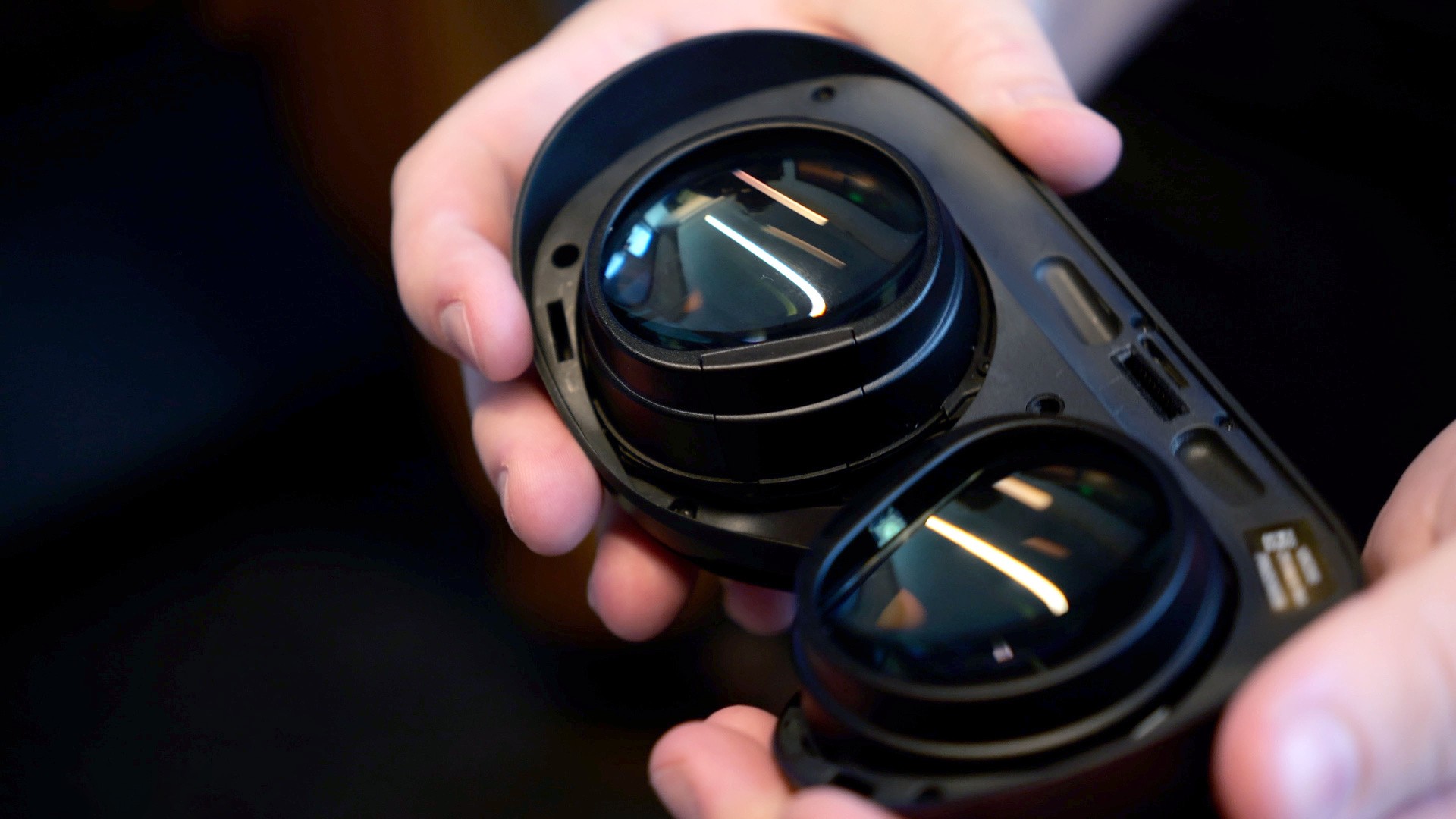
A years-old announcement about a collaboration with the OpenBCI initiative led us to ask Valve reps whether any sort of Brain-Computer Interface (BCI) might have been considered for Steam Frame. Their answer: Nah. But Frame does have at least one facial recognition feature built-in that Index and Quest 3 lack: pupil detection and eye tracking. And its impact on Frame performance is huge on multiple fronts.
In conversations with DF, Valve engineers confirmed this tracking powers two performance-enhancing systems: foveated rendering and foveated streaming. The former will sound familiar to PlayStation VR2 owners, since that headset tracks eye movement and, in many games, renders pixels based on where a person is looking. Meaning, if you glance to the left at a VR game's monster, everything to the right, above, and below that monster will have its pixel count in each eye dynamically reduced, and you arguably won't notice such peripheral changes.
Quest 3 does not include such a performance-boosting trick, and that alone could be quite the performance-booster for comparable software to run natively on Frame. Worth noting: foveated rendering must be enabled by developers on a per-game basis; Frame supports the feature with its eye-tracking system but doesn't turn it on by default.
A similar philosophy powers Frame's foveated streaming system, which is exclusive to wireless connections to SteamVR games on a nearby PC and does work on every Frame game. If you look at the aforementioned in-game monster to the left while using Frame, the objects in your peripheral view will also have their wireless streaming bandwidth reduced. It's the VR equivalent of a YouTube video where your focal attention gets the purest pixel fidelity, while the periphery is blurrier and has more macroblocking artefacts.
As a fun party trick, Valve turned on its "debug" mode to let us see how accurately its eye-tracking system followed our gaze. Valve engineers describe their eye tracking solution as "fast enough to beat you to" where your gaze is going - an odd description that only made sense when we saw the debug view of gaze detection working so rapidly.
This optimised PC-streaming pipeline is truly unique to the VR space, and it's made possible by Frame's dedicated wireless streaming dongle. Plug the Steam Frame Wireless Adapter into your PC via USB 3.1 Type-A - or, in a pinch, Valve says it will function fully in a USB 2.0 port - and it will transmit a dedicated WiFi 6E video stream via the 6GHz spectrum to your headset. (Steam Frame additionally supports 5GHz WiFi 7 bandwidth for use cases like voice chat with friends, but streaming your native PC games to Frame requires this 6E streaming dongle.)
Performance, battery and a new translation layer
Streaming from an existing PC isn't the only Frame gameplay option. Frame is the first Valve VR headset to include built-in native game rendering, and as a newer headset than Quest 3, it takes the opportunity to leapfrog past Meta's specs, utilising a Snapdragon 8 Gen 3 as packed with 16GB of LDDR5X RAM.
This mirrors the specs of the early-2024 Samsung Galaxy S24 Ultra smartphone but with 4GB more on-board RAM. Based on S24 Ultra benchmarks, this configuration delivers fantastic results compared to the Snapdragon XR2 Gen 2 found in Quest 3, more than doubling performance in synthetic Geekbench single-core and dual-core tests.
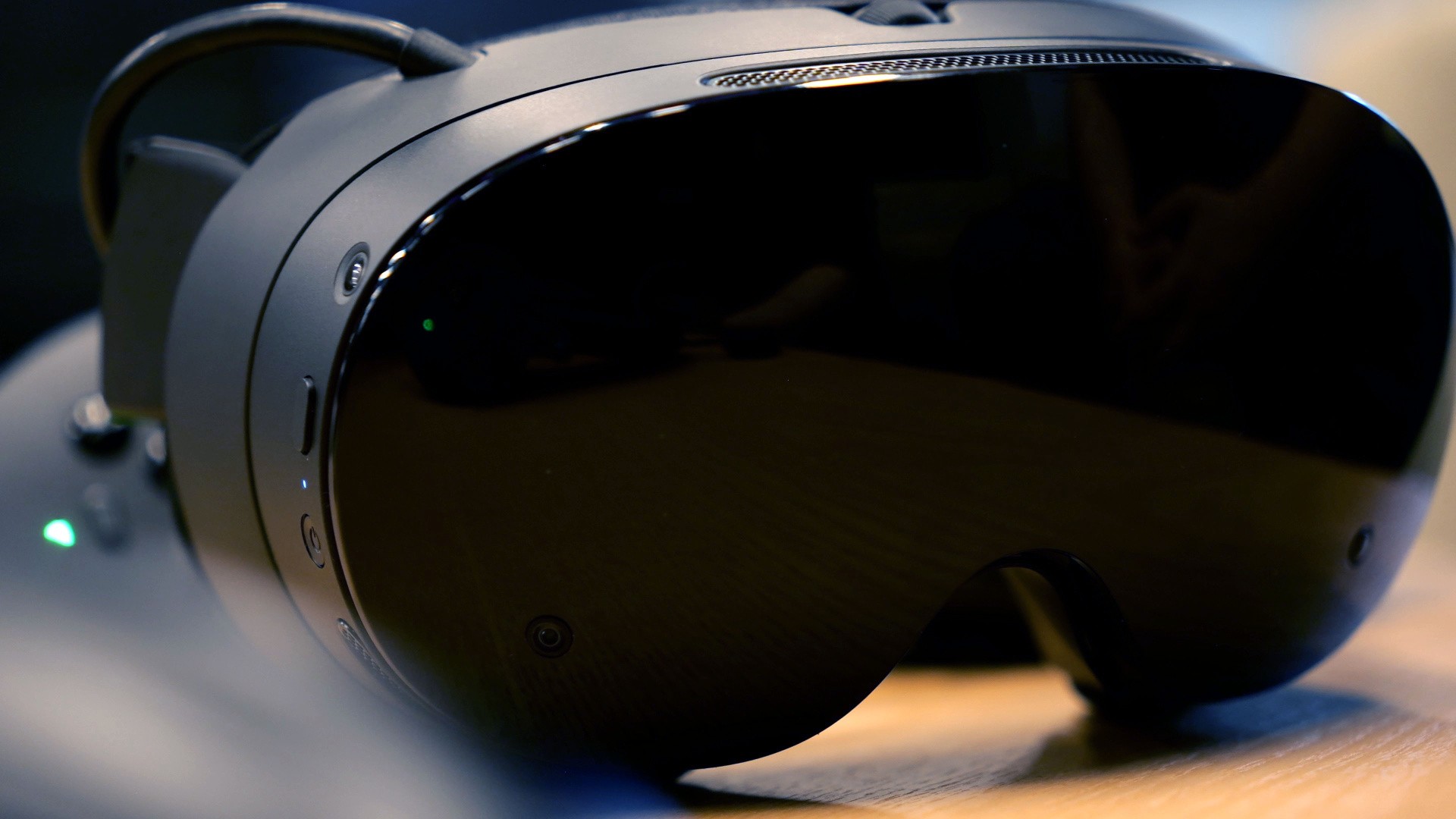
As is to be expected in a limited-time preview event, Valve's Frame demo included a limited testing suite of games. The two natively rendered VR games we sampled included Ghost Town, a first-person-perspective narrative-puzzle game, and Moss, a third-person adventure game with a first-person viewpoint. These each ran at an apparently smooth clip with fidelity and effects comparable to their Quest 3 counterparts.
Crucially, these game versions were not ports of the ARM64-specific code published on Quest 3. Rather, these each ran their native x86 code through Steam Frame's "Fex" translation layer. (If a VR game developer already has a working "APK" version of a VR game, Valve will soon begin opening up distribution of those APKs for Steam Frame users, should they prefer.) While Valve reps weren't forthcoming about the Fex translation layer's origins, we noticed a seemingly relevant announcement from CodeWeavers on November 6 about their own in-development ARM64 translation layer.
Codeweavers developer contributions make up a majority of the WINE translation layer's open source commits, which Steam's Proton translation layer relies heavily on, so we believe this announcement landing so close to the Steam Frame's reveal is not coincidental.
Valve engineers suggest that the Fex layer's performance cost is roughly 10 to 20 percent of a game's CPU-intensive workload, and they emphasize that this isn't a flat 10 to 20 percent drop in raw frame rate, because "all of the APIs that a game in a PC space would traditionally rely upon are implemented natively."
We look forward to conducting our own comprehensive testing on SteamVR x86 code as run through this newly announced Fex layer and figuring out how this stated performance cost weighs out compared to ARM64-focused APKs. For now, at least, our pair of real-time game demos suggest, at its best, a plug-and-play experience that favourably compares to Quest 3's performance maximums, if not exceeding them outright.
Though we should note one significant, possibly telling exception. Valve allowed us to test its signature, VR-exclusive adventure Half-Life Alyx in Steam Frame, but we were only able to play it as streamed from a nearby PC. Valve representatives did not clarify whether we should expect an optimised version of HL:A that will run natively in Frame, or whether they expect the Fex layer to bring it to a performant Frame state.
Instead, we were told flatly that Valve thinks of Steam Frame as a "streaming-first" device - an interesting designation considering the amount of work that has gone into getting native x86 code to translate to ARM devices. That includes a "Steam Frame Verified" program, which will resemble the existing Steam Deck Verified process. If a game is listed on Steam as Frame Verified, that badge will indicate users can expect a solid native-rendered experience on Frame.
As a cool party trick, Frame supports SD card hot-swapping between itself, Steam Deck and the newly announced Steam Machine. Take your SteamOS game installation files from device to device with zero additional formatting or other SD card optimisations needed. This is also an easy path to expand beyond Frame's two built-in storage options of 256GB and 1TB.
According to Valve, Frame's 21.6 Wh battery can power anywhere from 1-4 hours of gameplay based on factors like frame rates and a series of selectable performance presets - not too dissimilar from popular portable systems like Steam Deck. If you want to overdrive Frame to its maximum power draw, you can connect a USB Type-C cable to a power source (external battery or dedicated AC power) to extend your VR sessions past that slim one-hour maximum on built-in battery alone.
Changes from Valve Index: Tracking, new gamepads
Inside-out tracking, as made popular by Meta's Quest headset line and many Windows MR headsets, has finally come to a Valve headset. During the run-up to Valve Index's 2019 launch, its engineers insisted that external tracking boxes were the only guaranteed way to deliver quality tracking of a user's head and hands in real-world space. In the years since, they've changed their tune.
Like most recent Quest models, Frame's array of four outward-facing monochrome cameras visually maps and tracks a user's room, head and hands. (We did not get to test Frame's required room-mapping sequence but expect this to run similarly to the smooth setup phases in Quest 3 and PSVR2.) Valve also points to what it calls an "outward IR illuminator" that refines its external tracking for better performance in low-light spaces.
In our anecdotal testing, this felt incredibly performant, but there's a catch. The outward-facing cameras are not up to the same fidelity as the RGB cameras utilised in Quest 3. Frame users can toggle an outward-facing view while in VR to glance at their surroundings and, say, track people or pets in the same room, but it's not in any way designed to deliver satisfactory "mixed reality" gaming or application scenarios.
Valve confirms that this was a "cost-conscious" decision and opted to invest into Frame's pair of differentiated wireless radios instead of costlier cameras. "We're really happy with the trade-offs we made that serve all of your games, as opposed to trade-offs that might only work on a fraction of the catalogue," Valve's Jeremy Selan told us.
The company points to an "optional accessory port" on the front of Frame which could connect to future add-on hardware. In theory, this could support higher-resolution, MR-compatible cameras or even open up compatibility with Valve Index and HTC Vive's outside-in tracking boxes. But Valve has already been down this road with a "front trunk" accessory port on the face of Valve Index, which was only really used for attachments that added cooling fans to the front of the system. Maybe Valve has more interesting ideas for Frame's port, but their Index track record doesn't inspire excitement on our part.
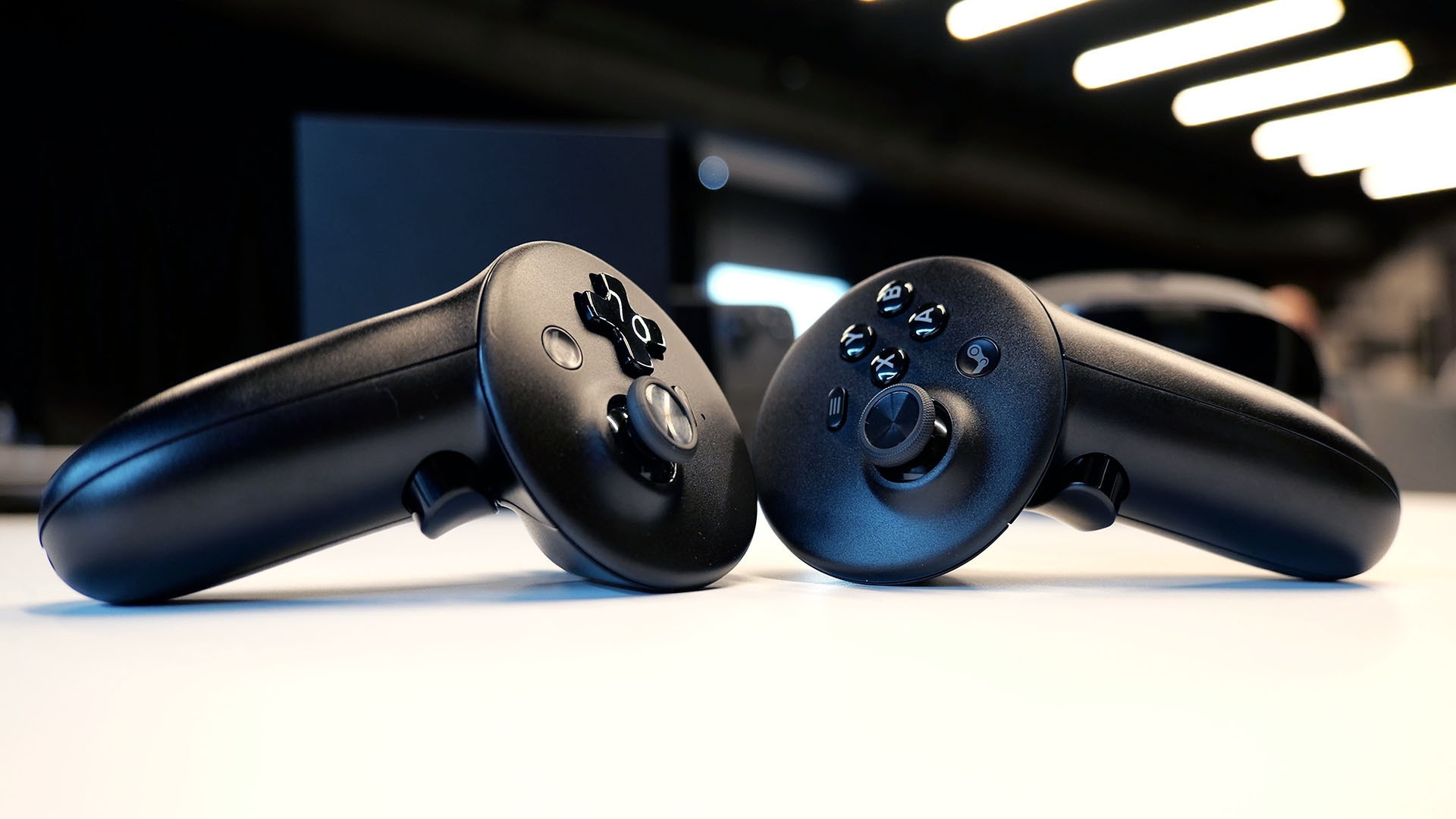
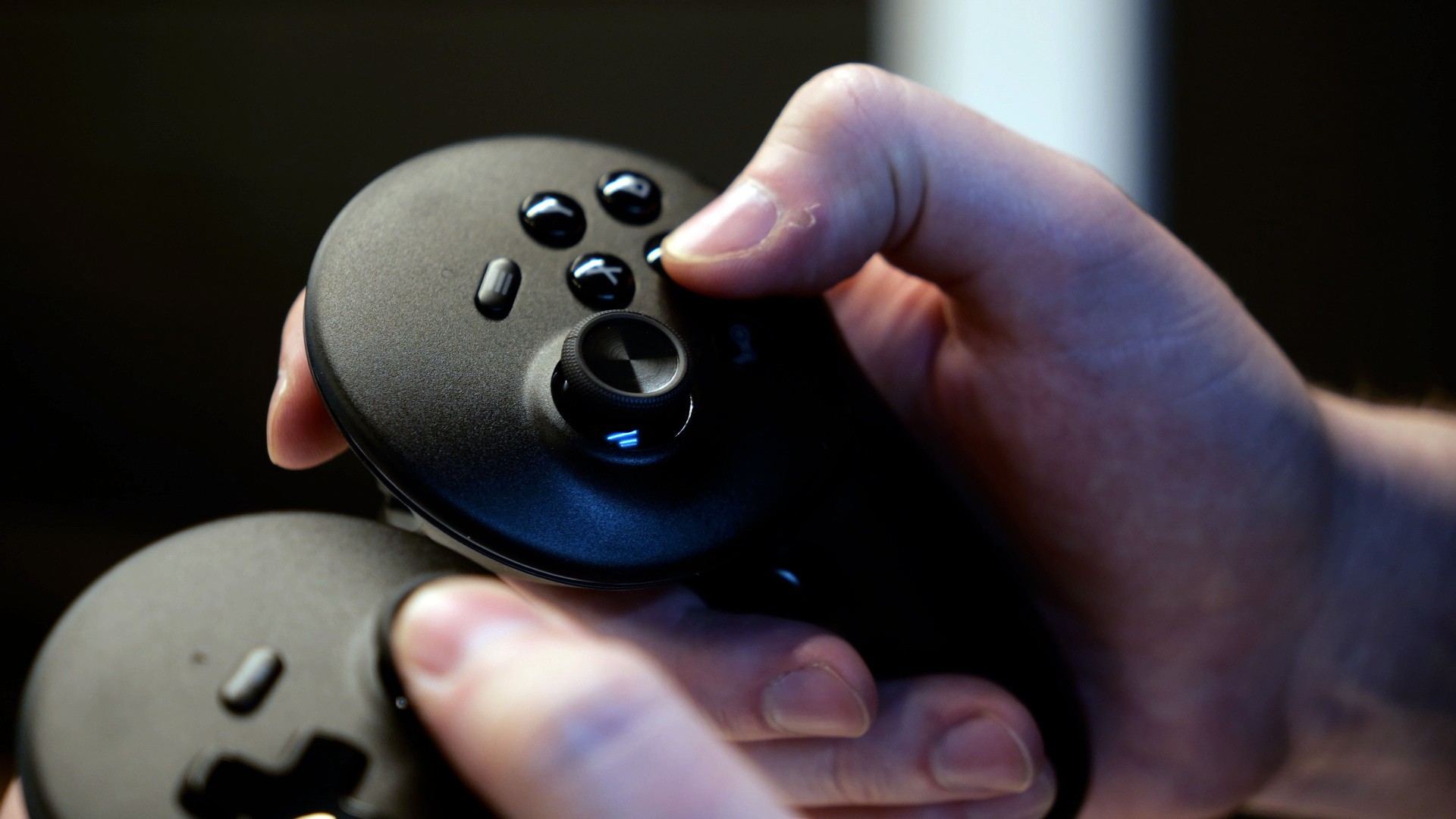
The gamepads, meanwhile, have scaled to almost entirely resemble those of Meta Quest, with a crucial difference: a 1:1 mapping of a standard console gamepad. If you've ever used Android sideloading to get unofficial games installed on a Meta Quest system, you know the pain point of its controllers missing a d-pad and a classic "ABXY" button array. Since Valve wants Steam Frame users to play their favourite standard 2D fare, the button touch-up makes sense, and the joysticks and buttons apparently use the same materials found in this week's refreshed Steam Controller, particularly Tunneling Magnetoresistance (TMR) thumbsticks.
All great for classic gamepad games, but what about the expectation of mouse controls in Steam games? Instead of putting touchpads on Frame's controllers, Valve has announced "Quick Mouse," a rebindable button that turns your hand-tracked controller into a laser pointer and locks into whatever 2D box (video game, web browser, etc) you're focused on. We didn't get a chance to lose hours to a Frame session of Sid Meier's Civilization, so we're not ready to make a judgement call on this feature, but we're curious to see how it fares in classic RTS and 4X fare - and whether it somehow might function decently in first-person shooters.
Everything else you might expect from a motion-tracked VR gamepad is here, including capacitive finger position sensing, haptic feedback and a trigger/grip button array (mapped to L1/L2 and R1/R2 on each hand, for gamepad parity). In other words, everything you'd need to comfortably play Valve's Half-Life Alyx in VR. Like with the headset, Frame's controllers support an optional hand-gripping strap to better resemble Valve Index's "Knuckles" gamepads.
Conclusion: Is Frame Mode where it's at?
In the initial wake of learning about and testing Steam Frame, we immediately thought about how its biggest possible rival might not be Meta Quest 3 but rather Steam Deck. At least, at the right price. We don't know if the eventually announced price will be closer to Valve Index at $999 or Quest 3 at $499. If it's nearer to the latter, that price tag could make a SteamOS fan choose between buying their first (or second) Deck or buying a Steam-friendly VR headset instead.
Faced with that choice, we don't have a clear recommendation, if only because Valve has dangled the mixed proposition of a magic wand that translates x86 code to run natively on Steam Frame... and a clear suggestion that Frame is designed first and foremost around streaming games from a nearby PC. So, which is it?
Valve may be cleverly hedging its sales proposition bets by imagining an Ideal Frame customer. Someone who is invested in the Steam marketplace, who likes playing higher-fidelity PC games at home, and who wants to pack portable-friendly game installation files into a headset that they might flip on while sitting in a hotel room, a family member's house on holiday or a lengthy plane ride.
But we need more time to stand, sit, and lie down while using Frame. In our brief tests with four video games, we appreciated the apparent active cooling system, the fantastic weight distribution and immediately comfortable fit, the unnoticeable dissipation of heat from the battery, the Index-like cloth material on the face mask and headstrap and the loud-and-clear 3D positional audio system. But we're curious whether longer sessions and increased use will reveal shortcomings on comfort level or performance (or drive us to buy third-party fixes, which we've had to do with the budget-minded Quest 3).
Valve has taken particular care to deliver quality VR optics, using similar fast-switching, low-persistence LCD panels as found in Valve Index, but engineers would only suggest that Frame has "similar levels of illumination shortness" compared to Index, not superior levels. So we are curious to see how comfortably native 2D games appear inside of Frame over extended periods; for example, whether its 120Hz mode (or the "experimental" 144Hz option) scales 60fps content without pixel persistence clashing with the panels' lack of VRR support.
Like on any other VR headset, testing such a visual experience is a matter of subjective determination, and so far, we've only seen a locked, high-frame-rate test of Hades 2 as an example of what to expect. That demo looked great, and we comfortably positioned its virtual projector image in our virtual field of view while slaying its mythological monsters. But we need to test the performance outliers while also weighing the realities and limits of VR optics.
And, gosh, we're still shocked that Half-Life: Alyx didn't run natively on the thing. Feels like an odd flex on Valve's part. We hope that's addressed soon.
Still, even with our lingering questions, this is the VR headset we've been hoping for: a quality, consumer-focused model with great WiFi streaming performance, a promising new translation layer for wider software support, seemingly tasteful concessions to balance price and usability and a darned good fit on the face. Also, if the price is right, we'll already be comfortable suggesting that this is a good-enough option for anyone who may prefer not to invest their VR budget into the internet behemoth that is Meta.
For more on today's Steam Hardware blitz of news, be sure to check out our extensive report on the new Steam Machine model and its accompanying new Steam Controller.

Comments 8
I've got an Index, and this is a really straightforward upgrade for me. No more cables, lighter headset, compatible with my existing games... great.
I'm really interested in the Android app support as well, less for gaming as much as for media apps. Being able to watch movies while on a plane, for example, would be brilliant.
This will likely be what makes me jump into VR gaming. Depending on the price , I'll get this and the Steam Machine around launch tme.
Yeah, without a price my excitement is withheld. As much as I loathe Meta as a company, there's a lot of thought put into the Quest 3 hardware and I'm not seeing a big enough feature to differentiate this. ARM translation is interesting but it's not like it affects the experience.
I'm really interested in this but would need to seriously consider the price and overall investment.
I currently have a PSVR2, which I love, and only MacBooks at home. So the million dollar question for me is, would I need to buy the Steam Machine as well to get the best out of this? If so, then that's a pretty sizeable investment.
I do love VR at lot, so if there's an option to buy this without the Steam Machine and there's a decent amount of good games, then I'm probably in on day one.
Maybe a deeper question is why Valve keeps investing in VR? It didn't seem to really make an impact in the gaming market in the last 10 years. Would be great if DF shares some thoughts about this.
I agree, no native port of Alex (and I don’t mean our PC expert is strange indeed. But if price is right this might be the second VR headset I’ll have ever bought. I had fun with PSVR but eventually I stopped using it as the setup was cumbersome. This sounds like a great improvement over that. And I’d rather give Valve my money than Meta.
I'm happy to see Valve continuing to work on VR stuff. I'm currently using the Meta Quest 3 for VR since it's solid standalone hardware at a decent price, but I'm not a fan of Mark Zuckerberg and Meta in general with how they handle things, so I'd strongly prefer to switch over to Valve for future purchases.
The Steam Machine interests me from a technological standpoint but as I have a 9800X3D paired with a 5090 and a PS5 Pro it is not something I will buy, however the Frame is on my seriously interested list. I did think about a PSVR2 but wanted to see the level of support and it became obvious fairly quickly that Sony has all but abandoned it so I held out, hoping that a new generation of PC VR would hit the sweets spot and I I think this ticks all the boxes at the moment apart from the one unknown, price.
Show Comments
Leave A Comment
Hold on there, you need to login to post a comment...