
 by
by Happy holidays! What better way to celebrate the festive season than with a tall glass of eggnog, family gathered around the fire and the horror-puzzling darkness of Bloober Team's Layers of Fear on Switch 2?
No, it's not your typical Christmas-adjacent gaming fare, but ahead of our own holiday break, Digital Foundry noticed that this recent port of a 2023 game - itself a compilation and remaster of older Layers of Fear games dating back to 2016 - appeared to have something unique for an Unreal Engine 5 game on Switch 2. Namely, it appears to support UE5's built-in Lumen system for ray tracing - and in docked mode, it somehow hits a frame-rate surprisingly close to 60fps.
We haven't yet seen Lumen enabled in any other UE5 game on Switch 2, so we put Layers of Fear under our microscopes while directly comparing it to its most comparable console version, the Xbox Series S. How does this implementation of Lumen fare? Are we seeing signs of either hardware Lumen or software Lumen? And what might this use of Lumen indicate for future Switch 2 games?
We begin with the simple fact that this is software Lumen on Switch 2, owing to telltale visual characteristics and comments from Bloober Team itself. Our own analysis shows that ray-traced global illumination (RTGI) is indeed enabled on Switch 2, and light bounces occur in dynamic, colour-appropriate fashion. These come with obvious software Lumen characteristics like a splotchy, noise-like effect on surfaces along with gradual, slow-motion reactions to dynamic moments like turning off a flashlight - even though that torch's light benefits from realistic light-bounces.
When put side-by-side with the game's Xbox Series S version, there are many scenes with identical software Lumen visual characteristics - as opposed to Switch 2 UE5 ports like Cronos: The New Dawn, whose lack of RTGI is immediately apparent when looking at Cronos scenes that have dynamic lighting characteristics on Series S but are in utter darkness on Switch 2.
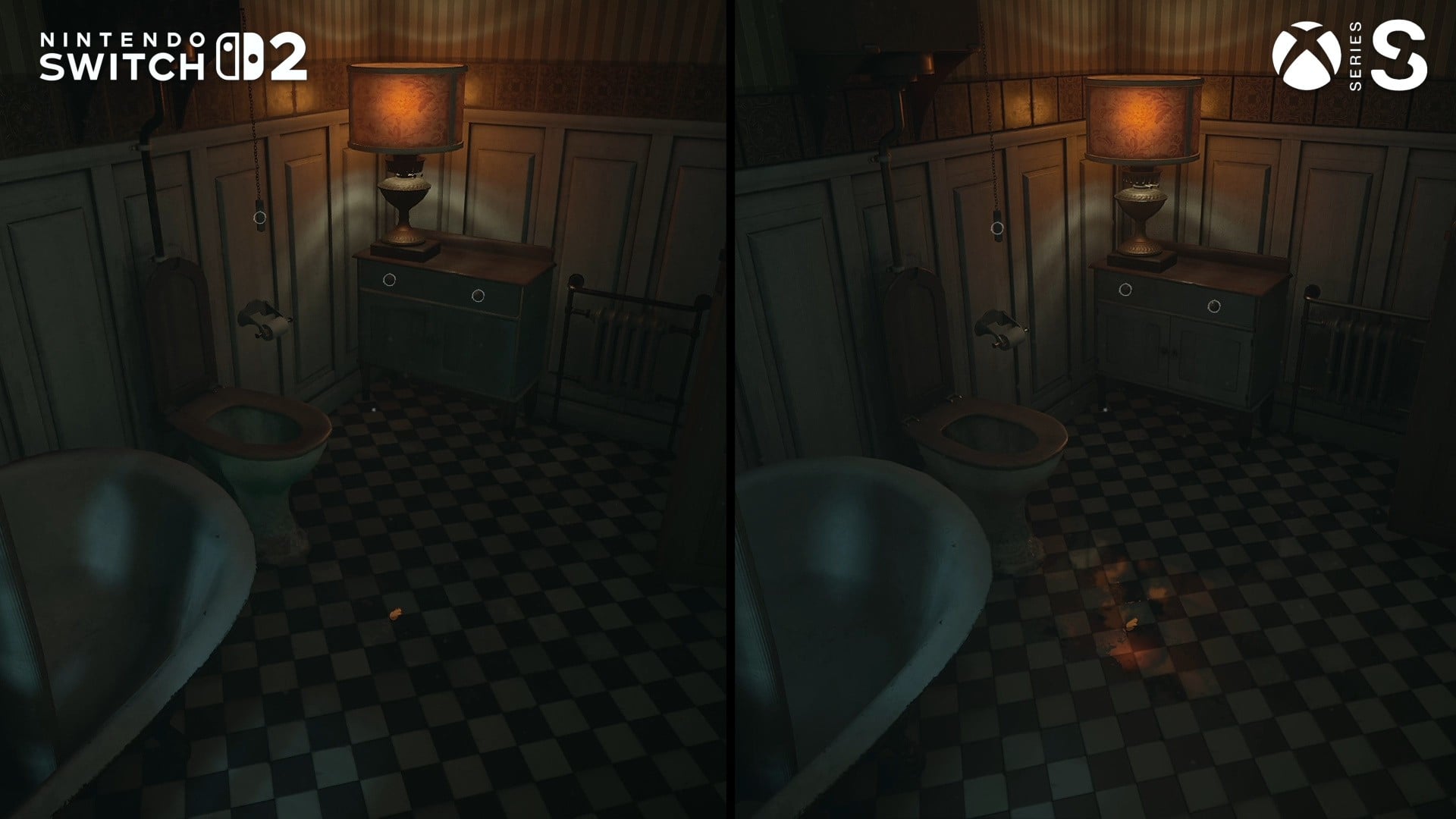
But on Switch 2's Layers of Fear port, there's noisier lighting and less-fine indirect shadows than on Series S. The biggest difference between these two versions is the Switch 2 port missing Lumen's reflection component. We've seen Series S games turn off software Lumen reflections, then take the diffuse GI's contribution, simplify it to a spherical harmonic, and use that to give the appearance of specularity. This can work for rougher surfaces, but coherent surfaces with potentially clear reflections are left out as a result - and Switch 2 doesn't include screen-space reflections (SSR) as a fallback.
On closer examination, there are other potential quality differences between Switch 2 and Series S. Light leakage is a bigger Switch 2 issue, and there's a lack of ambient lighting altogether in select Switch 2 scenes. This is a scene-by-scene issue in Layers of Fear, with some scenes being more equivalent and others exhibiting more obvious lighting differences - particularly when players approach a boundary line between indoor and outdoor environments and the GI model on Switch 2 appears to turn off in an interior scene.
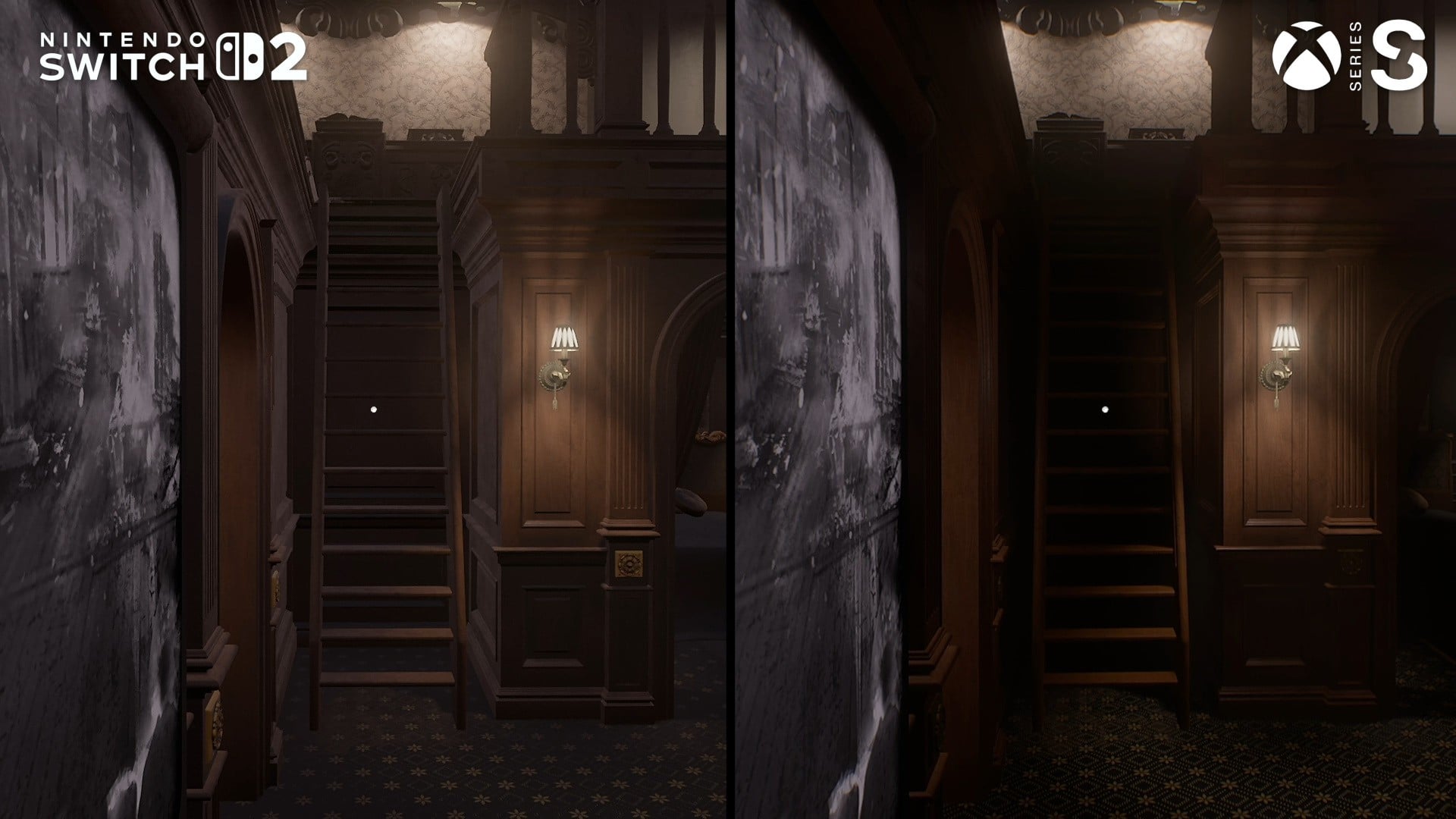
We can only guess at possible causes for these differences, such as reduced sign distance field (SDF) quality and generally lower memory-related performance on Nintendo's platform. Still, the 2023 refresh of Layers of Fear, as one of the earliest UE5 games, is arted around Lumen as a rendering default and would arguably need to be fully redesigned to work without at least software Lumen in place. So even with a noticeably reduced software Lumen implementation compared to other ports, Switch 2 gets the Lumen job done.
Unsurprisingly, other visual elements have been scaled down compared to Series S, including lower resolution shadows and volumetrics, simplified textures and downgraded transparencies. Layers of Fear's internal resolution on Switch 2 lands around 540p, with DRS often taking it somewhat higher, likely paired with UE5's TSR or Switch 2's "tiny" low cost DLSS implementation.
What's most interesting, then, is that downgrades to general visuals and to the demanding software Lumen stack have been paid off in the form of a 60fps frame-rate while in docked mode. Our frame-time charts suggest significant stretches of steady 60fps performance, though sadly, UE5's known issue with camera travel stuttering from frame to frame is present in Layers of Fear. Despite evading frame-time graph capture, it's perceptibly rough and a noticeable blemish on performance - so we'd love to see UE5 address this known issue. Bloober may have its own bug-fixing ahead of them to fix at least one sequence we discovered where frame-rates plunged into the 30s and 40s - and stayed in that very uneven zone for a while.
We can confirm another interesting resolution-to-performance decision by Bloober Team for the Switch 2 version: similar resolution when playing in portable mode, albeit with a frame-rate that runs unlocked, often settling in the 40-50fps range. The game stutters constantly even when frame-rate is relatively high, suggesting there may be an issue with VRR in this title. A stable 30fps lock with boosted visual settings may have been mode sensible.
While we were producing our coverage, we saw a comment from Bloober Team's CEO confirming that Lumen of some kind is being used, though Bloober also seems to have suggested to Wccftech that the game does not feature ray tracing support. Our guess is that Bloober is speaking specifically about hardware RT, because in Layers of Fear's PC version, disabling "ray tracing" simply disables its hardware RT model while leaving software Lumen running. Software Lumen is still tracing rays, it's just not using hardware acceleration to do it.
Our video coverage includes a look at Epic's recently developed and more performant form of Lumen, dubbed Lumen Irradiance Cache. We know it can offer a similar-if-downgraded diffuse lighting presentation on a wider range of hardware platforms - which may very well be leveraged in future UE5 games on Switch 2.


Comments 0
Wow, no comments yet... why not be the first?
Leave A Comment
Hold on there, you need to login to post a comment...