
 by
by 
Intel's Panther Lake reveal at CES 2026 sets up a mouthwatering battle royale in the months to come, with laptop integrated graphics able to compete against discrete GPUs at much lower power budgets. At the same time, Intel is claiming performance leadership against AMD's existing Strix Point-based processors - and by extension, the revised Gorgon Point, which is essentially a refinement of the Strix design. In combination with Qualcomm's ARM-based second generation Snapdragon X2 processors, there's a very strong chance that we'll get great gaming performance on energy-efficient devices this year, paving the way for next-generation handhelds that will really take the fight to AMD.
From the coverage we've seen so far, it's Panther Lake that has dominated the limelight at CES. On the CPU side of the equation, the maxed out Core Ultra X9 388H configuration features 16 cores: four P-cores, eight E-cores and a further four low power E-cores. There's an NPU rated for 50 TOPs on top of the integrated graphics 120 TOPs.
But really, from a gaming perspective, it is the Arc B390 GPU that is the star of the show. Based on the Xe3 (Celestial) architecture, the top-end Panther Lake has 12 Xe cores, with Intel promising anything up to a 77 percent performance lead over the outgoing Lunar Lake, and an 82 percentage point advantage over AMD's Strix Point-based Ryzen AI 9 HX 370 with its Radeon 890M graphics.
Some caution is recommended with these numbers, as my experience is that although Lunar Lake is very impressive, its gaming output varies between AMD Z1 Extreme and Z2 Extreme performance within our test suite. Even so, it should be a good degree faster at least - and initial benchmarks do seem to bear this out.
The thing is that specs and apples-to-apples benchmarks alone do not completely define the integrated graphics experience. All of AMD's higher-end integrated graphics products - even the mighty Strix Halo - are based on the older RDNA 3.5 architecture, notably lacking in machine learning performance. There is no bespoke ML-based upscaler or frame generation technology available for them, with AMD's FSR Redstone endeavour limited to RDNA 4 upwards, effectively leaving every existing PC-based AMD APU behind.
Meanwhile, Intel doesn't just have an impressive ML-based upscaler available - XeSS Super Resolution - it also has multi-frame generation. My colleagues at CES were impressed by it and I have scanned over some of the Cyberpunk 120fps captures they took on-site. It looks to be the real deal. This is important stuff for desktop graphics, but crucial in the integrated graphics domain, where boosting frame-rates is all-important, an where accepting compromises in image quality and latency is typically more acceptable. All the stops are pulled out to get the most demanding games running and Panther Lake has higher quality tools there to get the job done.
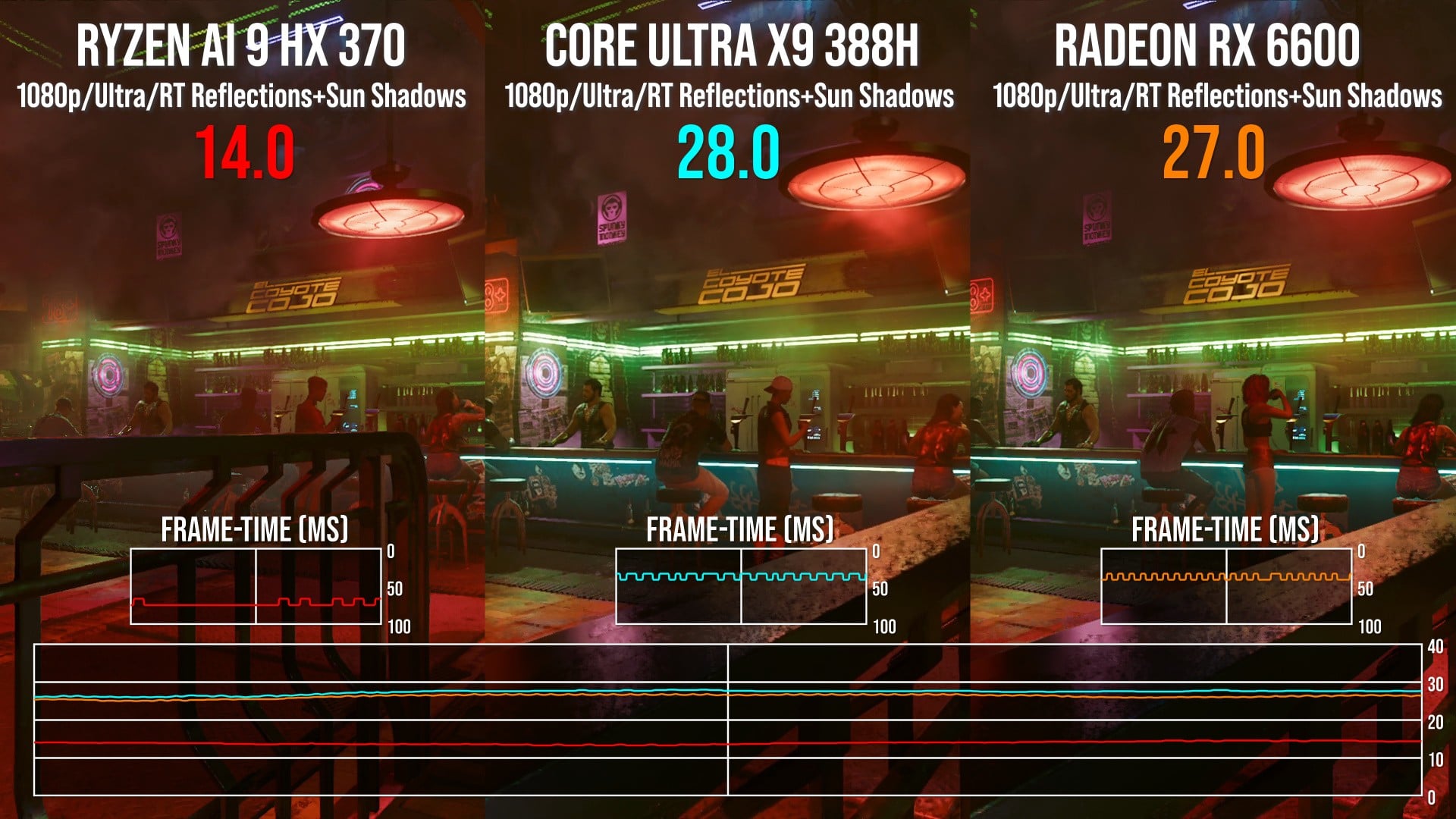
Panther Lake has more horsepower than any integrated GPU other Strix Halo, plus the requisite ML features on top. Seemingly, as a complete package, it is in a class of its own, which should - in theory - become more apparent when you compare the actual experiences side-by-side.
But if you want to talk about raw performance, Alex and Oliver got the chance to take capture from a Panther Lake laptop at CES 2026, where "CPU package" readings from the HWINFO tool measured consumption typically between 58W to 64W. We'll have much more on this in future, but we decided to really put the chip through its paces in one of our tests. We ran Cyberpunk 2077 at native 1080p at ultra settings with RT reflections and shadows turned on along with chromatic aberration, vignetting and film grain turned off. As we used video capture via HDMI in this case, we set the output to 1080p at 120Hz with v-sync enabled.
The standard benchmark delivered a 29.05fps return on Panther Lake vs 15.66fps on a Strix Point mini-PC configured to a similar 65W. Even so, that's a vast 85.5 percent improvement for Panther Lake over Strix Point in this case. We'll have more exhaustive benchmarks on more games soon, but we also tested AMD's classic Radeon RX 6600 - which delivered 29.03fps in the same test. Basically identical. For the record, XeSS balanced mode took Panther Lake's 29.05fps average up to 55.96fps - a 92.6 percent boost.
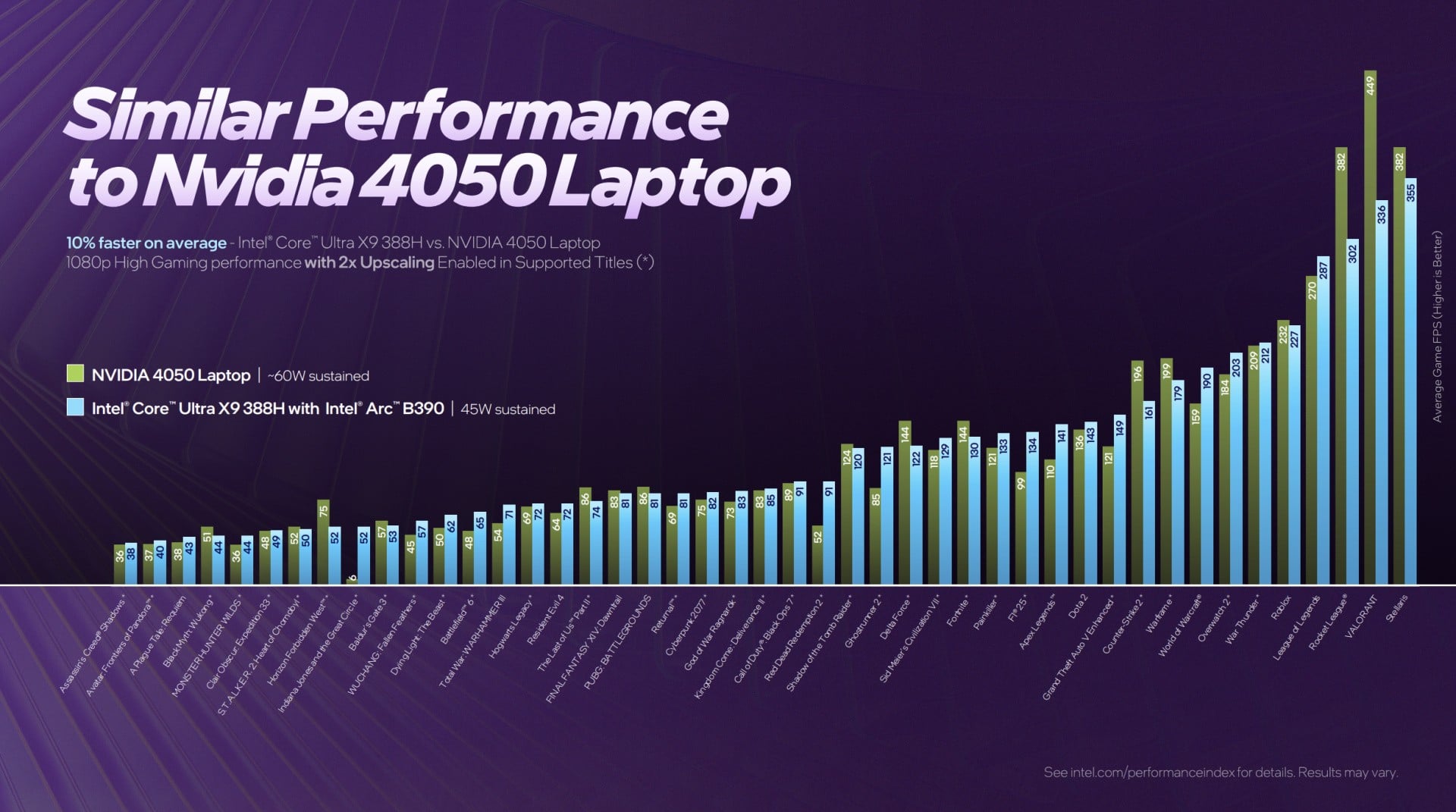
So, in a world where Intel is struggling so badly in the desktop CPU space, why is Panther Lake - a mobile part - so important? A key reason is that even in the face of extremely impressive Ryzen competition, laptops remain an Intel stronghold and a huge marketplace it cannot afford to lose. The prior generation Lunar Lake was competitive with AMD's Strix Point and, presumably, this year's Gorgon Point, so the new processor should be strong enough for Intel to claim market leadership.
But then there's the handheld market. Intel has worked closely with MSI on its Claw PC portables and while its initial effort was lacking, my own experiences with MSI Claw 8 AI+ have been rather favourable. It's challenging AMD's Z1 and Z2 Extreme processors with good performance, plus you get full-fat XeSS super resolution and frame generation. And now, with Panther Lake, there's a horsepower boost too.
In his interview with Intel's Tom Petersen yesterday, Alex was interested in Panther Lake's potential here as AMD has dominated the handheld space. "I don't think that's going to be the case going forward," Petersen replied. "As this market has matured a little bit, it's become a little bit more of a real market, rather than an experimental market… I'm excited because Panther Lake is so high performance with a display that's high resolution and small form factor, you can run for a long time playing whatever your tier one title is, because we got enough performance, right? It's pretty cool."
This is just the beginning: we'll have much more on Panther Lake soon.


Comments 8
but how much power does it use compared to using nvidia or amd and how well does it do at 15 watts
Tom is just great this interview was fun to watch
Those new Asus Zephyrus G series laptops with these new Panther Lake chips look quite tasty albeit probably costing close to $5K for the fully loaded G16, RTX 5090 variant.
This result on CP2077 is very bad for strix point because there is no upscaling involved, it's just raster and RT power, and the 890m was completely outclassed.
When you add FSR3 against full Xess comparison, it will get really ugly.
I think a good ML upscaling option is absolutely essential for any future gaming handhelds (as shown by Switch 2), and the lack of current options is why I've never really felt compelled to upgrade my Steam Deck. If Intel can come in with a good alternative and push AMD to innovate it can only be a good thing.
Rich, there's a small typo... "16 cores: four P-cores, eight E-cores and a further eight low power E-cores." It should be just 4 low power E-cores.
@bespokePoster Thanks for that, I made a tweak.
This looks really impressive, I will be interested what ends up happing with their top end mobile chips, full fat Celestial might be a very good choice for good battery life but still reasonable performance for graphics work and occasional gaming.
This does make me question why there are no RDNA 4 mobile chips though, can AMD really afford to wait until mid 2027 sitting on RDNA 3.5 and on the CPU side is it feasible for them to add 3D cache to the CPU on an SOC?
Show Comments
Leave A Comment
Hold on there, you need to login to post a comment...