
 by
by 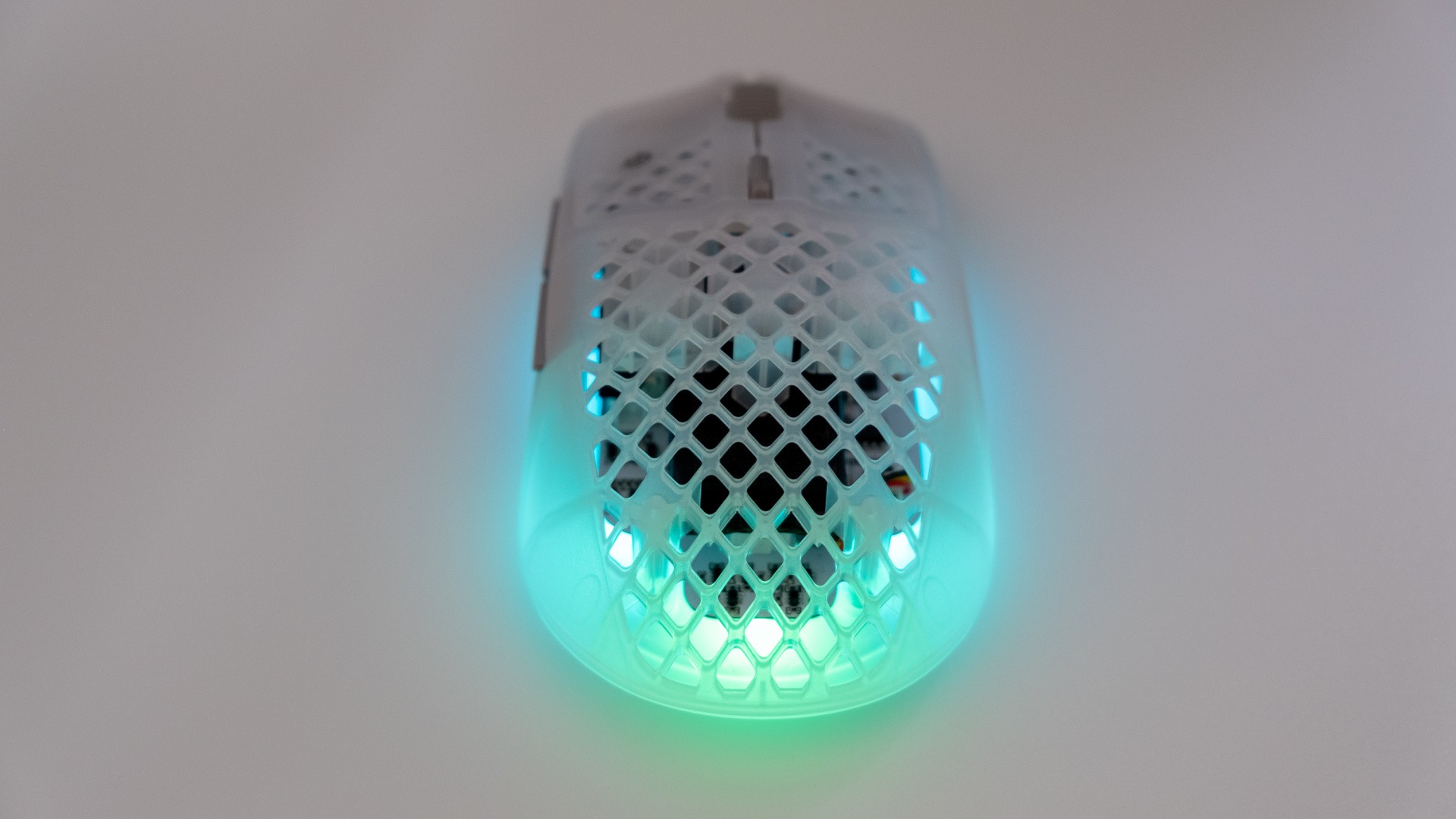
SteelSeries make some of my favourite headsets and keyboards on the market, but their Aerox ultra-light mice have fallen behind many of their rivals over the last six years, as ventilated shells have become less popular, optical sensors have improved and electronics packages have offered improved battery life and higher polling rates. The new Aerox 3 Wireless Gen 2 is intended to be a more modern offering that maintains the classic holey look preferred by some players, so does it hit the mark? And does it challenge the best options available at that competitive sub-£100/$100 price point?
To find out, I tested the Aerox 3 Gen 2 for a week, using it for my usual writing and photo editing work, plus games of MechWarrior 5: Mercenaries, Unreal Tournament 2004 and 007 First Light. In truth, I don't think that the new Aerox fully hits the mark, but it still might be worth picking up for some players. Here's why.
First of all, the Aerox 3 Gen 2 retains the unique looks of its predecessor, with unusual diamond-shaped cutouts throughout the top and bottom of the mouse, with the only solid surfaces being where your fingers rest on the sides and front. The more obviously machined pattern shouldn't upset trypophobics, and the internals are coated in an IP54 dust and water resistant material to protect them from any accidents (the SteelSeries video of the mouse being used underwater is pretty funny). Build quality is also more solid than you would expect looking at the mouse, with no flex evident whatsoever - even when the mouse is gripped far tighter than normal. Combined with the transparent plastic surface and strong RGB lighting, you get a mouse that looks interesting, and I appreciate the option for white, black or pink colourways.
In terms of the actual shape of the mouse, it's unsurprisingly unchanged for the second-gen model - and from the earlier Rival which I know a lot of people liked - with an ambidextrous body, a relatively central hump and dimensions that suit all but the smallest or largest hand sizes (121x67x38mm). The weight is also middle-of-the-pack, at 68 grams - not heavy by any means, but not as impressive as the 35-60g mice that are becoming more common at this price point.
Interestingly, the sensor is placed five percent off centre, towards the back of the mouse, which can make tracking a bit more stable for arm aiming but makes wrist-based movements a bit faster. It's not necessarily good or bad, but just something to be aware of. The sensor is also quite old, relatively speaking, based around a PixArt 3335 released in 2018. This is a good, well-tested choice for wireless mice, as it is power-efficient and still capable of good performance, but many of SteelSeries' rivals are investing in more modern examples that can track at higher speeds.
SteelSeries' GG software is also, unfortunately, a step behind what's offered by the likes of Razer and Logitech, and there's no web-based option which I've come to prefer, as it obviates the need to download software, keep it updated and often keep it running in the background. GG is complex too, with a antiquated-feeling "hub" ethos that bundles in multiple functions that I don't necessarily need, like a gameplay video recorder, an aim trainer, audio processing and so on; even controlling RGB is done in a separate place than remapping buttons.
I do like how quickly and easily that you can update the firmware, not requiring you to connect the mouse via a cable or needing a separate download via the browser (like Razer), and the actual act of changing mouse settings is easy enough. DPI settings are extremely granular, with the option for multiple sensitivity levels, raw acceleration curves and polling rates from 125Hz to 4000Hz. There are even some unique options here, including a rotation countermeasure and a "sensitivity matcher" that makes switching from your old mouse to the Aerox 3 Gen 2 extremely easy (and feels a little like a magic trick, as you move both mice together). I just wish there was a web hub with the settings that I need 99 percent of the time, so that I can get in and out easily.
Thankfully, actual performance is excellent. Click latency is extremely competitive, with the TTC Gold mechanical microswitches also providing clean, snappy feedback, and I didn't face any issues tracking enemies in MechWarrior 5 or flicking onto targets in Unreal Tournament 2004 instagib. The shape here suited my relaxed claw grip well, and especially combined with a great mouse pad (the Razer Atlas Pro glass pad) I was even able to avoid embarrassment in Counter-Strike 2. The only issue I had was coming back to the game, when the mouse sometimes took an age to reconnect to the PC - but this seems to have been fixed with a firmware update.
Battery life is only so-so though, with a good-on-paper rating of 120 hours via 2.4GHz wireless - but enabling 4K polling drops this to 35 hours. Likewise, enabling RGB also drops the battery life, and you can easily need to recharge every couple of days if you keep both at their highest settings. Charging is fast, but there's no dock to speed things along. I'd therefore recommend using the "Illumination Smart Mode" setting that automatically disables RGB while the mouse is moving to extend longevity. I hope any sequels here use more efficient wireless packages to extend battery life towards the 180-hour mark possible on the (18g lighter!) Razer Viper V4 Pro.
As a budget to mid-range mouse, I'd be happy to recommend the Aerox Gen 2 Wireless - it's performant, eye-catching and feature-rich. However, it's still some distance behind the best mid-range mice from Logitech and Razer, to say nothing of more aggressively-priced options from Chinese firms like Akko, Ninjutso, Mchose and Keychron.
At its current £90/$95, the Gen 2 faces stiff competition from the likes of the Viper V3 Hyperspeed, Logitech Superlight 2 and Corsair Sabre V2 Pro - all of which are lighter solid-body designs with better sensors and arguably superior software packages. For me, it all comes down to ecosystems, and you could still go for the Aerox 3 Wireless if you're already enjoying SteelSeries' excellent keyboards or headsets. If you're invested elsewhere though, I'm not sure the new-gen Aerox 3 Wireless does quite enough to break through.