
 by
by 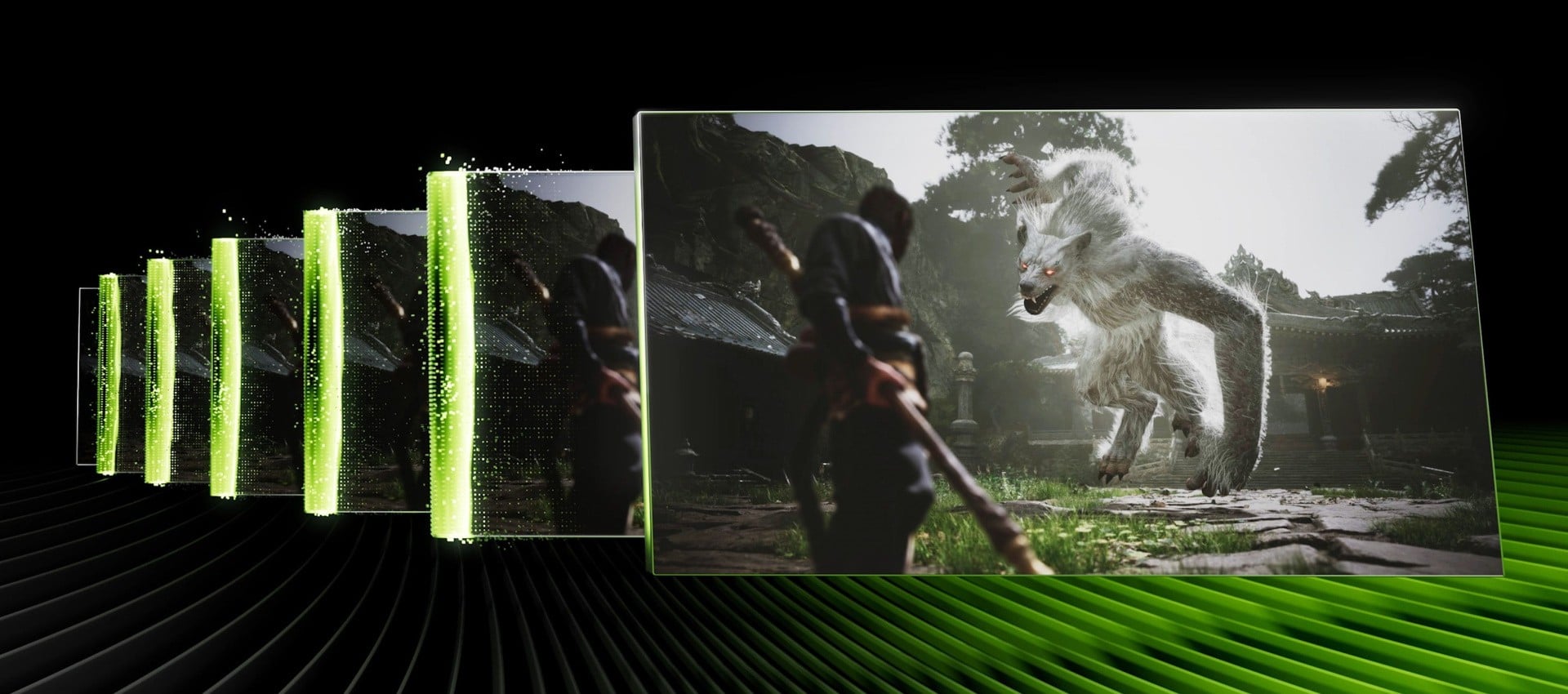
Nvidia's Monday-night "GeForce On" presentation, timed with this week's Consumer Electronics Show in Las Vegas, NV, included an unsurprising flurry of AI-related announcements. On the GPU front, rather than emphasise any new graphics hardware, Nvidia instead unveiled DLSS 4.5, which updates two pieces of the DLSS image reconstruction family.
The first, a "second generation" version of its Super Resolution "transformer" model, is out right now for all Nvidia RTX GPUs and can immediately be forced on in DLSS 4-compatible games using the official Nvidia App. The second, Dynamic Multi-Frame Generation, will come exclusively to Blackwell GPUs sometime in the "spring" with a new 6x FG maximum and a frame-rate cap - and Nvidia says these will combine to deliver smoother frame-time cadence.
When pressed about the event's lack of new RTX GPU models, particularly anything from a rumoured RTX 5000 Super series, Nvidia representatives responded by saying the company does not "talk about unannounced or rumoured products."
Before we go hands-on with RTX 4.5's new transformer model ourselves, we have seen limited demo sequences that spotlight some of its image quality improvements. These include reduced ghosting when a first-person view rotates at high speeds, increased image stability and reduced shimmering when dynamic lighting is cast on a finely textured surface, superior parsing of fine particles in effects like flames and generally improved anti-aliasing.
Each of those improvements addresses existing Digital Foundry criticisms about the existing transformer model, though each demo shown off in a pre-CES session lasted no longer than a few seconds - so we look forward to further, rigorous testing to see how DLSS 4.5 transformer impacts a variety of graphics scenarios. Today's Nvidia App update includes two new transformer models to choose from: "model M," which is recommended for general use, and "model L," which is recommended for a more aggressive "4K ultra-performance" upscaling profile.
Nvidia reps suggest the new DLSS 4.5 Super Resolution model uses five times the compute of the 1.0 transformer model, and floating-point 8 (FP8) support on the hardware level in Ada Lovelace and Blackwell GPUs drives "even faster" performance of this new, updated Transformer model. But we did not receive clear indications of what DLSS 4.5 transformer's performance hit will be on either newer or older GPUs - and previous testing has confirmed that the 1.0 model incurs a performance penalty compared to the older DLSS "CNN" model, especially on RTX 20 series and 30 series parts.
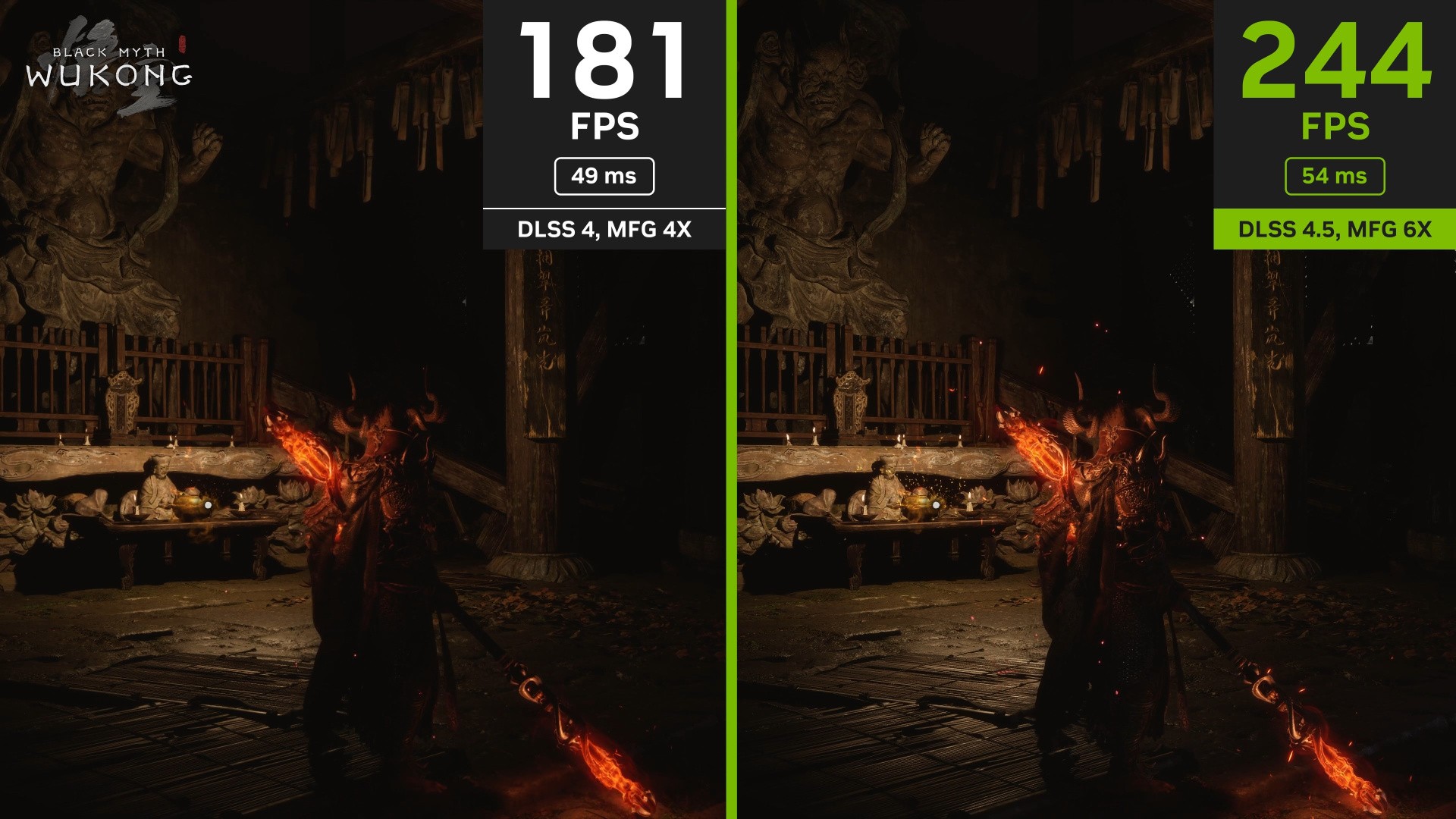
Nvidia says that the updated transformer model figures into DLSS 4.5's improved frame-generation technology, as well - with higher-quality image input leading to higher-quality generation of new frames. Between that and other undisclosed updates to the FG model, Nvidia says DLSS 4.5 DMFG - again, as a Blackwell GPU exclusive - will generate up to five frames of animation from every source frame. This surpasses DLSS 4's three frames generated per source frame.
The "D" for "Dynamic" applies to whatever target frame-rate is set within the Nvidia App. DMFG will keep tabs of that target and either emphasise MFG in moments where source frames dip or let the GPU natively render more frames when it's easily able to. Nvidia says that at either extreme - with either more source frames or more generated frames - the new DMFG system has been tuned to improve DLSS 4 MFG frame-times, proudly advertising "better frame-pacing" in its promotional materials. Exciting stuff if it all bears out - and we'll be there day one to test how well the new model balances image quality, frame-time delivery and input latency.
The event included a number of other announcements, a few of which we can recap here before likely getting hands-on opportunities either at CES or down the line in the weeks and months to come.
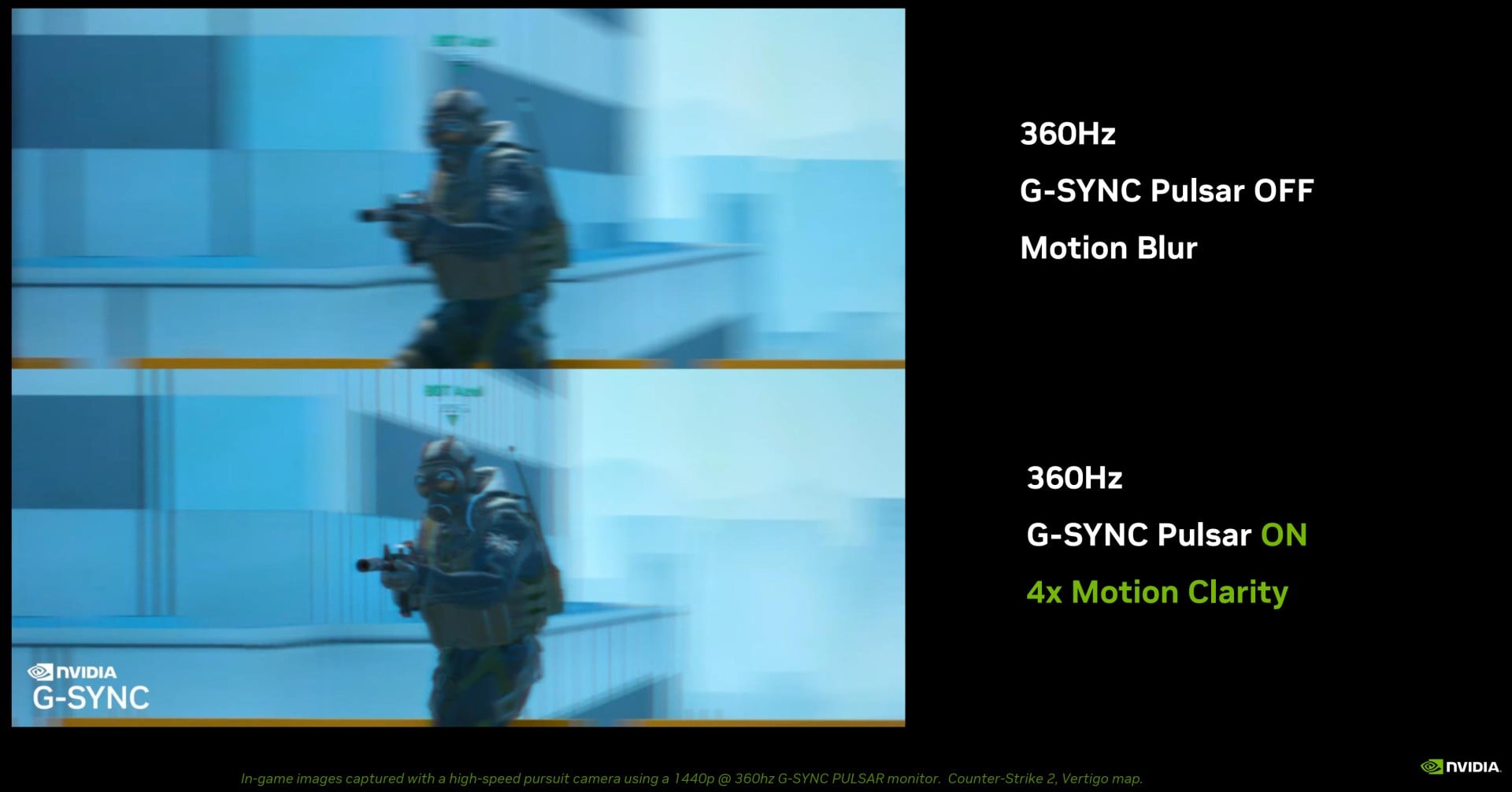
Nvidia Pulsar: One of Nvidia's least AI-influenced announcements is the long-awaited rollout of Pulsar-compatible monitors, following the technology's debut at CES 2024. This entirely new approach to frame presentation on flat-panel monitors combines backlight strobing with a de-flickering pass and smarter pixel colour-shifting, and it effectively gives LCD panels motion quality more in line with CRT displays - even when running as low as 120Hz.
The first wave of compatible monitors from Acer, AOC, Asus and MSI all max out at 27-inch and 1440p resolution, and all four models go on sale on January 7th.
RTX Remix: A new "Remix Logic" system advertises a substantial number of visual aspects that can be added to RTX Remix mod projects "without ever needing to touch the source code or programming." World-changing effects like weather can now be triggered selectively: instead of snow and ice appearing everywhere, an RTX Remix mod will now limit this weather to particular environs and exclude interior areas. RTX Remix Logic will add more variables for particle and volumetric effects and material types, and it will also include triggers for chromatic aberration, vignettes and other "stress" signals.
Like any other RTX Remix toggle, these will likely vary wildly based on how modders manually update important in-game aspects like lighting conditions and material types - and we've recently taken a deep dive into how much a lift such an update can require in the form of the uneven-but-promising in-development Unreal RTX project.
Nvidia ACE: What if on-board Tensor cores could be redirected from graphical tasks to other ML-intensive work - particularly something that models assistance and advice in an intensive strategy game? For years, Nvidia has been touting its Nvidia ACE systems as a wholly offline, locally rendered option for such experiments, and the GPU maker now points to a beta test coming to Creative Assembly's 2023 strategy game Total War: Pharoah, which will add an AI advisor as an Nvidia RTX-exclusive beta test in 2026. We hope you have VRAM to spare, however, as the "experimental" test will initially require roughly 6GB of spare VRAM to function.
Neural Texture Compression: Nvidia confirmed a small SDK update to this technology will launch during CES week. Nvidia tells us to expect inference performance increases in the 20-40 percent range relative to the currently posted SDK. The company will offer more information in a developer blog this week.
Comments 13
Every 6 months or so, Nvidia give me more reasons to leave AMD and stum up the extra for one of their GPU's!
Very interested to see how DMFG pans out. It'd be nice to just set a frame rate target and have the number of "fake frames" fill in the gaps whenever the real frames fall behind that target.
As a nice fallback for stress points, I can see a lot of utility in this.
While I have major issues with Nvidia's product stack, particularly on pricing and RAM allocation, DLSS continues to be the thing that makes me want to pick up an Nvidia GPU as a gamer. AMD are always several steps behind here.
6 GB of VRAM required for that AI assistant feature is absolutely crazy. That only allows 10 GB on a 16 GB card (which probably won't work too well for most resolutions), or the 4090 & 5090, which simply aren't attainable for the vast majority of people. That sounds like a feature they were going to advertise alongside the 50 Super cards with VRAM to spare, but it's not meant to be I guess.
I hope DMFG will make vsync obsolete by locking to a display’s exact refresh rate. I’m running a 60Hz OLED tv in the basement, and I’m pretty sure a lot of gamers still rock fixed refresh rate monitors. Could this be possible?
As much as I grumble about Nvidia, this kind of stuff is actually genuinely cool. Super Resolution upgrades being "upgradeable" through a variety of generations of their GPUs (at varying performance costs) is genuinely an awesome feature.
I really wish that Sony would have implemented something like this with the PS5 Pro/PSSR, letting games simply use a newer version without game intervention.
Kind of interesting that we are now in the age of software advancements being more significant than hardware (sometimes). The gains are often subjective so we'll have to wait and see how much significantly better (or not) the new transformer model upscaling is.
Frame generation exceeding my monitor refresh has been a massive problem even with my 240Hz monitor. Games often don't have a good frame rate limiter built in, and external ones sometimes don't work with frame gen or introduce pacing issues. So I'm definitely interested in dynamic FG. Even with my 240Hz monitor however, 5x and 6x are only going to be reached for path tracing games which are few and far between for now. At 240Hz, 6x frame gen would only kick in for base FPS less than 40, which is where latency becomes too high for a mouse imo (and does a controller really need 240Hz Alan Wake 2...)
@Photoss
It could be possible, but not ideal. Frame gen is good at higher frame rates, in my experience it is brilliant at increasing visual fluidity by pushing anything already 60hz higher, up to the 240hz max my monitor can take, however using it to bring a sub-sixty game up to sixty feels really bad.Whilst it only technically adds a very small amount of input lag, below a level that is actually perceivable it makes the lag feel worse due to there being multiple frames inserted between, it is somewhat hard to understand until one actually experiences it. The advantage of this will also align well with VRR because it allows the monitor to display the additional frames as and when they are ready. With frame gen not all frame times are equal, at 240hz that is not really an issue but at 60hz without VRR it might be. As DLSS 4.5 is live now I am hoping we might get some preliminary analysis data in the Direct that arrives over the weekend.
@MattUK "Frame gen is good at higher frame rates"
Agreed, for now at least. The future is all about finding software solutions to hardware limitations. They'll get the latency thing sorted in time.
@MattUK
I agree with you on frame gen being better well over 60hz, but I would still prefer a degraded 60hz that frame drops that automatically set refresh rate to 30hz via vsync
@Photoss See that is different to me and I guess why there is no universal solution. I get get used to and deal with a rock solid thirty, although it is not ideal, where as a game that bounces around in the fifties without VRR I find an awful experience. I guess that is why some of this is so subjective, even on the same hardware some people really hate uneven frame pacing, fluctuating framerates, but others are not bothered by it at all.
@NetshadeX I somewhat agree, although they have already found hardware solutions, VRR and 120/144/240hz displays. To and extent I feel that latency has been solved where it can be, e.g. it is basically unnoticeable at 120hz or higher, but at less than 60hz one can feel fluctuations in latency because they are bigger due to the gap between reference frames. Again, some people will be bothered, others will not, I think that is why some of this is subjective and there are people who never seem to notice (incorrect frame pacing, fluctuating frame rates, some people do not even notice screen tearing).
@sloppysnek
Yeah, Lossless Scaling already does this, and I prefer its frame pacing stability over even NVIDIA's. The only issue is that there are more artifacts w/ LS's algorithm, since it works without motion vectors and effectively has to generate everything via dead reckoning.
That said, I ended up getting a 240hz oled monitor to take advantage of LS. A high frame rate, w/ dynamic/adaptive frame gen up to 240 is niiiiice.
Show Comments
Leave A Comment
Hold on there, you need to login to post a comment...