
 by
by 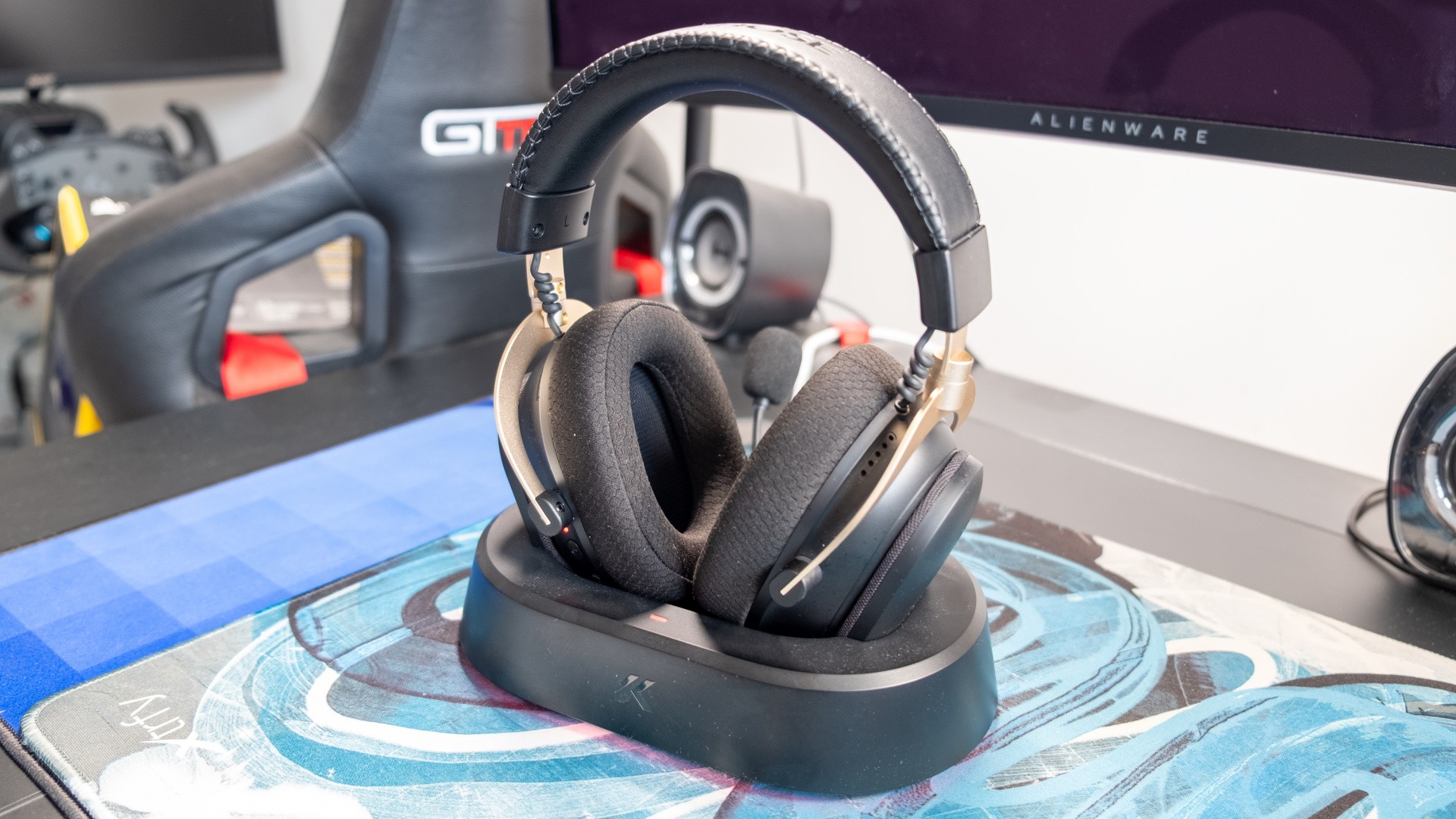
Mchose is best known for its high-end yet cut-price gaming mice, but the Chinese firm is now expanding into wireless headsets. The Mchose V9 Turbo+ is their flagship offering into the competitive £140/$140 market, with 2.4GHz wireless and Bluetooth support, a magnetic charging dock and a metal build. It's a decent looking package, but how does it shake out in real-world use?
Out of the box, the headset actually feels more substantial than it looks in the product photos, with thick earcups, a nicely padded headband and a removable boom mic. The design here reminds me of a pastiche of several popular gaming headsets: the metal yokes and general shape remind me of the classic HyperX Cloud 2, the controls are reminiscent of recent Razer BlackShark models and the earcups use a similarly patterned athletic fabric to a SteelSeries Arctis Nova.
At 320g, the headset is a middleweight option, and the thickness of the padding and the swivelling earcups make it comfortable to use even for extended periods. I get the feeling that the headset doesn't sit quite evenly on my head, which is a bit weird, but it doesn't affect comfort noticeably. The controls here are nicely differentiated and easy to use, which is important if you want to quickly make a volume adjustment in the middle of a round of Counter-Strike 2, for example.
The dock is the piece that makes this headset fit into that premium £100+ category, as it adds substantially to the utility of the headset. The wings that extend up from the dock's base make the headset slide in easily from most angles, and you get a nice bit of audible feedback when charging starts. There's a cutout for the headset mic too, which helps prevent putting the V9 Turbo+ in backwards. The dock also provides RGB in a place where you can actually see it, unlike most headsets, and provides a place for the USB dongle to be inserted. You can also just take the USB dongle out and therefore plug the headset into other devices without needing the full contraption, which is a nice bit of flexibility. The headset itself can be recharged via USB-C, so the dock isn't required.
The physical design here is all good stuff, but the tuning is where the firm's lack of experience with audio gear is perhaps more visible. Don't get me wrong, this is far from an unusably poor gaming headset, and the 60mm drivers are capable, but going back to similarly-priced SteelSeries or Razer alternatives in side-by-side testing reveals some issues.
There's a lack of depth or body in the mids and low-end, delivering one-dimensional sound that is fine for competitive play but underperforms in more complex, orchestral or dynamic outings. It's harder to distinguish individual instruments while listening to music, for example, or enjoy the rapturous swell that accompanies a great victory song in an RPG. I played through a lot of 007 First Light on these headphones, and while they delivered everything I needed to play the game in terms of audio cues and dialogue, I found the score significantly more impactful on the Creative XF1 speakers I was testing at the same time.
The microphone is also fairly basic, without the AI noise cancelling tech that makes a lot of gaming mics more usable these days. That means there's a decent amount of detail, but you do tend to pick up external noise like the clatter of a keyboard or other people talking in the same room, which is less than ideal. I did most of my meetings with this headset and never got any complaints, but listening to recordings back, this is one of the poorer wireless headsets I've tested recently when it comes with mic quality and isolation.
Despite the subpar audio experience, the nuts and bolts here are solid. The wireless connection was reliable and far-ranging, allowing me to bring the recycling bins in without losing connection - transmitting audio an impressive 50m or so - and the Bluetooth connectivity worked fine as well. Charging was never an issue, given the dock, and build quality feels robust for a headset of this price. I also quite like the way these headphones look - the black and gold colourway is distinguished, and lacking any RGB ornamentation or indeed prominent branding on the earcups themselves suits me fine. Despite Mchose offering a web hub for their keyboards and mice, the headset isn't compatible. The downloadable software took multiple attempts to launch successfully, but eventually offered firmware updates and an equaliser.
Ultimately, a headset fundamentally is meant to let you hear, and let you be heard, and that's where the V9 Turbo+ falls down - despite its laudable design and features. At £50, I'd be happy enough to say that the average-at-best sound is fine, and even at a flat £100 asking price I'd say that the V9 Turbo+ is worth considering due to its convenient dock.
However, at the current £140 Amazon UK price, there are simply too many better options from bigger brands. Just looking at headsets that I've personally tested, you could consider the £90 Logitech G Pro X Wireless, the £129 SteelSeries Arctis Nova 5, or the £140 Razer BlackShark V2 Pro - all are better options with more consistent performance, despite lacking the cool dock.
In the US, the Mchose headset is more competitive at $140, but you could still get the $130 Logitech G522, $120 Corsair HS80 Max or $110 HyperX Cloud Alpha, in addition to the headsets named above. Again, none of these have the useful charging dock, but the upgrade in audio quality is probably worth it.
I'm interested to hear your views though - what headset do you trust at that sub-$150 price point? Let me know in the comments below.